Many vendors now pitch AI for risk management information systems (RMIS). Most demos When the model is wrong, who notices, and how fast? That is the question every risk leader should put to a vendor selling AI for a risk management information system (RMIS). Many vendors now pitch AI with a confident summary, a ranked list of claims, or a suggested reserve, and the room nods along. What they rarely show is the review step: where a person must intervene, what they see when they do, and whether the system makes that intervention easier or harder than simply accepting the model’s output. This post covers how to design that step so people stay accountable for the decisions AI influences.
Why more automation does not always mean better risk management
Many RMIS conversations carry an assumption that more automation equals more maturity. Triage without a person. Denial language without a reviewer. Policy interpretation without a claims handler. Board packs without an analyst.
Sometimes that assumption holds. High-volume, low-stakes classification is where machines earn their keep. Routing an incident to the right queue, flagging a missing field, or surfacing a similar historical claim all benefit from speed and consistency, and people are expensive to spend on that layer of work.
Risk work is not only volume work, though. It is judgment under uncertainty, often with legal, regulatory, and relationship consequences. Treating every AI feature as a step toward a lights-out process produces fluent errors that nobody owns. The useful question is what happens in your process when the model is almost right. Almost right is the dangerous zone. Obviously wrong answers are easy to catch, but nearly right ones tend to get approved.
Three autonomy levels for RMIS AI features
Different parts of the risk stack call for different levels of autonomy. One practical way to think about it is in three bands, which map to the familiar human-in-the-loop, on-the-loop, and out-of-the-loop autonomy tiers. The labels below describe how those tiers show up in day-to-day RMIS work.
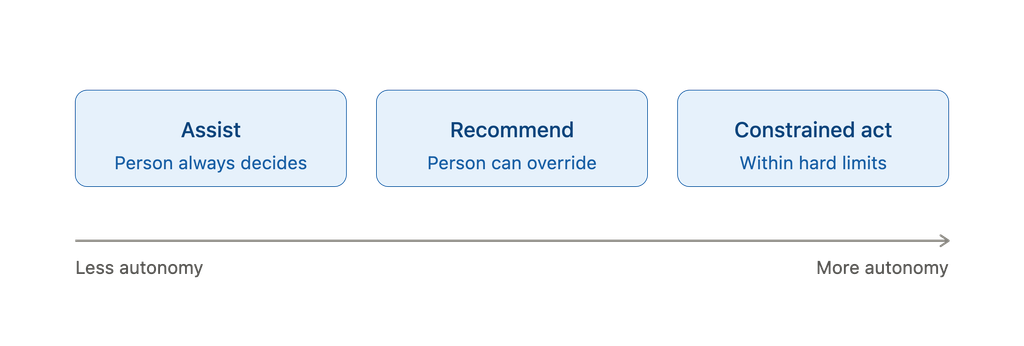
- Assist. The model drafts, ranks, or highlights, and a person always decides. Examples include first-pass intake summaries, similar-claim retrieval, draft narratives for a loss run, and suggested questions for an underwriter meeting. The AI reduces blank-page time. It does not close the file.
- Recommend. The model proposes an action with a rationale a person can inspect. Examples include reserve movement suggestions, referrals to a specialist adjuster, or a flag that a claim may hit an aggregate limit. The reviewer can accept, amend, or reject the proposal, and the system should record which path they took.
- Constrained act. The model may take a narrow action inside hard rules, such as assigning a queue, requesting a missing document, or applying a standard tag. It should not invent coverage positions, communicate denials, or change financials outside defined thresholds without a human involved.
Many organizations buy Assist features and accidentally deploy them as Constrained act, because the workflow never forces a stop. The button says “Apply.” Nobody designed “Review.”
Why poor RMIS design hides the human reviewer
Human-in-the-loop fails less often because people refuse to engage and more often because the system makes engagement costly. If AI output sits in a separate window, disconnected from the claim record, handlers will paste conclusions without context. If the rationale is a black box, review becomes a rubber stamp. If accepting a suggestion takes one click and challenging it requires an IT ticket, the loop is theater.
A serious design puts the human decision in the same place as the work:
- The suggestion appears on the claim, incident, or policy record, not in a side product.
- The rationale is written in plain language and tied to data the reviewer can open, such as fields, documents, or prior similar matters.
- Accept, amend, and reject are first-class actions, each recorded in an audit trail.
- The team tracks overrides and uses them to improve the model rather than treating them as user error.
Without those pieces, you do not have human-in-the-loop AI. You have human-adjacent automation.
Practices for keeping people accountable
Teams that get this right start by mapping decisions before they map models. For each decision, they ask what financial, legal, or reputational harm follows if it goes wrong. Decisions with meaningful downside stay in Assist or Recommend until the evidence says otherwise. Low-downside volume tasks are usually the first candidates for Constrained act.
They also write escalation rules that people can remember and apply. Thresholds, confidence bands, and “always escalate if” conditions belong in the operating model, not only in a data science notebook. A rule nobody on the claims floor can recall will not guide anyone’s decision.
They measure outcomes beyond speed. Ticket deflection and time to close matter, but they do not show whether decisions are sound. Override rates, rework after AI-assisted decisions, complaint patterns, and movement in Total Cost of Risk tell a fuller story. An AI that speeds up bad decisions is not a win.
Finally, they train people on when to distrust the model. The skill is not “use AI.” The skill is recognizing fluent nonsense, especially when the underlying taxonomy is messy or the document set is incomplete.
Where to place the human checkpoint in your AI roadmap
AI inside an RMIS will keep getting better at drafting, ranking, and spotting patterns. That is not in doubt. What is in doubt is whether risk teams will treat the human as a governance control or as an inconvenience to optimize away. Human-in-the-loop is not a temporary stage on the way to full autonomy. For the parts of risk that carry judgment and accountability, it is the destination: machines that prepare and propose, and people who decide and own the outcome.
A practical test: if your AI roadmap cannot show, on one screen, where a person must stop and why, you do not have a loop. You have a leap of faith. Start by mapping the decisions that carry the most risk, assign each one an autonomy band, and build the review step into the workflow before the feature goes live.
See how Archer RMIS AI fits your program
If you want to see how Archer RMIS AI brings policies, claims, and incidents into one connected system, explore RMIS AI and request a demo. Our team can walk you through how exposure data and claims records sit together and how AI-powered analytics surface patterns from the data already in the system.
Frequently asked questions
What does Archer RMIS AI manage, and why does that matter for human review?
Archer RMIS AI brings insurance policies, exposure data, claims, and incidents into one system of record. That matters for the review step described above. When the records a reviewer needs live in one place, the reviewer does not have to rebuild the claim history from scattered spreadsheets and inboxes before deciding. Keeping the work and its supporting data together is what makes a quick, informed review realistic.
Can teams outside risk management use Archer RMIS AI?
Yes. The claim intake portal is built for use across the enterprise, not only by dedicated insurance or risk staff. That matters because many claims and incidents start with people outside the risk team, such as frontline staff reporting an event. When those people can submit information through the same system, the review starts with complete records rather than forwarded emails and missing details.
How do AI-powered analytics help me find the patterns that need review?
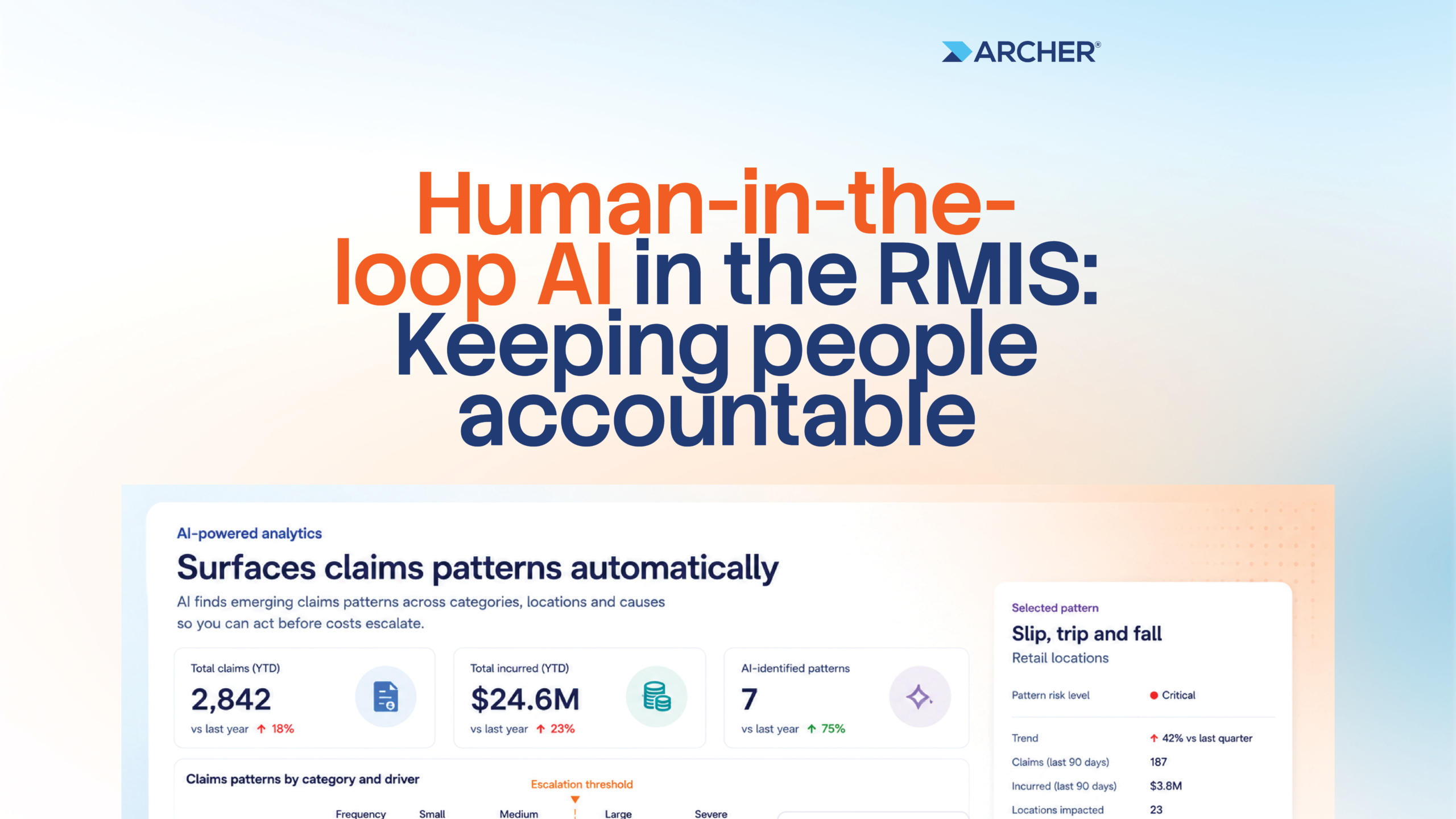
The analytics surface claims patterns and areas for improvement directly from data already in the system, without a separate reporting project. Treat those patterns as a reason to look more closely, not as final conclusions. A cluster of claims tied to one policy type, for example, may point to a coverage gap, a process issue, or a data quality problem. Track override rates and outcomes against the same patterns so you can tell whether the analytics are guiding decisions well.