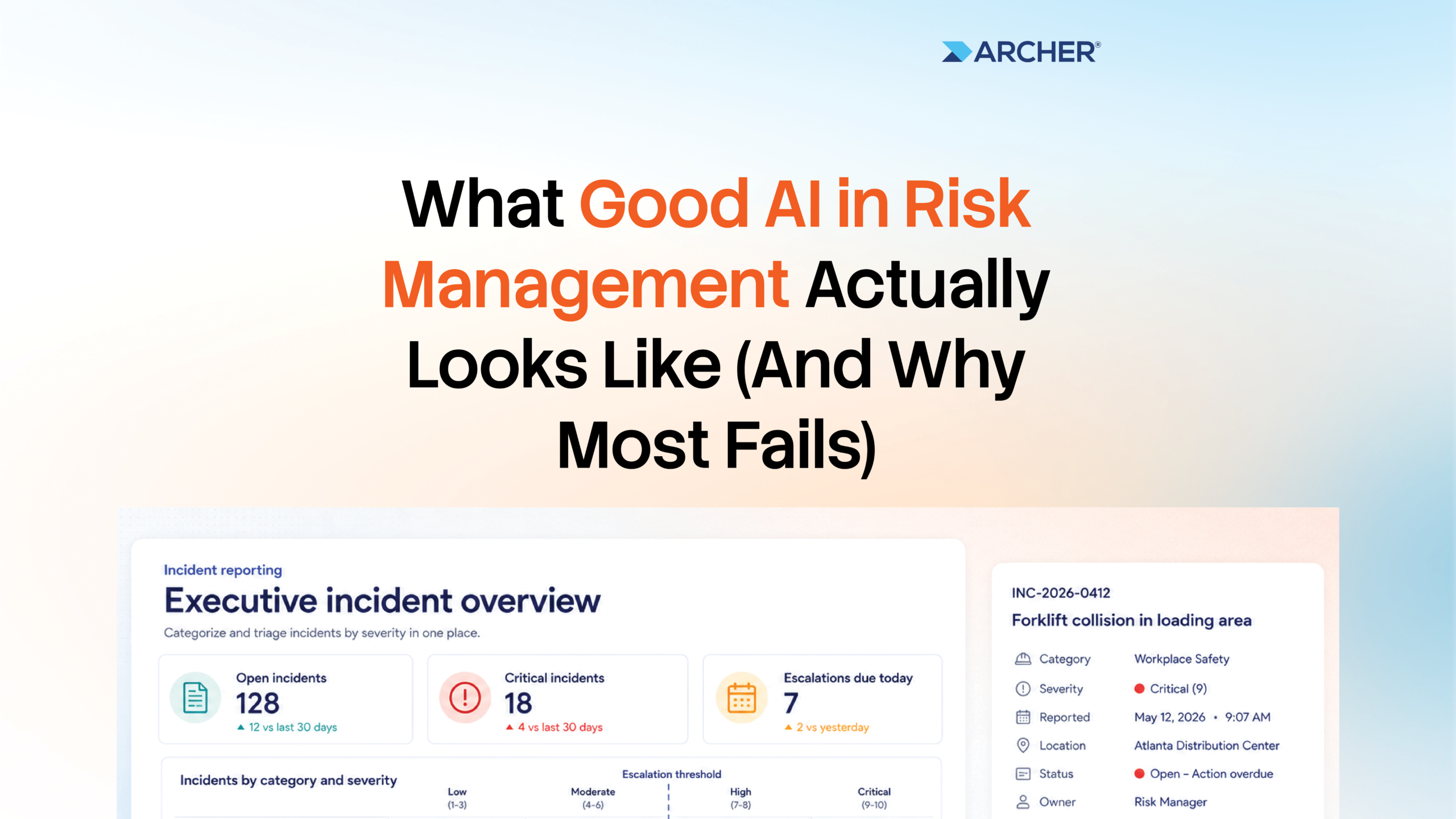
Good AI in risk management isn’t the flashiest dashboard or the most advanced model — it’s the capability that measurably improves the decisions your risk function makes most often, in a way your team can understand and trust. The organizations getting this right start with a specific decision they want to improve, not a technology they want to deploy. They fix their data before they buy the tool, and they keep a human accountable for every call the AI informs.
The rest of this article breaks down why so many AI investments in risk management fall short, how to tell generative AI apart from predictive AI (and when to use each), and the concrete markers that separate real transformation from an expensive dashboard widget.
Why most AI in risk management underdelivers
There are two versions of AI adoption happening in risk functions right now.
One looks impressive in a vendor demo. The other looks modest on a slide but genuinely changes how a team operates. Most organizations are on track to buy the first when they need the second — and the gap between the two rarely comes down to the technology itself. Today’s AI tools are mature enough to do the job. What separates the winners from the disappointed is whether the organization was clear, going in, about what “good” actually means.
The trap of treating AI as a feature
When AI gets bolted onto a risk management information system (RMIS) as a feature rather than built around a real need, it shows up in familiar ways:
- A chatbot that answers questions about policy documents
- A dashboard widget flashing an anomaly score
- A report with a confidence interval that wasn’t there last quarter
None of that is useless. But none of it is transformative, either — and when the promise outpaces the payoff, trust in the whole AI capability erodes faster than almost anything else in a risk program.
The root issue is direction. AI-as-a-feature starts with what the technology can do and goes looking for a problem to solve. That’s backwards. It’s capability chasing a use case instead of a use case pulling the right capability into existence.
Good AI in risk management starts from the opposite end. It starts with the decisions that actually matter — the ones where better information changes the outcome — and works backward to figure out what capability is needed to support them.
The decision-first sequence for AI adoption in risk management.
Which risk decisions actually matter?
Risk leaders don’t make hundreds of high-stakes calls a week. They make a handful, and those are the ones worth building around:
- How to allocate risk transfer budget across a portfolio
- Which locations or business units represent risk concentrations worth actively managing
- Where to direct loss prevention resources
- How to respond when the external risk environment shifts materially
What these decisions have in common is that they’re made with incomplete information, under time pressure, by people juggling far more than one priority. The quality of the decision is bounded almost entirely by the quality and accessibility of the data behind it.
This is exactly the constraint good AI is built to address. It shrinks the gap between a question being asked and a reliable answer being available. It surfaces patterns in historical loss and exposure data that no human reviewer would catch manually at scale. And it produces the forward-looking view — the loss forecast, the exposure projection — that lets a decision get made based on probable outcomes rather than pure hindsight.
A real-world example: the portfolio exposure review
Done manually, a portfolio exposure review means pulling data out of multiple systems, reconciling mismatched formats, and assembling a picture that’s often stale by the time it reaches the person who needs to act on it.
Done well with AI, that same review becomes something a risk manager generates on demand, built on data that’s already integrated and current.
The decision itself doesn’t change in kind — it changes in speed and reliability. That’s the entire point. This isn’t AI replacing risk judgment. It’s AI making risk judgment better informed.
Generative AI vs. predictive AI: know the difference
One of the more useful mental models for evaluating AI in a risk context is the split between generative and predictive capability. Conflating the two is one of the most common — and costly — mistakes risk teams make.
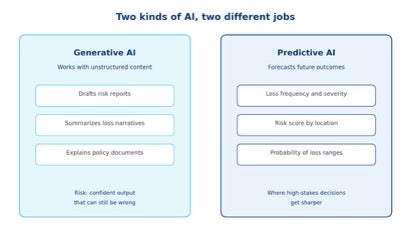
Generative AI drafts and summarizes; predictive AI forecasts outcomes.
Generative AI
This is the category most people already know through large language models. It excels at working with unstructured content: drafting, summarizing, extracting, and explaining.
In a risk function, that translates to:
- Processing loss adjuster narratives at scale
- Generating first drafts of risk reports
- Making dense policy documentation usable for non-specialists
The productivity gains here are real. So is the risk of over-reliance — generative models can produce confident, polished output that’s simply wrong, and the error isn’t always obvious on first read.
Predictive AI
Predictive AI is a different animal entirely. It’s trained on historical data to forecast future outcomes: loss frequency and severity, risk scores by location or activity type, or the probability that a given event profile leads to a specific range of losses.
This is where the highest-stakes risk decisions actually get sharper — not faster, sharper.
Both categories have a role to play. But they solve different problems and carry different failure modes. Teams that treat generative and predictive AI as interchangeable tend to apply the wrong tool to the wrong problem, then draw the wrong conclusions about whether “AI” is delivering value at all.
3 markers of organizations getting AI adoption right
Across the organizations actually making progress on AI in risk management, three habits show up again and again.
1. They define the change before they pick the technology
Not “we want to use AI” — something specific and measurable, tied to a decision that matters. Examples:
- “Cut the time to produce our quarterly exposure report from three weeks to three days.”
- “Identify the ten highest forward-looking loss-probability locations in our portfolio before renewal season.”
Specificity is what separates a strategy from a wish list.
2. They treat data quality as their job, not the vendor’s
Output quality is bounded by input quality, full stop. Organizations that expect an AI vendor’s technology to compensate for fragmented, inconsistent, or incomplete data are consistently disappointed.
The organizations that do the unglamorous work first — integrating, cleaning, and enriching their data — are the ones whose AI capability performs at or above expectation once it’s live.
3. They keep human judgment at the point of consequence
AI should change what a risk manager knows and how fast they know it. It shouldn’t be making the decision itself.
That line gets harder to hold as a capability becomes more embedded and more trusted — which is exactly why it has to be held deliberately. The moment AI output stops being interrogated and starts being rubber-stamped, the risk profile of the function changes in ways that often go unnoticed until they matter.
The bottom line
Good AI in a risk function isn’t the most sophisticated model on the market or the most feature-rich platform. It’s the capability that reliably improves the decisions that matter most, in a way the people using it can understand and actually trust.
That’s a modest bar to describe and a genuinely hard one to clear. It takes clarity about the goal, discipline around data foundations, and the willingness to start with the use case that delivers a clear benefit — not the one that looks best in a demo.
The organizations that get this right rarely make headlines for their AI strategy. What they do instead is make fewer bad risk decisions, allocate capital more effectively, and earn a more credible seat at the table than they had before.
One question worth taking back to your own risk function this week: which decision, if you could make it a week faster or a week more confidently, would move the needle most for your organization?
Read more in our 3-part series on RMIS:
FAQs
Good AI in risk management is capability that’s built around a specific, high-value decision — like portfolio exposure allocation or loss prevention targeting — rather than added as a generic feature. It should measurably speed up or improve that decision while keeping a human accountable for the final call.
Generative AI works with unstructured content — drafting reports, summarizing loss narratives, explaining policy language. Predictive AI is trained on historical data to forecast outcomes like loss frequency, severity, or risk scores by location. Generative AI boosts productivity; predictive AI sharpens high-stakes decisions. Using the wrong one for the job is a common — and costly — mistake.
Most underdeliver because they’re implemented as a feature (a chatbot, a dashboard widget) rather than built to solve a specific decision-making problem. Add in poor underlying data quality — which no AI vendor can fully compensate for — and the result is a tool that looks impressive but doesn’t change how the risk function actually operates.