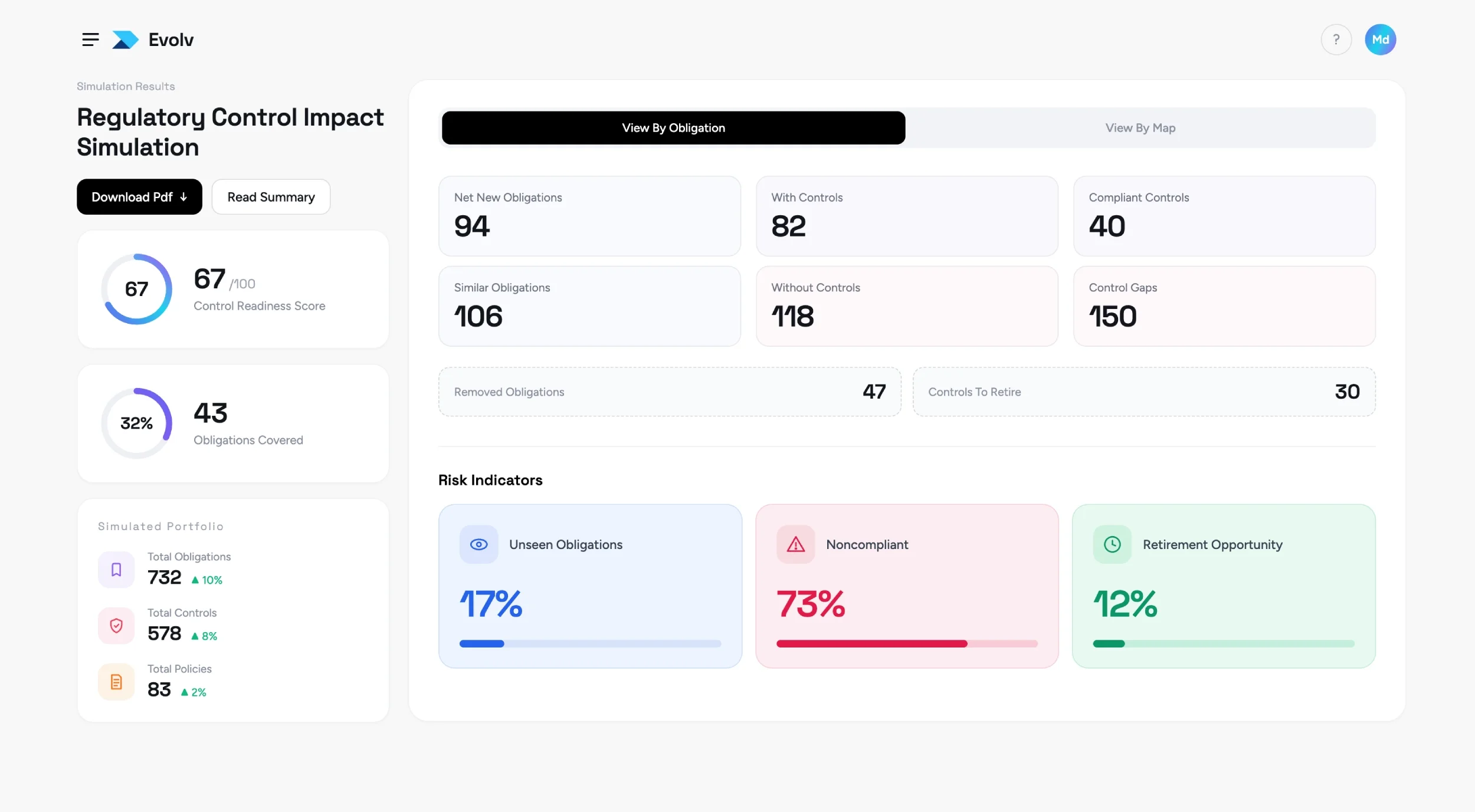
Cyber risk and business risk, finally the same number
From the analyst closing a finding to the board reading the exposure summary, every role works from the same assets, controls, and risk data.
Trusted by 1,500+ organizations
-
1,500+
Clients across 48 countries
-
50%
Of clients in the Fortune 500
-
65%
Of organizations putting more effort into quantification
-
15,000+
Members in the Archer risk community
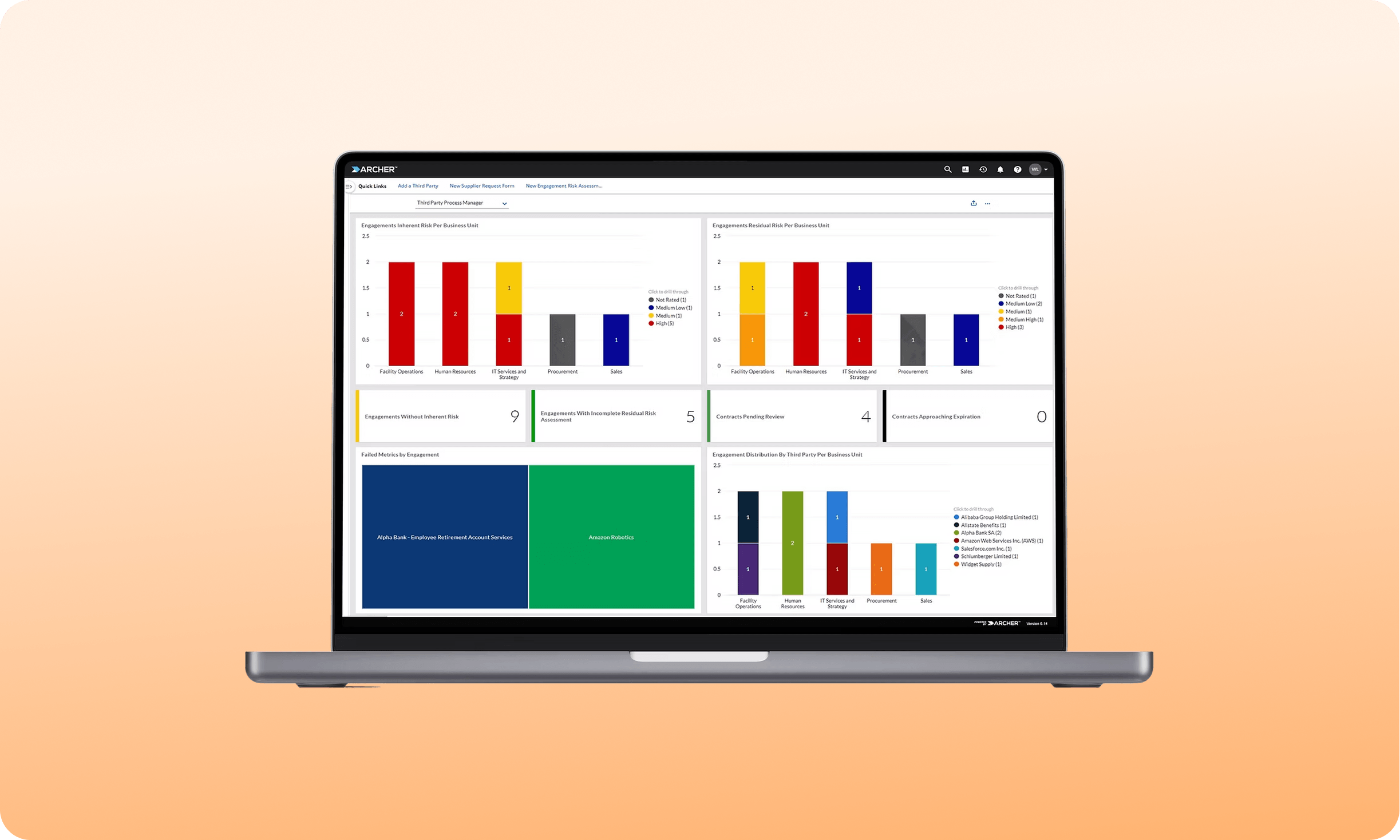
One set of assets and controls, a view for every role that asks
An analyst assesses a system once. That result reaches the director’s queue, the CISO’s exposure summary, the enterprise register the CRO owns, and the board pack, with no rekeying and no fight over whose spreadsheet is current.
-
Analysts: assess once, and it lands everywhere
-
CISO and CRO: one exposure number, not two
-
Board: an exposure view that survives questions
What the analyst, the CISO, and the board each get
From IT risk analyst to enterprise risk officer, one platform serves every role.
For the IT risk analyst
Archer fits the process your team runs now, so assessments, control tests, and findings sit in one queue instead of four spreadsheets and an inbox.
For the security GRC lead
Roll every system, control, and open finding into one picture of exposure, so you answer the hard question in the meeting instead of rebuilding the deck.
For the CISO and the CRO
Cyber exposure and enterprise risk draw on the same assets, controls, and scenarios, so the two of you bring one number to the executive table.

Where an IT and security risk program actually does the work
Nine interconnected use cases replace spreadsheets with workflows that move findings and controls from assessment through closure.
1
IT risk register
Catalog the organization and its IT assets, then log every IT risk against the systems it touches, so the register reflects the estate you actually run.
2
Control testing
Test IT controls on a project schedule and pull results in from automated systems, so manual evidence and machine evidence land together in the same record.
3
Vulnerability triage
Rank threats and vulnerabilities by what they put at risk in the business, using asset context and scan results to settle which one your team works on first.
4
Incident response
Escalate, investigate, and close declared incidents in a defined workflow, with the business context that tells the team which incident to work on first.
5
Policy content
Start from current security frameworks and control catalogs, including the ISO 27000 series, COBIT 5, the NIST 800 series, and PCI DSS, all shipped with the use case.
6
Regulatory change
Track changes to IT obligations, judge the business impact, and route the response, so senior management hears about a new requirement from your team first.
How every role benefits from one platform
For security and IT risk teams
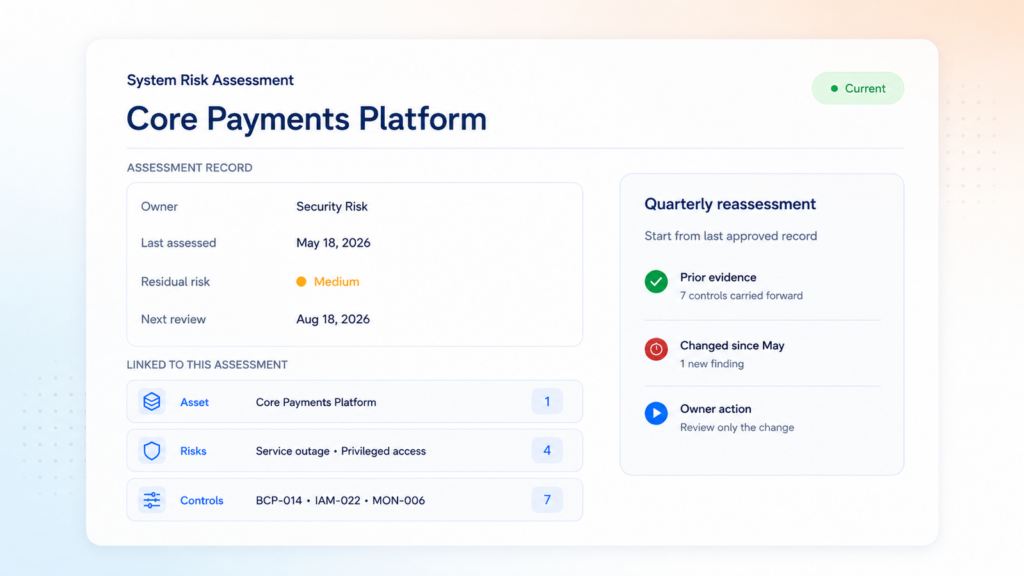
Assess a system once and let the result stand. Risks link to the assets they threaten and the controls meant to hold them, findings carry owners and dates, and next quarter’s reassessment starts from last quarter’s record instead of a blank template.
For the CISO and the CRO
Cyber exposure and enterprise exposure draw on one set of assets, controls, and scenarios, so the security number and the enterprise number reconcile before the executive meeting rather than during it. You fund what the shared picture says matters.
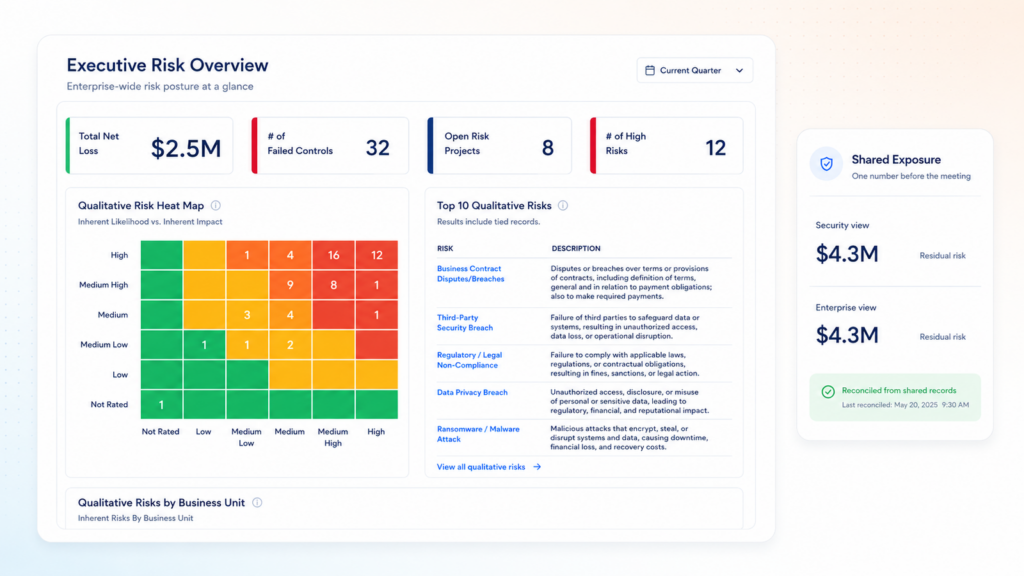
For the board and audit
The exposure summary the board reviews comes from the same records the analysts work in, so a question about one number ends in a control and an owner rather than a promise to follow up. Appetite set in the boardroom reaches the thresholds security runs against.
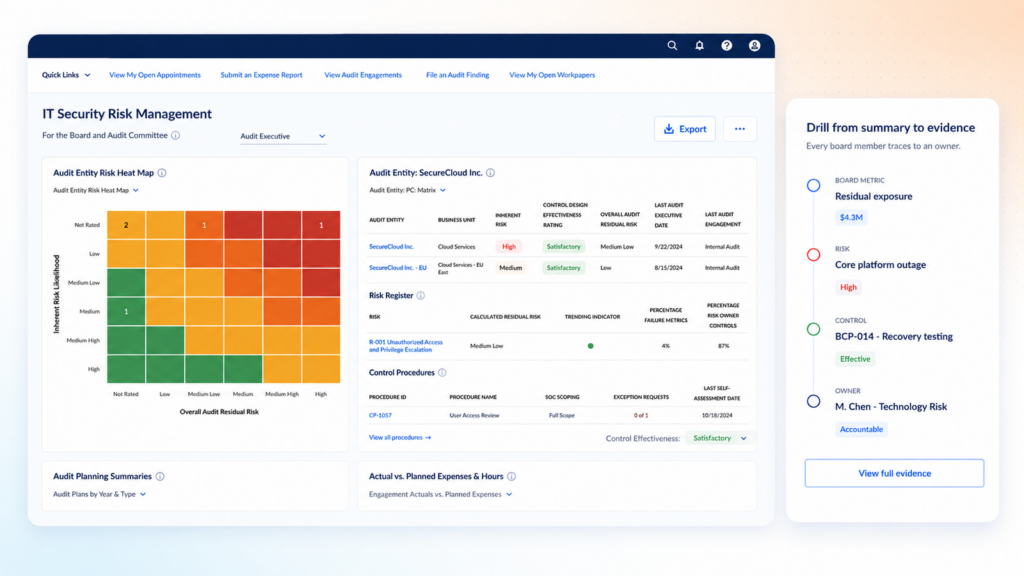
The images used above are not actual product screenshots.
What your team gains with Archer
Archer Evolv enables an integrated strategy across your risk and compliance functions.
-
Faster audits
Cut audit prep time by up to 40% with reusable evidence and automated collection.
-
Fewer surprises
Continuous monitoring surfaces emerging risk before it becomes an incident.
-
Lower tooling cost
Consolidate overlapping GRC tools into one platform and reduce license sprawl.
-
Board-ready reporting
Generate executive and board reports in minutes instead of days.
-
Confident compliance
Stay continuously audit-ready across every framework you operate under.
-
Scales with you
Onboard new units, frameworks, and regions without rebuilding your program.
What your team gains over a point IT risk tool
Archer sits on the same platform as enterprise and operational risk, so cyber and business risk reconcile before the meeting instead of after.
A point IT risk tool
Work spread across a scanner, a spreadsheet, and a ticket queue
Here’s what you get
-
Asset data limited to the tool
-
Evidence scattered across systems
-
IT risk only, no business context
Archer IT & Security Risk
One platform for IT risk and enterprise risk
Here’s what you get
-
One queue, one record, one reassessment cycle
-
Trending on residual risk and control effectiveness
-
Cyber estimates built from the same scenarios enterprise risk uses
-
Appetite set at the top reaches control thresholds and remediation dates
-
Works with the CMDB, scanners, and ITSM you already run
Custom spreadsheet builds
Proof that paperwork moved faster
Here’s what you get
-
Manual tracking and updates
-
No integration with source systems
-
Risk interpretation varies by user
Explore Our Case Studies

Eastern Bank Uses Archer to Drive Business Processes and Streamline Compliance
- View case study:
- View case study: Banorte Bank Gains Accurate Picture of Risk with Archer
- View case study: Intuitive Surgical Migrated to Archer SaaS for their journey to empowered risk management
- View case study: Operational Resilience for Financial Services Institutions
More than 1,500 organizations run on Archer®, including half the Fortune 500 and 37 of the top 50 global banks. See what their teams were up against, what they built, and what changed.
Eastern Bank Uses Archer to Drive Business Processes and Streamline Compliance

Banorte Bank Gains Accurate Picture of Risk with Archer
Intuitive Surgical Migrated to Archer SaaS for their journey to empowered risk management
Operational Resilience for Financial Services Institutions
Trusted by the teams who carry the risk
Risk, compliance, and audit leaders on what changed after Archer Evolv was implemented.

We recognized the need for a GRC software platform that would be central to our ability to improve and transform our enterprise risk and compliance processes.
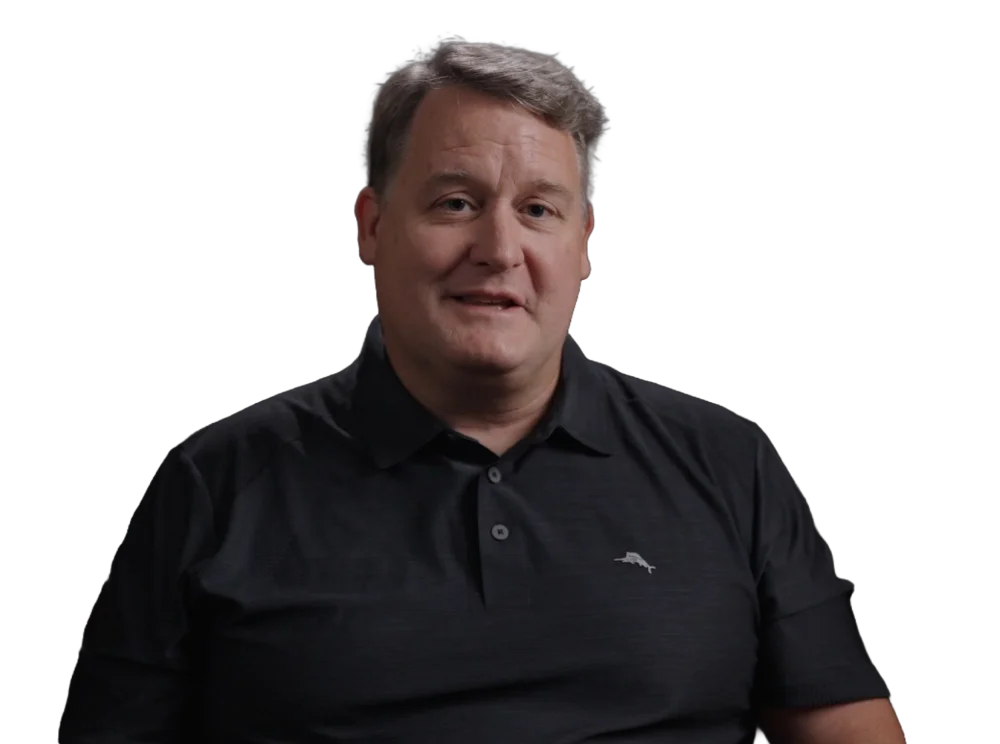
Archer is the source of truth, and it creates a nice audit trail for us. As an insurance company, we're audited by every governmental entity. Now we can say, here's our repository, take a look.
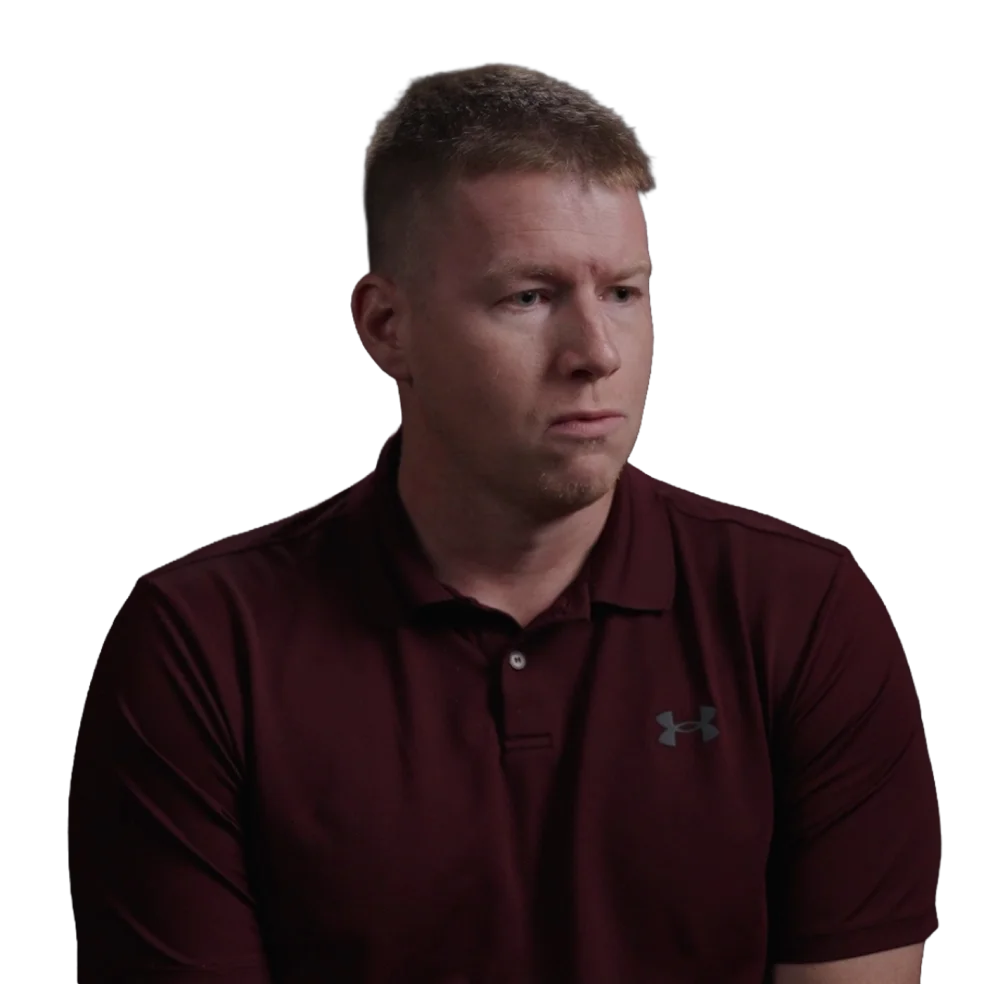
Risk aggregation is a big point for us, to see where our risk is located within the organization, and to give greater visibility for boards and executives.

Turkcell is using Archer as the main GRC tool in the company. It provides us a transparent and safe governance framework.

Archer gives us the ability to boil things down into numbers and specifics versus generalities. It's management by fact versus intuition or feel.

It connects all the different applications together, so you can use those cross-references and connections to make better business decisions, because you have it all in one place.
Questions security teams ask before they choose
Straight answers to what the team running IT and security risk actually needs to know.
Archer configures to the process you run today, and it takes asset context, scan results, and control evidence from systems you already own. Your team maps its own workflow during scoping, well before anything goes live.
Scope drives the timeline. Intuitive Surgical spent seven months choosing and six weeks migrating. Most programs start with one use case out of the nine, and the first thing leadership notices is the reporting time your team stops spending.
Archer takes scan results and asset data as inputs, so your estate stays where it is. Vulnerability findings arrive with business context already attached, and issues route back into the tracking your teams use today.
No. The solution area holds nine use cases and most programs sequence them. Teams often begin with IT risk management or controls assurance, then add vulnerability, incident response, policy, and regulatory work on the same asset and control records.