See risk forming before it becomes loss
Cyber, AI, business interruption, and regulation top this year’s risk list, and each one lives in a different system. Evolv Risk reads them as one.
1,500+ organizations run risk and compliance on Archer · 50% of clients in the Fortune 500
-
1,500+
Clients across 48 countries
-
50%+
Of customers in the Fortune 500
-
65%
Of organizations putting more effort into quantification
-
15,000+
Members in the Archer risk community
Your register refreshes quarterly. Your exposure does not wait.
The board asks where exposure sits and whether you are ready. That looks forward. Your register, heat map, and quarterly assessment look back. Evolv Risk keeps the picture current, so the answer is ready before the question lands.
-
One risk picture instead of six disconnected ones
-
Exposure that moves when the business moves
-
Every score traced to the source behind it
Built to hold up when the board asks how you know that number
Archer Evolv delivers enterprise capabilities for companies of all sizes.
An answer you can defend
Every judgment carries its own lineage, so you can open any risk score and follow it back to the document, the version, and the date it came from.
A picture that stays live
Signals from inside the business and outside it feed one view, so a shift in one corner shows up wherever it raises risk instead of sitting in a silo.
Work that lands in Archer
Operators do not stop at a summary. They open the assessment, assign the owner, and update the register in the system your team already works in.

What your team gets on day one, in the order they will use it
Archer Evolv is specifically designed to meet the needs of GRC teams and business users.
1
Continuous signal intake
Internal loss events, control failures, third party changes, and outside intelligence land in one place as they happen, so no one spends a week chasing what changed.
2
Business impact scoring
Exposure reads in financial terms rather than a color on a grid, so a risk in one business unit compares honestly against a risk in another when funding is short.
3
Confidence-based routing
Every operator scores its own certainty. Calls above the threshold your team sets move through. Calls below it reach a named reviewer before anything changes.
4
Versioned source lineage
Sources, amendments, and reasoning keep their history at the citation level, so a question about how a risk reached the register has an answer already waiting.
5
Two-way Archer integration
Evolv reads and writes to your Archer record, which stays the system of record, so your team stops keying the same finding into two places and nothing drifts apart.
6
Dynamic AI guardrails
Policy documents turn into live guardrails that test and monitor the AI your business is already running, and route what fails into your issue management process.
What Evolv Risk does in the moment
Spot exposure before it lands
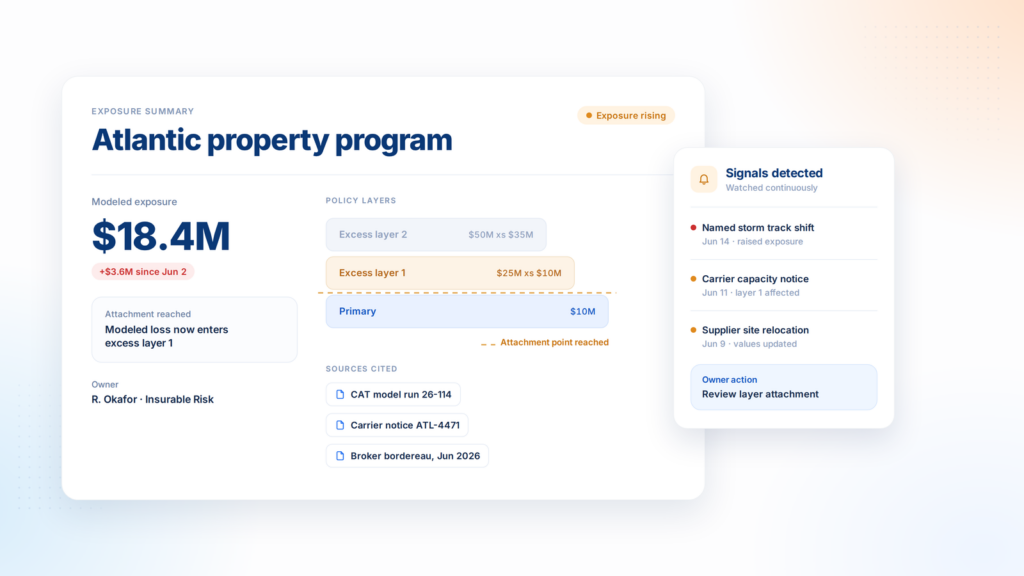
A threat in one domain cascades into three others long before anyone reviews it, and the first sign shows up in a system your risk team does not watch. Evolv Risk reads those signals continuously and raises exposure as it forms, while there is room to act.
Decide against your appetite
Enterprise risk holds one piece, operational risk another, the business units the rest. Evolv Risk reads every domain from one plane and scores exposure in business terms, so you can weigh a supplier concentration against a control gap and fund the greater.
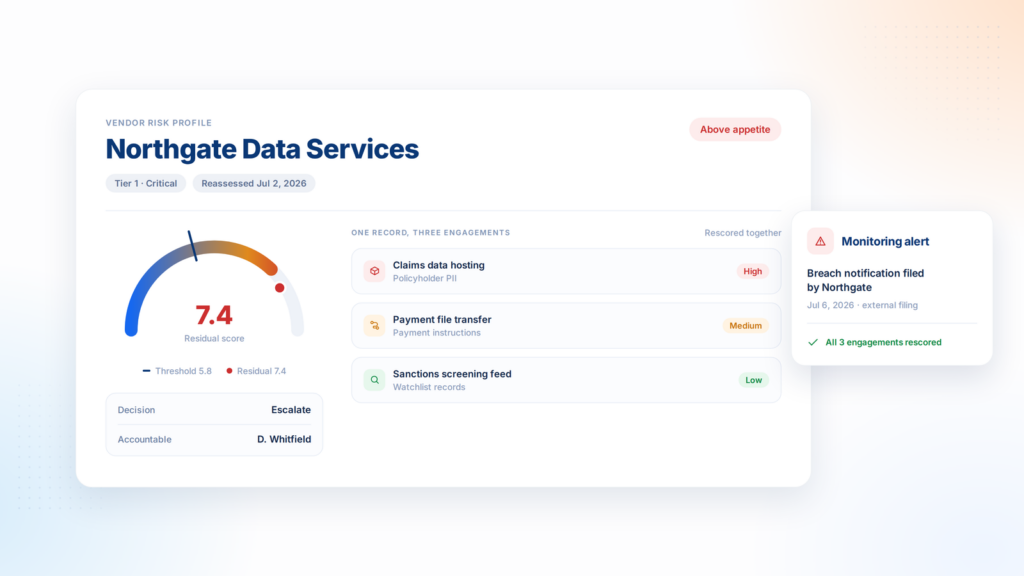
Defend every judgment you make
Regulators now ask you to demonstrate that controls work, not that a policy exists. A register updated twice a year cannot carry that. In Evolv Risk the reasoning and source trail travel with the decision, so the evidence exists when you make the call.
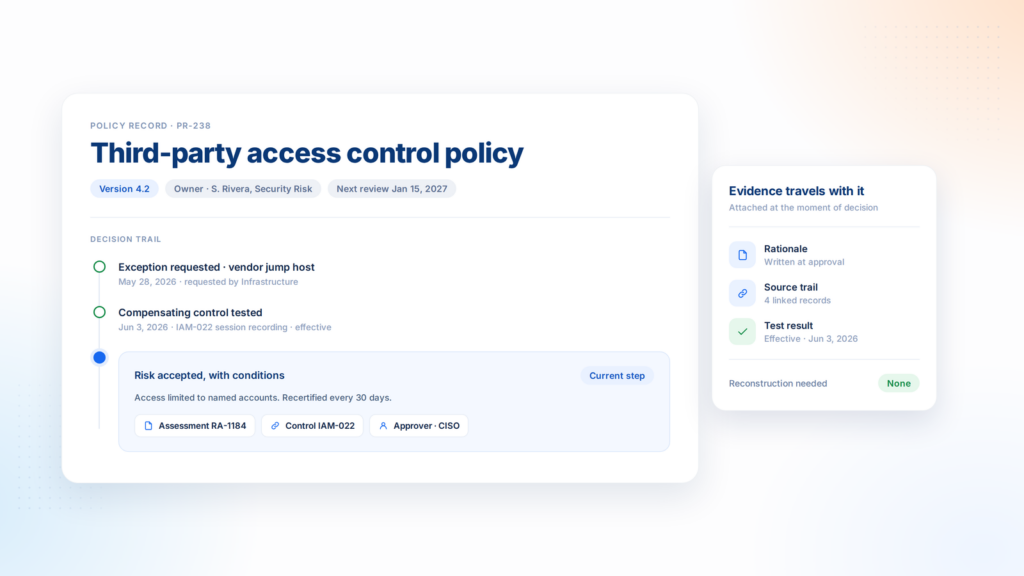
The images used above are not actual product screenshots.
Everything your risk program needs, all of it on one platform
Archer Evolv enables an integrated strategy across your risk and compliance functions.
-
Risk register
One catalog of every risk across the enterprise
-
Control library
Map a control once to every framework it covers
-
Loss event management
Capture incidents, analyze them, tie them to controls
-
Key indicator management
Thresholds that trigger before the exposure arrives
-
Third party exposure
Read supplier risk alongside everything else you carry
-
Board reporting
A current view of exposure, ready when the meeting is
How an Archer Evolv operator differs from a general-purpose AI tool
See how Archer GRC stacks up against generic tools and custom enterprise builds.
Where the answer comes from
Basic coverage for teams just getting started.
Here’s what you get
-
Preset frameworks
-
Custom permissions
-
Custom infrastructure
Archer Evolv Risk
Built for teams that need real-time visibility and control.
Here’s what you get
-
Pre-built risk templates
-
Native integrations (200+)
-
Automated evidence collection
-
Cross-framework control mapping
-
Real-time executive dashboards
-
AI-assisted risk scoring
-
Multi-tenant SaaS deployment
Handling uncertainty
Spreadsheets, shared drives, and tribal knowledge.
Here’s what you get
-
Manual tracking
-
Custom infrastructure
-
Custom updates
Explore Our Case Studies

Eastern Bank Uses Archer to Drive Business Processes and Streamline Compliance
- View case study:
- View case study: Banorte Bank Gains Accurate Picture of Risk with Archer
- View case study: Intuitive Surgical Migrated to Archer SaaS for their journey to empowered risk management
- View case study: Operational Resilience for Financial Services Institutions
More than 1,300 organizations run on Archer®, including half the Fortune 500 and 37 of the top 50 global banks. See what their teams were up against, what they built, and what changed.
Eastern Bank Uses Archer to Drive Business Processes and Streamline Compliance

Banorte Bank Gains Accurate Picture of Risk with Archer

Intuitive Surgical Migrated to Archer SaaS for their journey to empowered risk management
Operational Resilience for Financial Services Institutions
Trusted by the teams who carry the risk
Risk, compliance, and audit leaders on what changed after Archer Evolv was implemented.

We recognized the need for a GRC software platform that would be central to our ability to improve and transform our enterprise risk and compliance processes.
Archer is the source of truth, and it creates a nice audit trail for us. As an insurance company, we're audited by every governmental entity. Now we can say, here's our repository, take a look.

Risk aggregation is a big point for us, to see where our risk is located within the organization, and to give greater visibility for boards and executives.

Turkcell is using Archer as the main GRC tool in the company. It provides us a transparent and safe governance framework.

Archer gives us the ability to boil things down into numbers and specifics versus generalities. It's management by fact versus intuition or feel.

It connects all the different applications together, so you can use those cross-references and connections to make better business decisions, because you have it all in one place.
Evolv Risk, answered
Plenty of vendors have one of these. The defensible position is having all three on the same foundation.
An operator works inside your own record, bound to an identity and scoped to what that identity already permits, so it reaches nothing your team has not granted it. It cites what it used, and when it is not certain it routes the call to a reviewer.
No. It protects their time for the judgment only they can make. The operator handles the gathering and the first pass. Your experts own the decision, and every override they make teaches the operator what your organization means by acceptable.
Four domains run in production now: regulatory intelligence, regulatory change management, AI risk, and decision support. Operational risk is next, then IT risk, policy content, and third party. Start with what ships today and add the rest.
No. Archer Evolv runs on the Archer instance you already have, and that is the point. The controls, policies, findings, and workflows your team encoded are what make the AI defensible. Data quality operators improve your data during deployment.
They read from the same plane, so risk and compliance work from one lineage instead of two. A regulatory change that lands in Compliance moves the risk picture in Evolv Risk, because neither has to be told what the other found.