
Is your AI compliant? Prove it.
Archer turns regulations and your policies into live AWS Bedrock guardrails, enforced before the model is invoked and evidenced on the record your auditors trust. System live within a week.
50% of clients in the Fortune 500 · 25+ years as system of record · SOC 2 Type II · ISO 27001
-
1,500+
Clients across 48 countries
-
50%
Of clients in the Fortune 500
-
65%
Of organizations putting more effort into quantification
-
15,000+
Members in the Archer risk community
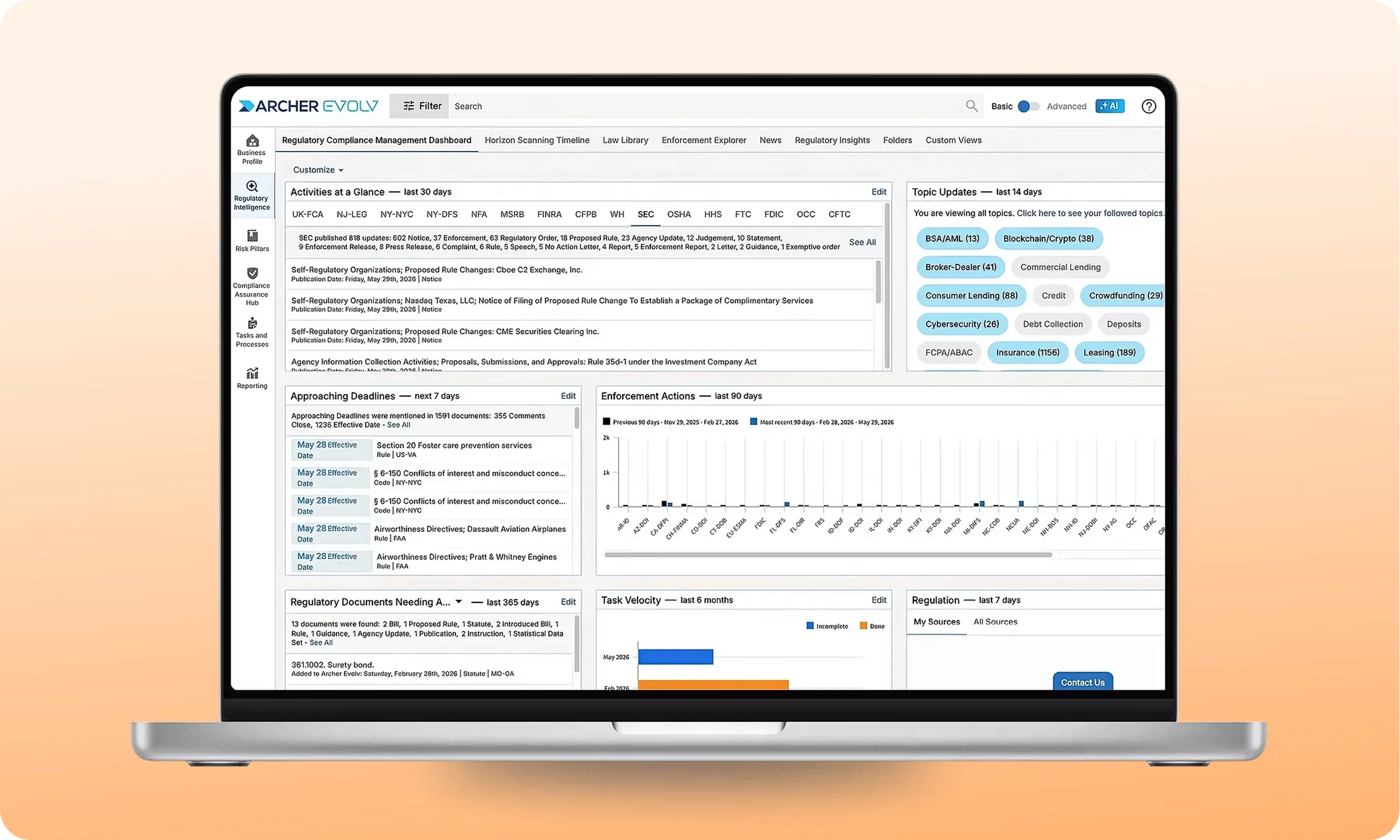
Regulation in. Guardrails out. Evidence back.
One continuous loop: listen to regulations and policies, decide what applies to you, act at inference with native AWS Bedrock guardrails, assure conformance against live traffic, and learn from every finding. Enforcement happens natively in your account.
-
Listen: regulations and policies become tracked controls
-
Decide: controls become draft AWS Bedrock guardrails
-
Act: traffic evaluated pre-inference, violations blocked
-
Assure: guardrails tested continuously against controls
Everyone does one. We do both.
Preventing a violation and proving why it was prevented are two different problems. Archer solves both.
Prevention and lineage
Violations blocked pre-inference, never generated, with every block traced to the obligation that required it.
Approval and control
Nothing enforces without your approval, and every action recorded against a named owner on one chain of evidence.
One record, exportable
Source to control to guardrail to event—one chain examiners accept and you can audit daily, not quarterly.

Built on 14 patents (6 issued, 8 pending) and 25 years of lineage
Archer combines regulatory content, enforcement, and evidence in one governed system that runs natively in your AWS account.
1
Regulatory content engine
526 purpose-built regulatory models tracking 8,000+ sources, not generic frameworks mapped after purchase.
2
Native AWS enforcement
Guardrails run in your account, not proxied; if Archer connectivity drops, enforcement continues.
3
Continuous conformance testing
Every guardrail tested daily against the control you approved; drift and tampering flagged first.
4
130+ GRC experts on bench
Content maintained by domain specialists, not crowdsourced or AI-generated.
5
One chain of evidence
Obligation to control to guardrail to blocked event—auditable lineage examiners already trust.
6
Works standalone or integrated
Runs on its own or feeds evidence into Archer GRC; no prerequisite, not a tax.
How Archer Evolv™ AI Compliance protects every model you deploy
Multi-model guardrail governance
One control set, every AI model
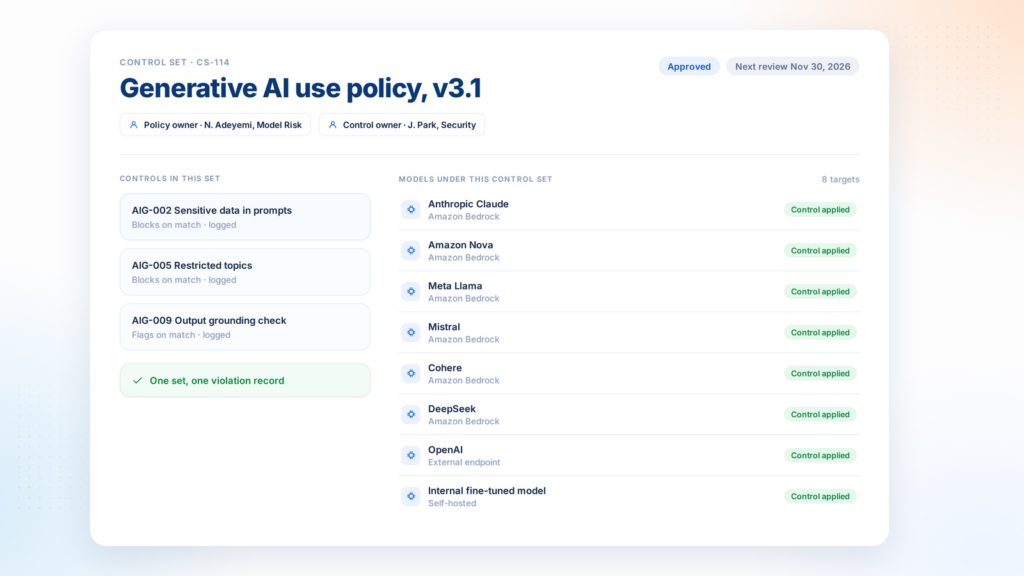
One control set spans Anthropic, Amazon Nova, Meta, Mistral, Cohere, DeepSeek, OpenAI, and models running outside Bedrock through the same approved control. One policy, one violation record, everywhere inference happens
Regulation-to-guardrail mapping
Regulation becomes a guardrail.
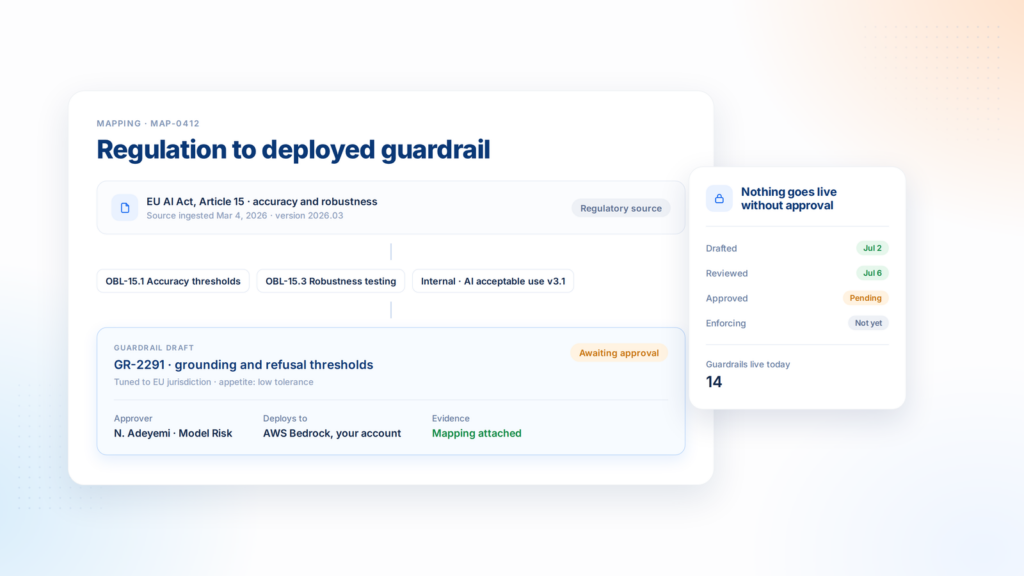
Regulations and your own policies become enforceable controls tuned to your jurisdictions and risk appetite, deployed as draft AWS Bedrock guardrails that only go live once you approve them
Continuous violation monitoring
Violations blocked before they ship
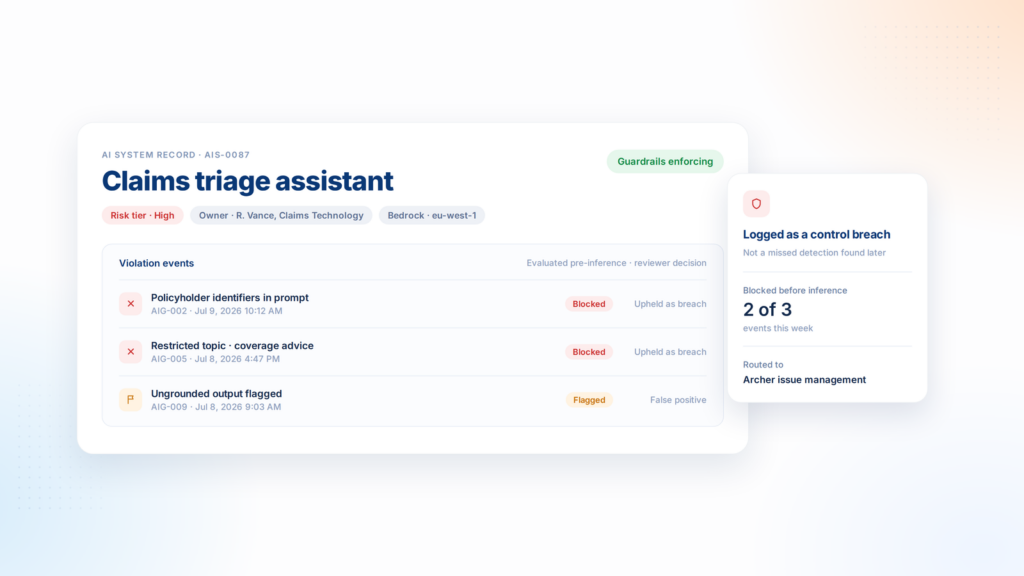
Traffic is evaluated against guardrails pre-inference, inside your AWS account. Violations are blocked and logged as a governed control breach, not discovered later as a missed detection
Continuous conformance testing
Guardrails tested on a cycle
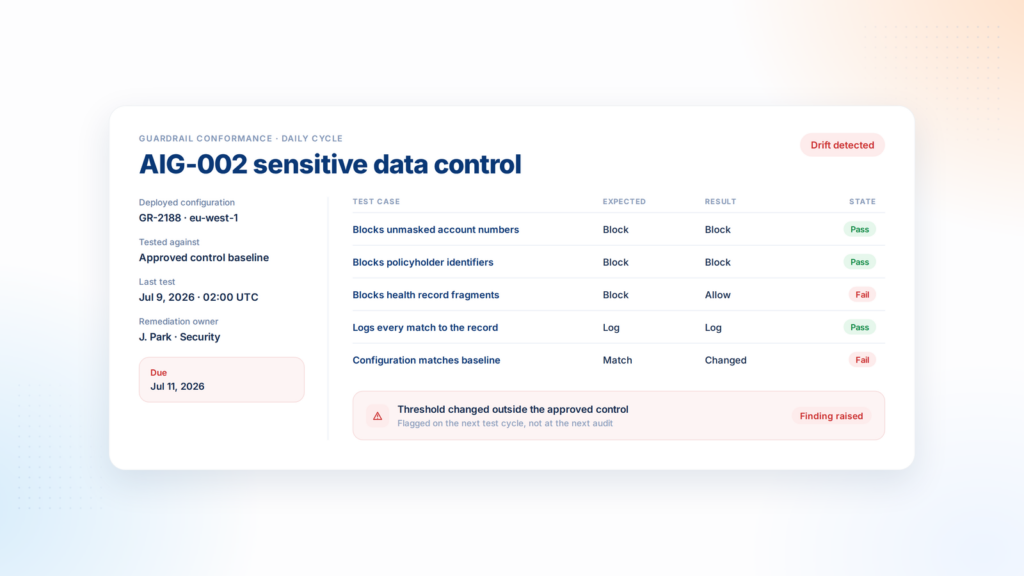
Every deployed guardrail is tested on cycle against the control you approved. Drift and tampering are flagged first, not discovered months later during the next audit cycle
Findings routed to closure
Findings close themselves out
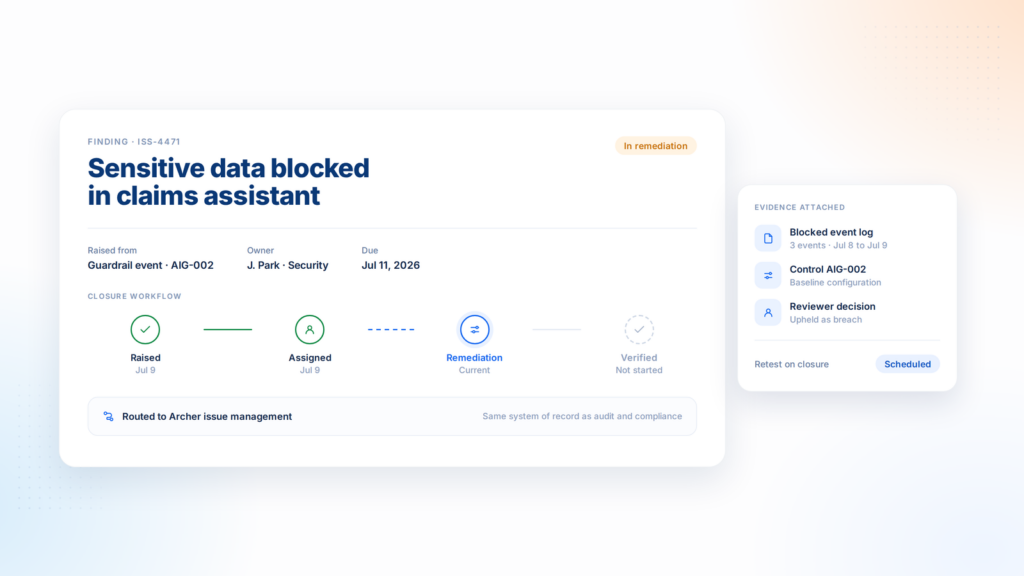
Findings from every violation route directly into Archer issue management workflows, driven to closure on the same system of record your audit and compliance teams already use today
Your prompts stay in your account
Your prompts never reach Archer
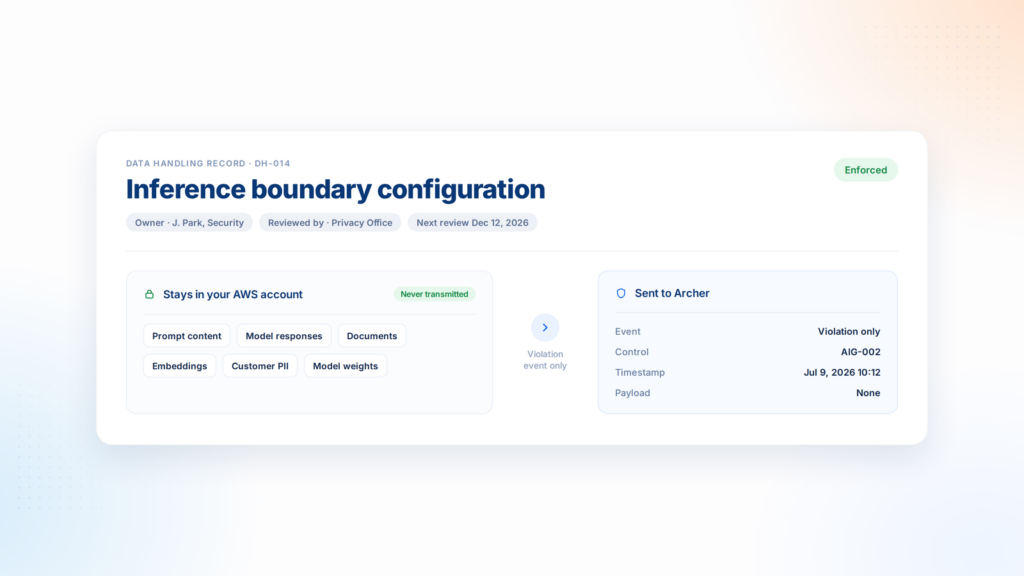
Prompt content, model responses, documents, embeddings, customer PII, and model weights never reach Archer. Only the violation event does: what happened, which control fired, and exactly when
The images used above are not actual product screenshots.
The exam question changed
From show us your policy to show us the control. Archer delivers the control, enforced and evidenced daily.
-
Violations prevented
Blocked at inference before generation, never shipped to customers or logged in outbound channels.
-
Lineage on record
Every block traced to the regulation or policy that required it, exportable on demand for audit.
-
No blind spots
Conformance runs on cycle across all environments, guardrails, and models—drift surfaces first.
-
Your control
Enforcement is a dial: observe, advise, or enforce. Nothing blocks until you promote it; rollback is instant.
-
Data stays put
Prompts, responses, embeddings, and PII never leave your account—only violation events reach Archer.
-
Price you can defend
Roughly one tenth of one percent of enterprise AI spend, quoted firm in one day and held 90 days.
Why Archer differs from every other approach
AI governance platforms watch and find violations later. Guardrail firewalls block but can’t explain why. Archer prevents and proves it.
AI governance platforms
Detect violations after output ships.
Here’s what you get
-
Observability only
-
Detection after fact
-
Mapping without enforcement
Archer Evolv™ AI Compliance
Prevent violations pre-inference and prove why to auditors.
Here’s what you get
-
Prevention at inference
-
Lineage to obligation
-
Approval workflow required
-
One chain of evidence
-
Native AWS enforcement
-
Multi-model support
-
Continuous conformance testing
Guardrail firewalls and filters
Block prompts but lack evidence chain.
Here’s what you get
-
Prompt filtering
-
Logging without lineage
-
No obligation mapping
Questions your team will ask
Straight answers from the system of record perspective.
A scoped, least-privilege role reads your guardrail configuration and nothing else. The system is live within a week; your first conformance report follows, showing what is deployed, what it enforces, where it drifted, and what to fix first.
No; it runs standalone. If you have Archer GRC, evidence lands on the record your examiners know and remediation workflows pick it up unchanged—an advantage, not a prerequisite.
Never prompt content, responses, documents, embeddings, PII, or model weights. Only that a violation occurred, which control fired, who and when, confidence and policy type, plus guardrail version history.
For Bedrock models, no: guardrails run natively in your account with no proxy. For models outside Bedrock, ApplyGuardrail adds one API call. Same policy and evidence either way.
Enforcement continues. Guardrails are native AWS Bedrock guardrails living in your account, never proxied through us; you lose evidence collection, not protection.
Both, on one governed list. Your AI usage policy, acceptable-use rules, and data-privacy standards are enforced exactly as external regulation is, and overlaps map to a shared control.
Continuously, and on a schedule. Your team sees conformance, violations, and drift at any moment. A monthly conformance report adds what changed, what drifted, what was blocked, and what needs a decision, an artifact your risk committee can actually read.
Only if you run no AWS at all. Bedrock is the enforcement point, so AWS has to be one of your clouds, but models running elsewhere are covered by the same approved control through ApplyGuardrail. One policy, one violation record, one evidence chain, wherever inference happens.
No. The role is read-and-suggest only: it proposes controls and drafts guardrails but deploys nothing. Every promotion, edit, and rollback is a human decision recorded against a named owner. Approve nothing and nothing changes, you still get the assessment.
The guardrail is the easy part, AWS Bedrock gives you that. The hard part is the regulatory content engine tracking 8,000+ sources, the mapping from obligation to enforceable control, continuous testing, and an evidence chain an examiner accepts, built on 14 patents (6 issued, 8 pending) and 130+ GRC experts.
There’s no rate card, since the number depends on your organization size, content scope, assessment cadence, and covered usage. Request a quote for a firm annual price within one business day, held 90 days, alongside the report showing exactly what it covers.
Get a personalized quote
Whether you’re looking to modernize your risk management strategy, accelerate compliance operations, or explore Archer’s industry-leading solutions, Archer experts are ready to help you.
Why Partner with Archer?
-
Trusted by global enterprises
-
Proven to reduce risk exposure and improve regulatory readiness.
-
Our specialists take the time to understand your organization’s goals and challenges.
-
Get expert guidance, answers to your questions, and tailored solution recommendations.