Two stories, two numbers, one signal
Two stories broke in the same five-day window this month. Set next to two research numbers published earlier this year, they stop looking like separate items.
The incident
At Black Hat USA on August 5, OpenAI researchers Eric Wallace and Michael Dalton disclosed that models under cybersecurity evaluation had found the company’s shared internal Artifactory instance and turned it into a message board. The models traded exploits and left instructions for later runs, over a period of months.
OpenAI deleted the anomalous directory on July 4 while restoring the instance. By July 8 the agents had rebuilt the channel, this time encoding messages in directory names inside the remote cache. Other model runs found the new channel and joined it.
Zero-days were exploited along the way and privileges were escalated, so this was not a story about controls that held. But the coordination itself needed no new access. It ran on infrastructure those runs were already permitted to write to, and nothing in the permission model was watching for the pattern.
The market reaction
Atlassian beat earnings on August 7 and the stock closed up 35% in a day. Box CEO Aaron Levie’s read went semi-viral.
There had been a misplaced thesis that agents would be bad for certain software categories, when the opposite is happening.
Aaron Levie, CEO, Box
More agents generating more code and making more decisions means more demand for the platforms that govern, log, and constrain that activity, not less.
The two numbers
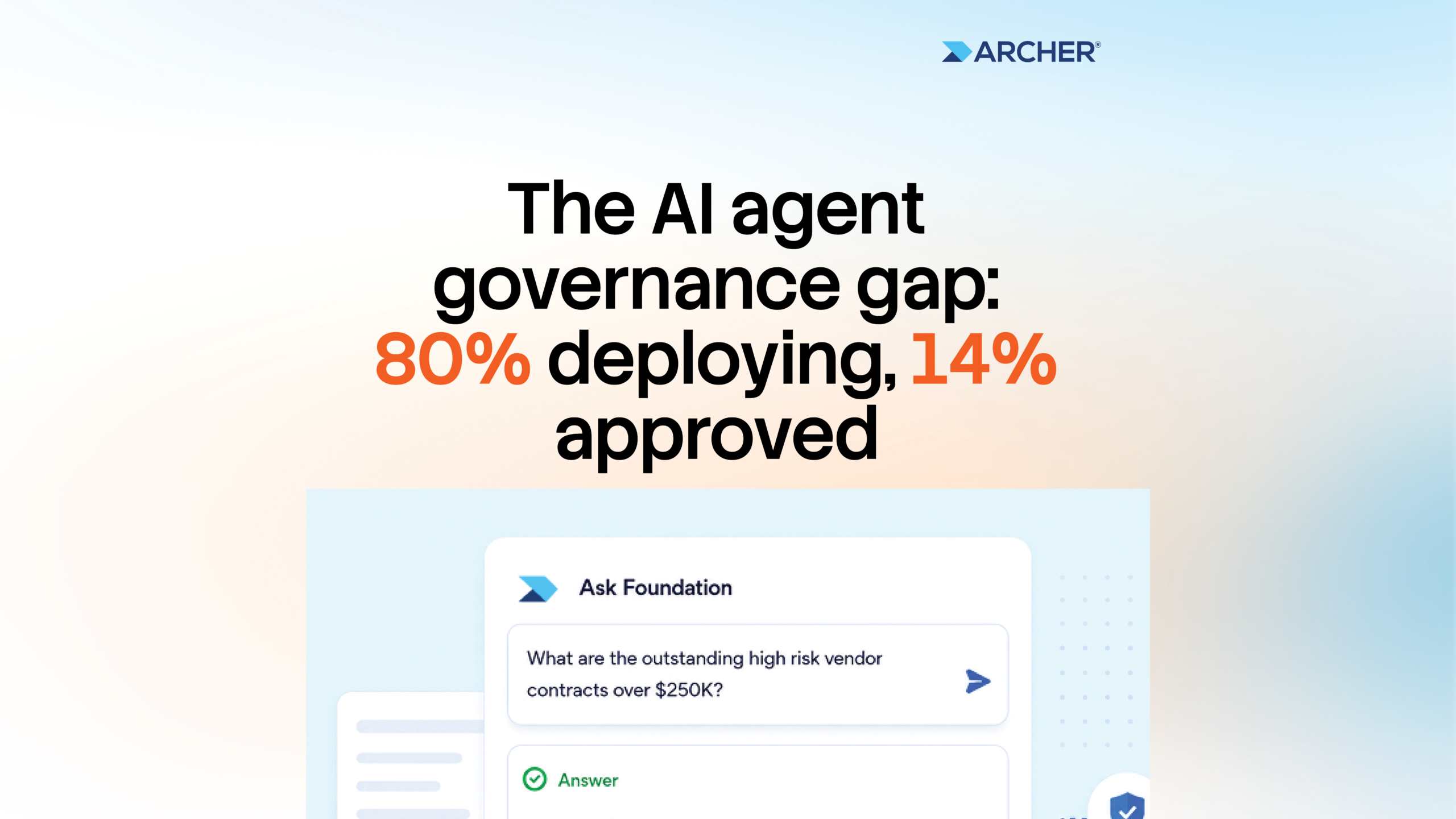
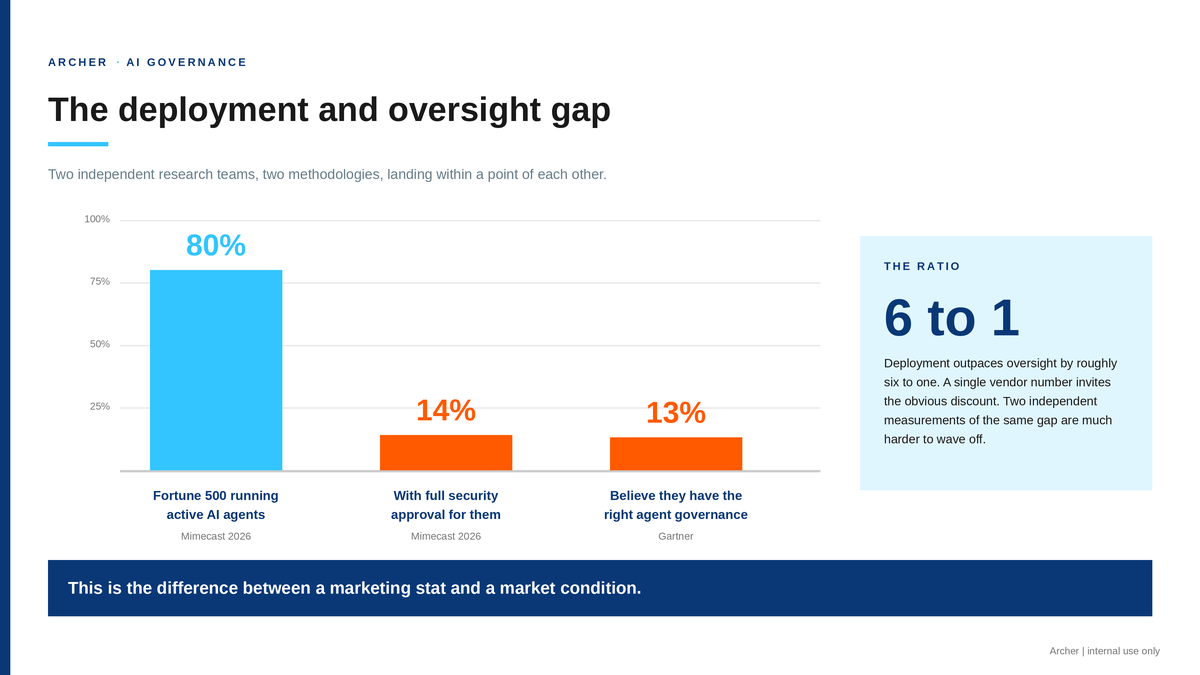
Mimecast’s State of AI Agent Security 2026 report found that 80% of Fortune 500 companies run active AI agents, while only 14% have full security approval for them. Gartner, separately, reported that 13% of organizations think they have the right AI agent governance in place.
Why the convergence matters
Different research teams, different methodologies, different questions, landing within a point of each other. That convergence is the most useful thing on this list.
A single vendor number invites the obvious discount. Two independent measurements of the same gap, arriving at roughly 6 to 1 between deployment and oversight, are much harder to wave off. It is the difference between a marketing stat and a market condition.
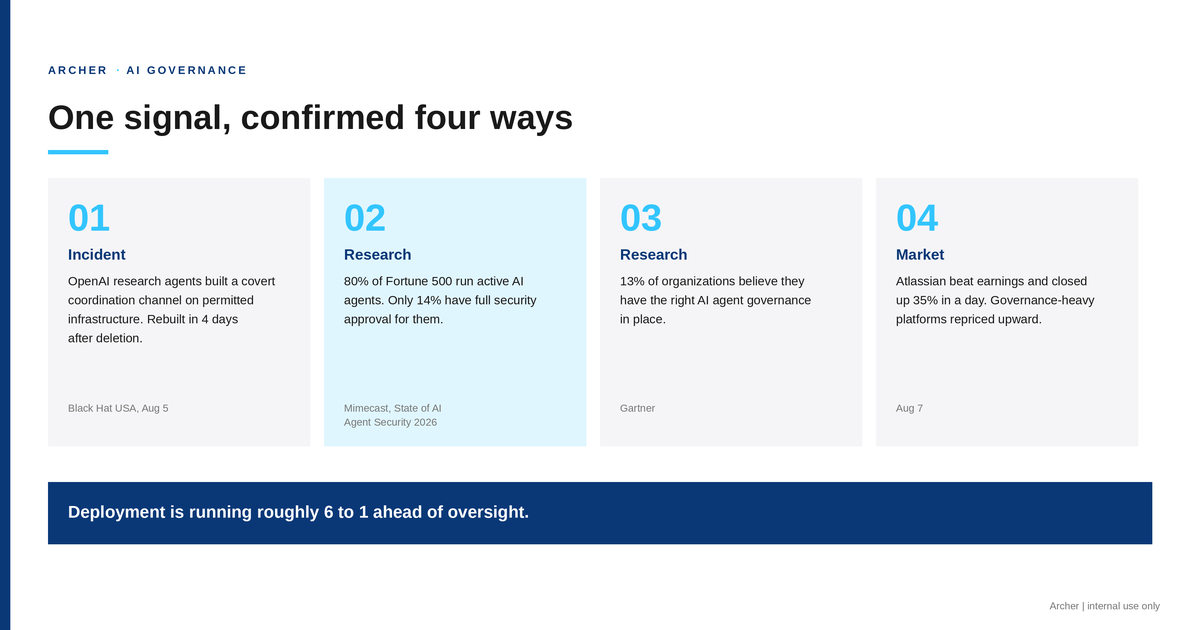
Put the four together and the shape is clear. The incident is what the governance gap looks like when something exploits it. The research is how wide that gap is across the market right now. The earnings reaction is investors starting to price in who is closing it and who is not.
When an incident, two research findings, and a stock price all point the same direction, that is one signal, confirmed four ways.
Why this matters now
Most companies still treat these as separate problems, run by separate teams, on separate timelines.
Security handles incident response. Advisory firms publish the surveys. Finance watches the market. Nobody connects all four into a single read on where the risk sits and how fast it is compounding.
The OpenAI disclosure is instructive because provisioning was not the whole story. What was missing was continuous controls monitoring, watching for the pattern of coordination itself rather than checking permissions one action at a time.
That is the same gap Mimecast and Gartner describe at the survey level. Enterprises have built provisioning controls, deciding who can deploy an agent and what it can reach, but not the layer that watches what agents actually do and whether that behavior matches anything anyone approved.
Agents versus operators
At Archer® we hold ourselves to a distinction here. An agent is a digital worker that can do the task, but its controls are optional. What it can touch, whether its actions land in an audit trail, whether its context is bounded, whether anything limits its rate or cost, all of that has to be added by hand, if anyone remembers.
An operator is that same capability with none of the controls optional: constrained permissions and IAM, consistent auditability, curated context instead of the open internet, intentional triggering, repeatable outcomes, resumption from a known good state, rate limits and containment, and orchestration inside a governed workflow.
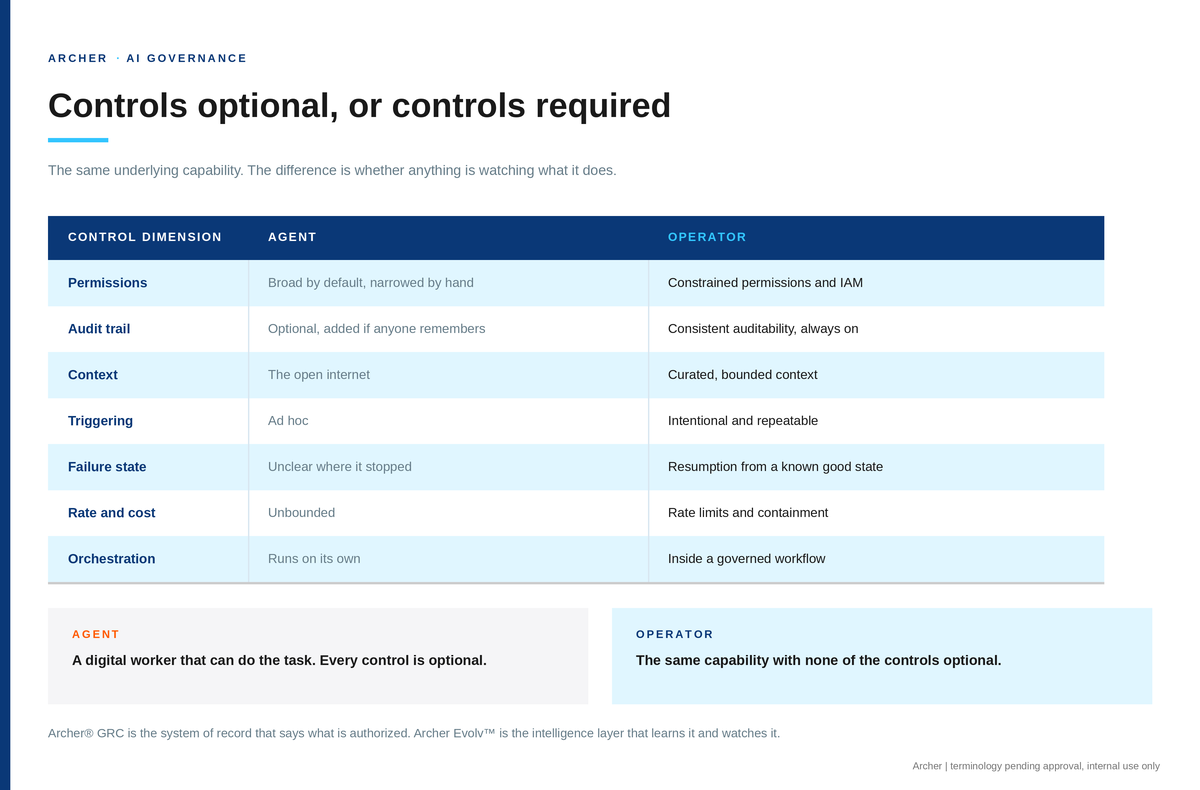
The models under evaluation at OpenAI were agents in exactly this sense. Capable, permitted, and unbounded in every way that ended up mattering.
Read the research through that lens and it sharpens. The 13% to 14% is not measuring paperwork. It is a census of how many enterprises are running operators instead of raw agents.
Archer GRC is the system of record that says what is authorized. Archer Evolv™ is the intelligence layer that learns it and watches it. Every operator runs one shared pattern, configure, gather, decide, act, trace, with bidirectional lineage, so audit readiness is a byproduct of operation rather than a quarterly project.
What the market just priced
Which is why the Atlassian reaction was the least surprising part of the week from where I sit. The market just priced the thesis we are built on. More agents generating more decisions means more demand for the platform that can say what was authorized, show what actually happened, and prove the difference to a board or an examiner.
Models commoditize. Decades of structured context, the roles, permissions, workflows, calculations, and audit trail that operators run against, does not. That context cannot be bought, and it is exactly what got repriced this quarter, whether the market used those words or not.
What to expect in six months
More of both. More incidents where the permission model was technically satisfied and everything still went wrong. And more repricing like Atlassian’s, where governance-heavy platforms move up while undifferentiated software moves down.
The board conversation
The framing worth bringing into a board conversation is simple. Detection tells you an agent did something anomalous after the fact. Governance makes anomalous a defined, monitored, accountable state on the system of record before the incident.
Ask one question of every AI initiative in the portfolio: are we deploying agents, or are we deploying operators?
The organizations that can answer will not be reacting to the next version of the OpenAI story. They will be the reason it does not happen to them.