Built on proprietary models trained since 2017, Archer Evolv™ AI Operators are purpose-built digital full-time employees that work alongside risk, compliance and security teams, under their supervision, inside the GRC harness and system of record those teams already trust.
80% of Fortune 500 companies are running active AI agents. Only 14% have full security approval for them. Gartner predicts that by 2027, 40% of enterprises will demote or decommission autonomous AI agents because of governance gaps discovered only after a production incident.
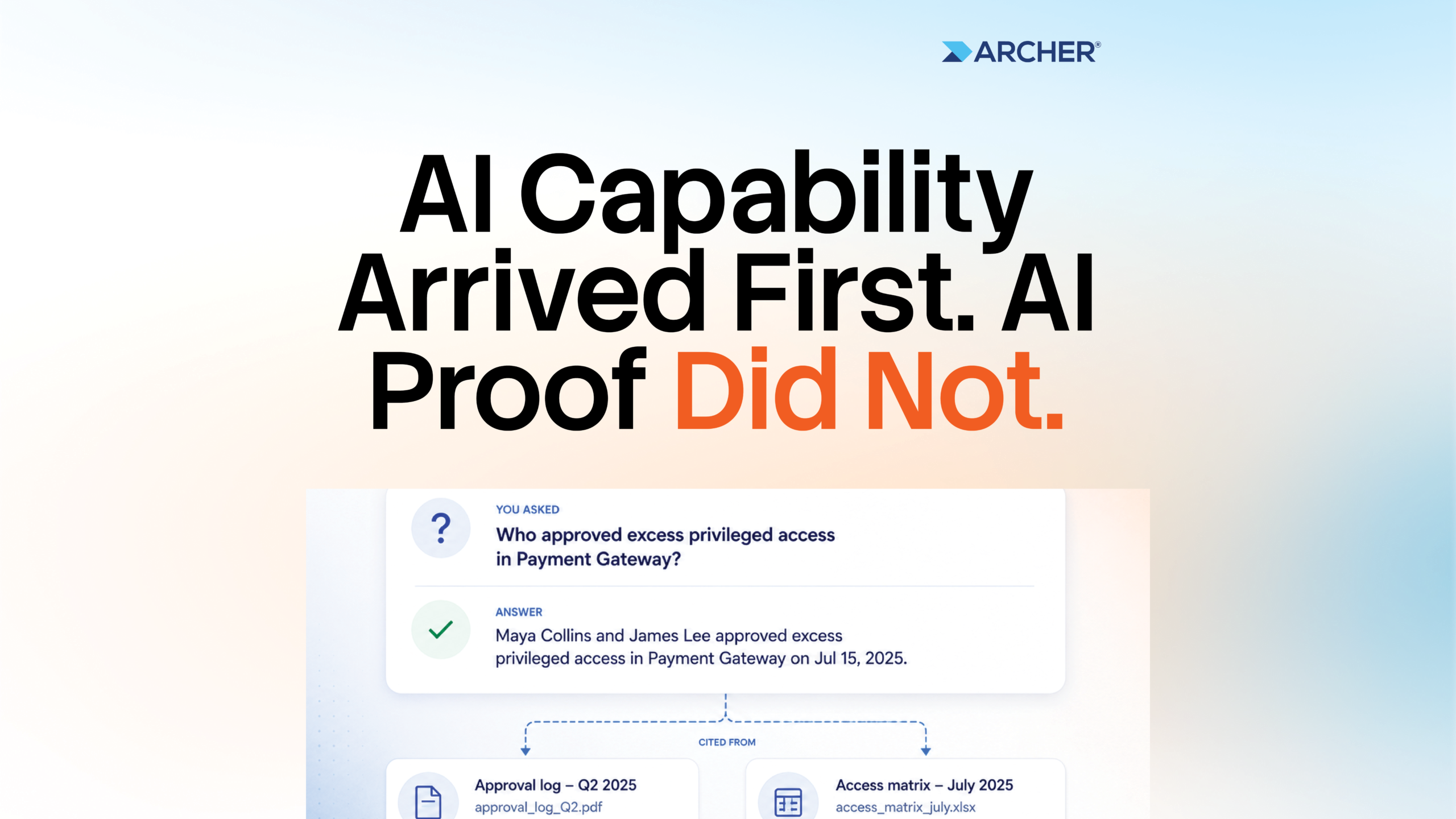
Read those three numbers together and the shape of the problem is clear. The capability showed up. The proof did not.
That gap is not a gap in model quality. The question facing a board is no longer whether AI will act on the company’s behalf. It is whether anyone can show the action was allowed. When a decision carries no assurance, the risk does not disappear. It moves onto someone’s desk.
Three desks, specifically.
- The Chief Risk Officer needs to know which risks changed before the board inquires.
- The Chief Compliance Officer needs to trace regulation to obligation to control to evidence before an examiner does.
- The Chief Information Security Officer needs visibility into what AI is running, what each agent can touch, and what evidence exists when one acts — the visibility CISA and NSA now recommend for every organization adopting agentic AI.
In the age of AI, risk, compliance and security are converging into one discipline. That discipline needs AI that understands the records, relationships and controls behind all three, and can be defended when it acts.
Act I: the job was already getting harder
A new regulatory change lands somewhere in the world every six minutes.
The pressure was mounting before agents entered the picture, and it was mounting on every front at once. Risk leaders are expected to see around corners as the business changes. Audit teams need to cover more of the enterprise without adding armies of auditors. Third-party teams are managing expanding ecosystems of suppliers, technology providers and partners. Compliance teams are trying to keep pace with regulations that change across jurisdictions, industries and markets.
The traditional answer has been more people, more workflows, more applications and more data. There is a limit to how far that model scales, and that limit is where AI creates another possibility.
Picture a risk manager starting the day with an AI colleague that has already reviewed changes across the risk environment and surfaced the risks that deserve attention. An auditor asks for the controls, evidence, prior findings and workpapers relevant to an engagement and begins with the context already assembled instead of spending days finding it. A third-party risk manager has thousands of vendors continuously examined for changes, inconsistencies and potential exposure, with the highest-priority issues routed for human review.
None of that requires a new system. All of it requires a governed one.
Act II: reliable agents are a harness problem
A model is not an employee. Between a capable model and dependable work sits a layer most enterprises have not built, and it is the layer that decides whether an agent can be trusted with a week of work. Call it the harness.
The harness is what holds long work together. It carries state across a task that runs for hours or days, so an Operator working through fifty thousand third-party records does not lose the thread halfway. The harness confines every action to a defined scope, so an Operator reads only what it is permitted to read and changes only what it is permitted to change. It reports the progress of each Operator it delegates to, so a supervisor can see what ran, what it touched and what remains open. And it does all of that through one orchestration path rather than a separate integration for every agent.
A general-purpose harness cannot do this job in GRC, because it does not know what any of the records mean. It cannot tell a control from an obligation, a finding from a remediation plan, or a third party from the same third party entered three different ways. It has no view of who owns a risk, which approval a change requires, or what evidence an examiner will ask for. Scope, in GRC, is not a permission string. It is a role inside a control environment.
That is why the harness has to be domain-specific. Archer built one for GRC, and it is built around three connected systems.
- System of record — Archer® GRC. The trusted enterprise environment connecting risks, controls, regulations, audits, third parties, evidence, workflows and the rest of the GRC context an organization has spent years assembling.
- System of intelligence — Archer Evolv™ Foundation. Shared AI capabilities that understand the context and relationships across that environment.
- System of outcomes — Archer Evolv™ Workplace. A marketplace of purpose-built AI Operators that function as digital full-time employees.
What Archer Evolv Foundation actually does
A digital workforce needs more than access to a large language model. It needs context, and Foundation supplies it in three specific ways.
- Ask the record. Anyone with permission asks any record, application or relationship a direct question in plain language. No report builder, no export, no specialist in the middle. The answer comes back in seconds. Every query honors the roles already configured in Archer, so a person sees only what they hold clearance to see, and one question can cross vendor risk, audit, policy and a custom application at once instead of returning a single silo’s slice.
- Answers with proof. Foundation checks each answer against a curated index of the organization’s own records and content, then returns the citation with it. A reviewer sees the source, not a guess, and opens the underlying record in one click. Foundation also writes plain-language summaries of dense records and applications inside Archer, so nobody copies text into another tool to read it.
- Records worth trusting underneath. A data-readiness layer runs continuously beneath both of those. It evaluates records against defined quality rules, scores completeness, consistency, standardization and timeliness, and shows exactly where records fall short. Operators then merge duplicate entries, flag vague free text that would fail a review, and reconcile values that drifted across applications. Every correction leaves a trail a person can inspect and undo.
That last piece is where most GRC AI efforts fail first, and it deserves its own section.
Every Operator follows the same five steps
Whatever domain an Operator works in, it runs the same build pattern.
- Gather. Pull the relevant records and context from Archer.
- Analyze. Interpret them against standards, obligations and prior work.
- Generate. Propose a finding, mapping, draft or plan.
- Approve. A named human reviews, edits or rejects it.
- Update. Write back to Archer with full traceability.
Step 4 is not configurable. Nothing writes back to Archer without a named person approving it, and there is no setting that turns the gate off.
Layered on top of that pattern is one adaptive loop that repeats in every domain: Listen for material change in the signals already moving through a process, Decide by classifying and ranking against standards and risk appetite, Act by drafting outputs and triggering governed execution inside Archer, Assure by confirming the result and producing audit-ready evidence with full lineage, and Learn by feeding outcomes back so the next cycle is sharper. There are Listen Operators, Decide Operators, Act Operators, Assure Operators and Learn Operators, everywhere.
Built since 2017, not bolted on last year
More than 22 million regulatory documents. More than 100 legal and regulatory experts who build and version-track them. 250 million GRC records. 492 purpose-built models reviewed by more than 100 domain experts. 8,000+ regulatory sources monitored continuously.
Those numbers answer a fair question: why would a GRC company be good at AI?
Archer has been the system of record for the world’s most regulated enterprises for 25 years. The AI is younger than that, but not much younger, and it did not start last year. The models, corpus and expert review that came with Compliance.ai have been in development since 2017, trained with experts in the loop on every result, and they now run across all of Archer.
As Bill Diaz, Chief Executive Officer of Archer, put it: “The models, data and experts that came with Compliance.ai now run across all of Archer. GRC teams do not need another AI tool sitting outside the way they work. They need AI that understands their business, was built responsibly from the start, and can be defended to their board.”
The difference that history makes is easiest to see in a narrow test. An Operator can only enforce an obligation that someone correctly identified from a regulation and mapped to a control, so Archer evaluated how reliably models determine the effective date of a piece of legislation. In published tests on regulatory date extraction and requirements traceability, raw LLMs with crafted prompts were wrong 56% to 88% of the time. Archer Evolv resolved 100% of the same set — not because the model never hesitates, but because low-confidence work routes to a human expert instead of shipping with no flag.
That is the whole distinction in one result. For productivity, an agent is sufficient. For control, only an Operator is defensible.
Act III: the workforce that becomes possible
Once the harness exists, hiring looks more like onboarding than installing.
A team selects the Operator that matches the work, defines what it can read, propose and change, and assigns the person responsible for its output. Every Operator is identity-bound through SAML or OIDC with SCIM 2.0 provisioning, scope-constrained to defined records and actions, and audit-emitting: every action writes a structured, immutable record. Outputs carry calibrated confidence and a justification, not just an answer. And because Operators run on a multi-provider model fabric, none of it is locked to a single LLM vendor.
From that point the Operator shows up in the work the way a new analyst would. It takes an assignment, does the volume, and routes what needs judgment to the person who owns the decision. And everything it did stays visible after the fact.
Supervision is lighter than people expect, because it is exception-based. A supervisor does not review every action an Operator takes. They review the exceptions it surfaces, approve the changes it proposes, and can see the record of everything it read. That is the same arrangement a manager already has with a capable analyst, and it is the reason the model holds at scale.
What is working today
Dozens of Operators are in production now across Foundation, Audit, Third-Party Risk, IT Risk and Operational Risk. A few make the pattern concrete.
- Third-party de-duplication reconciles the same vendor entered three different ways across procurement, assessments and older applications, then fills in the firmographic gaps.
- Control hygiene reads free-text fields against quality rules, names the field and the rule it failed, and shows the reviewer what compliant language looks like. Run daily across a portfolio, it returns roughly 15 hours a month to each reviewer and catches the wording a person skims past.
- Audit engagement renewal clones a prior engagement and assembles the controls, evidence, prior findings and workpapers before the auditor opens it.
- Obligation extraction and classification reads regulatory text and turns it into structured, classified obligations, with 95% extraction accuracy after expert review and no manual tagging.
- Guardrail conformance tests AI guardrails against an organization’s own controls and against codified regulation.
More arrive every week, with more than 200 expected by the end of 2026 and more than 500 by the end of 2027, across nine GRC domains.
The count matters less than what stays constant as it grows. Each new Operator inherits the governance of the ones before it: the same permissions, the same lineage, the same evidence trail. A workforce that scales without a new governance model for every hire is the only kind worth scaling.
Domains also climb the same four stages in the same order, because each depends on the trust and data the one before it builds. Core automation takes the manual task. Intelligence standardizes outputs at volume so reviewer variation drops out. Risk insight shifts from reactive to predictive, surfacing anomalies before they become findings. GRC orchestration coordinates across domains, so one control failure informs risk, audit and resilience posture at once.
Why record quality matters more now, not less
There is a catch. A digital workforce can only be as useful as the information it works with, and a GRC record can have an owner, pass every required workflow and show the correct status while containing very little useful information.
A risk description might say “various operational risks associated with the process.” A remediation plan might say “will address.” A vendor might exist as Meridian Logistics in procurement, Meridian Logistics Corp. in another application, and Meridian Logistics Incorporated in an older assessment.
Nothing is technically missing. The workflow is complete. But ask AI, or a person, to use those records to make a decision, and the weakness is obvious. A control that reads “controls are in place” clears a workflow gate and then fails an audit. This problem is not new. AI makes it more consequential.
Historically, finding these problems was expensive, because nobody wants an analyst reading thousands of control descriptions, risk narratives, audit findings, remediation plans and third-party records looking for weak language, inconsistencies or duplicates. So organizations clean data when something creates urgency: an audit, a regulatory request, a merger, a migration. Then normal work resumes and the data deteriorates again.
AI changes those economics, because software can continuously examine much larger populations of records than any team of analysts could. One Operator identifies unusually weak free text. Another surfaces likely duplicates. Usage analysis shows administrators whether a field is still serving a purpose. Whole applications can be examined for declining use or overlap with core capabilities.
Instead of asking people to inspect everything, AI identifies where human judgment is most valuable. Record quality turns from a periodic cleanup project into an operating capability.
A governed service the rest of the enterprise can call
The gap between capability and proof does not stay inside any one team’s tools, and it does not stay inside Archer’s walls either.
The enterprise does not run its agents in one place. Procurement is building agents to evaluate suppliers. Security is building agents to triage incidents. Legal is building agents to review contracts. IT is standing up agents to manage access and change. Each of those agents eventually needs the same thing: trustworthy risk context, the controls that apply, and the obligations behind them.
Foundation is built to answer that call. Rather than functioning only as a feature inside Archer’s own applications, it operates as a governed service other enterprise agents can invoke. It is Model Context Protocol aware and accessible through standard APIs, so an agent elsewhere in the business can ask for a governed decision in place and receive it with its evidence, carrying the same permissions, lineage and audit trail that govern work done inside Archer.
That is the difference between a platform built for this from the start and one adding it after the fact. A governed agent workforce is not one that only operates inside a single application. It is one that other agents can trust, because every answer still traces back to its source and stays inside the same boundaries of what it can read, propose and change.
What winning the next era actually takes
The organizations that win the next era of GRC will not be the ones that added AI features fastest. They will be the ones that did four harder things.
- Rethought how the work gets done, rather than adding AI on top of the workflow that already existed.
- Treated record quality as an operating capability instead of a cleanup project.
- Insisted that every AI action carry its scope, its lineage and its evidence.
- Put their people on the decisions that require judgment, and gave the volume to a digital workforce.
Doing those four things requires a foundation: a system of record that provides trusted context, an intelligence layer that can understand and work across it, Operators that turn that intelligence into action, and governance that keeps people in control.
Archer Evolv Foundation and Archer Evolv Workplace are available today on SaaS and on premises. Everything a customer has built in Archer stays exactly where it is, connected securely with no migration, permissions and audit trail intact. Additional announcements follow at Archer Summit 2026, September 14 to 17 in Orlando, Florida.
The future of GRC will not belong to whoever adds AI the fastest. It will belong to whoever can still answer for what their AI did, every time, without having to go look.