Regulatory timelines shift every year, deadlines move, and guidance evolves. Yet compliance teams often continue executing against a plan built for the old timeline.
The European Union’s Digital Omnibus entered into force on July 27, 2026, changing the implementation timeline for several provisions of the AI Act. Among the most significant changes, the requirements for certain high-risk AI systems covered by Annex III now apply from December 2, 2027, while requirements for high-risk AI systems embedded in regulated products covered by Annex I apply from August 2, 2028.
For a compliance team that spent months building an implementation plan around the original timeline, those new dates represent more than a scheduling update. If the program hasn’t been reviewed and adjusted yet, it’s still executing against a deadline that no longer exists.
This is one of the challenges we keep coming back to in The Signal, Archer’s series on GRC industry news and events. Regulatory change doesn’t stop at the point where a new rule or amendment is published. The real work begins when an organization has to understand what that change means for its existing obligations, controls and compliance activities. However, the recent changes of the EU AI act is an example of how complicated regulatory change can be.
Why “Deadline Moved” Is Not the Same as “Problem Solved”
A compliance team has spent the last year preparing for the original AI Act deadline. The work is solid: obligations identified, owners assigned, controls mapped, evidence already collected. Everything is structured, and the team has momentum. Then the deadline moves six months forward.
What has to change?
For one, your project schedule no longer aligns to the actual deadline. The internal milestones you built around the original date may no longer make sense now that the finish line shifted. The person responsible for implementation by the original deadline may not be available for the revised date. Your control mapping may also need to change, since extending the timeline could require a different implementation approach, additional resources, or a new owner.
Most critically: if your compliance program isn’t aligned to the regulation as it stands now, an examiner will ask why. A well-designed control and a sound implementation strategy don’t answer that question if you’re still executing against dates that don’t exist anymore. That gap between the moment the regulation changed and the moment your program adapted is where the real risk sits. Most compliance teams spend months in that gap without knowing it.
The Difference Between Monitoring Regulatory Changes and Managing Them
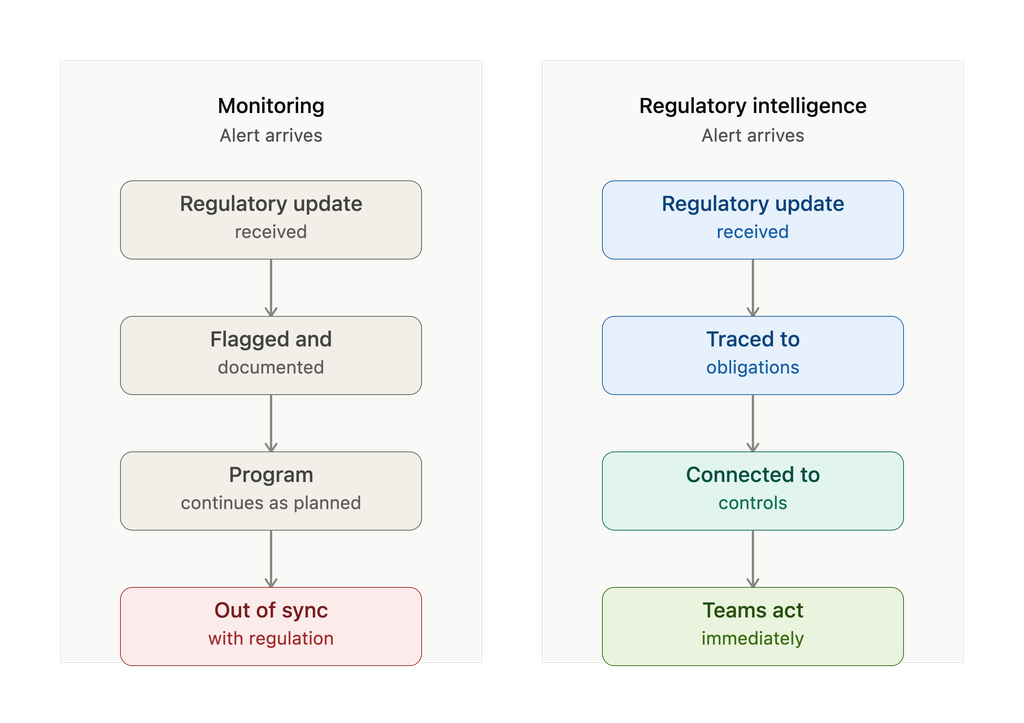
Someone monitors for changes: a regulatory alert arrives, a new rule gets published, or an implementation date moves. This is necessary work. But knowing that something changed is only the beginning of the problem.
The harder work starts when you need to translate that change into actionable decisions. When the EU AI Act deadline moves, your team must identify the specific obligations your organization manages, determine which controls the change affects, reassess timelines for work already underway, and check for conflicts with other regulatory programs. Most compliance teams can tell you when a regulation shifted. They struggle to tell you what that shift means for the work they’ve committed to.
Spreadsheets and email alerts flag updates. They don’t tell you which compliance controls a change affects, whether a new deadline collides with other programs, or whether your project schedule still holds. Manually reconciling a regulatory update against dozens of obligations spread across multiple jurisdictions becomes extremely difficult. This is where most organizations spend most of their regulatory time.
Why the EU AI Act Makes This Problem Visible
The Digital Omnibus amendment illustrates why regulatory change management is harder than most teams expect. Rather than one application date, the regulation staggers requirements across multiple timelines: August 2, 2026 for some requirements, December 2, 2027 for others, August 2, 2028 for still others. The EU continues issuing new guidance that clarifies what those requirements actually mean. Each clarification can shift your implementation plan, and each new deadline can conflict with work you’re already planning.
Most regulations work this way: timelines move, scope shifts, and guidance evolves continuously. Supervisory statements and enforcement actions clarify what requirements actually mean in practice. Related standards layer new requirements on top of explicit regulatory text. For a compliance team, regulatory change isn’t just about reading a new document. It requires understanding how that document connects to the obligations you’re already managing, what it changes about your existing controls, and what action you need to take.
Organizations that connect regulatory changes back to their compliance structures stay aligned. Those that don’t end up executing against outdated information, sometimes for months without realizing it.
Actionable Intelligence
Monitoring is a necessary starting point. You need reliable sources and a way to catch changes as they happen. But monitoring alone doesn’t answer the crucial question: what do I actually need to do about this change?
The gap closes when you connect every regulatory change directly to your compliance structure. When the EU AI Act timeline shifts, your team can immediately identify the affected obligations, trace them to the controls that address them, and pinpoint the internal projects that need attention. Rather than asking your compliance team to manually reconcile each regulatory update against their existing program, you get visibility into where the change actually matters and where it doesn’t.
That’s the difference between receiving a regulatory alert and having intelligence you can act on.
Archer Evolv™ is continously monitors that connection. The solution monitors regulatory sources, but it goes further: it identifies relevant changes and connects them directly to the obligations and controls your organization is managing. When a deadline moves or a requirement changes, your team sees immediately which parts of your program need attention. You stay aligned to the regulation as it stands now, not as it stood when you started.
If you’re managing regulatory obligations across multiple jurisdictions, see a demo of how Archer Evolv closes the gap between regulatory monitoring and regulatory intelligence.
This is part of The Signal, Archer’s series on GRC industry news and events. Read more about regulatory change management and what it takes to keep compliance programs aligned as requirements evolve in The Signal: September 2026.
Frequently Asked Questions
The EU Digital Omnibus entered into force on July 27, 2026, changing the implementation timeline for certain EU AI Act requirements. Requirements for certain high-risk AI systems covered by Annex III apply from December 2, 2027, while requirements for high-risk AI systems embedded in regulated products covered by Annex I apply from August 2, 2028. Organizations should review the applicable provisions and reassess their compliance plans to ensure they reflect the revised timelines.
Regulatory monitoring is receiving and cataloging regulatory updates. Your team gets an alert that the EU issued new guidance on the AI Act. You log it. You review it. You flag relevant pieces.
Regulatory intelligence is bidirectional. When new guidance arrives, you immediately trace it back to your specific obligations, understand which of your controls it affects, and know which owners and resources need to act. That connection transforms a regulatory alert into actionable information.
Archer Evolv™ continuously maintains that connection, so when a deadline moves or guidance changes, risk and compliance teams see the impact in real time instead of discovering it weeks later during a quarterly compliance review.
Archer Evolv™ monitors regulatory sources continuously and identifies changes relevant to your organization. When a deadline shifts or a requirement is clarified, the solution connects that change directly to the obligations and controls your program manages.
Your team sees which parts of your compliance program a change affects in real time, without waiting for an email alert or quarterly review. When the EU issues new AI Act guidance, you can quickly identify the systems and controls that need attention instead of spending days tracing the impact manually.
Archer Evolv™ shows you the connection between the new guidance, your specific obligations, and the controls addressing those obligations. Compliance teams know immediately what action is required and which owners need to respond. See a demo of Archer Evolv here.
Changes to EU AI Act deadlines can affect implementation schedules, assigned responsibilities, control mapping, resource allocation and evidence collection. Compliance teams should assess which obligations are affected, determine whether existing controls and projects remain appropriate, and update internal milestones to reflect the revised requirements. Failing to adjust a compliance program after a regulatory change can leave an organization working against outdated requirements.