
Governed AI, doing real GRC work.
An AI Operator is a governed agent built for one real job inside Archer: reading regulatory text, scoring a vendor, drafting a finding, watching for the next disruption. Every operator is identity-bound, scope-constrained, and audit-emitting.
-
9
GRC DOMAINS
-
221
OPERATORS ON THE ROADMAP
-
1
SHARED RUNTIME
-
5
STAGE ADAPTIVE LOOP
Most AI stops at drafting. Governance needs more than that.
The friction lands differently depending on the chair. A CISO owns the model-risk exposure. A CCO owns the obligations that don’t get met. A CRO owns the number that shows up in the board deck. A Head of Internal Audit owns proving all of it happened, on request, months later.
Useful isn’t the same as defensible.
Most of what a CISO has actually gotten approved into GRC programs stops at summarizing, drafting, or searching. It saves people time without changing the organization’s risk position. It’s useful. It isn’t defensible.
A log file isn’t an audit trail.
A regulator or examiner wants to know what the AI looked at, how it got there, who signed off, and where that’s written down. A log file an auditor assembles after the fact doesn’t answer that, and it’s the Head of Internal Audit who has to stand behind the gap.
A well-written wrong answer is still wrong.
Ask a general-purpose LLM a specific question about a regulation or a control design and the answer often reads well and is wrong. That’s not a risk a CCO can carry into an exam, and it’s the exposure a CRO ultimately has to quantify.
Governed digital workers, not another point solution.
Each AI Operator is bound to an identity, scoped to defined records and actions, supervised by a named human, and built for one specific piece of GRC work. Every run leaves a full audit trail. Underneath them sits a layer of Foundation operators handling the unglamorous part: keeping data clean, context current, and records complete enough that the work above holds up. Most GRC AI efforts fail here first.
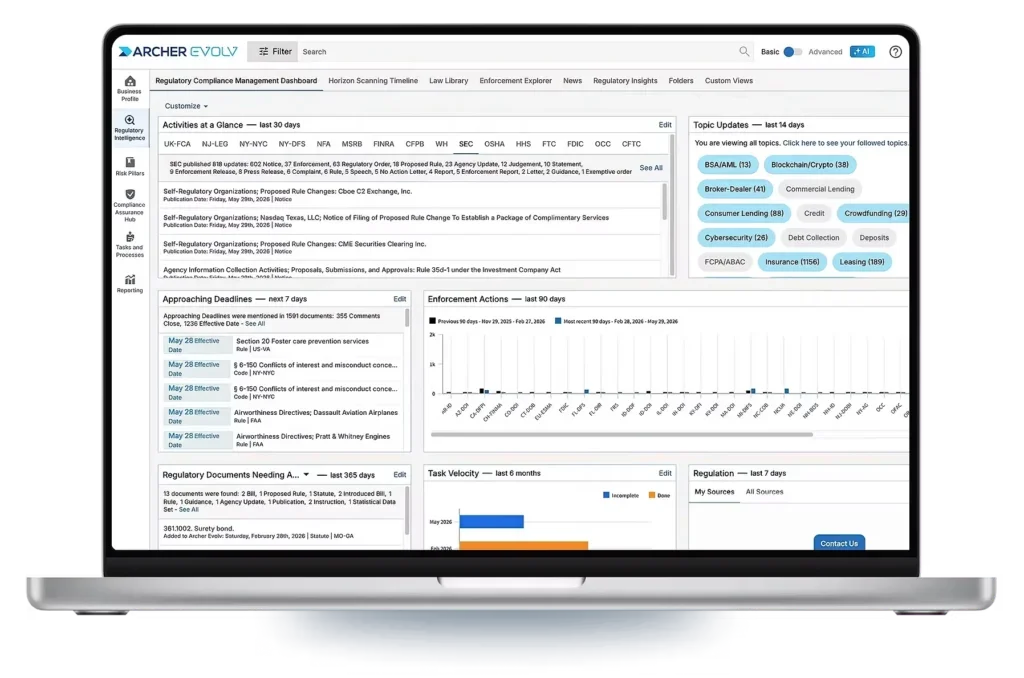
Operators deploy into the Archer environment your organization already runs. Nothing about how you run GRC has to change first. Every action writes back as a permanent, timestamped record, so the chain from recommendation through approval to final state stays in one place.
An operator is a member of your ecosystem rather than another console to log into. Controls move left into the build pipeline as compliance-as-code, checked before a workload ships instead of after audit finds the gap. The same operators serve second-line risk and third-line audit.
-
Explainable logic
Every decision carries its reasoning, so nothing is a black box.
-
Expert-in-control
A named human supervises every operator. Actions stay inside your approval gates, never around them.
-
Auditable actions
Full lineage on every change, from trigger to write-back.
The operators furthest along, not a full roadmap slide.
These are furthest along, with target availability dates between July and September 2026. Every one writes back into Archer, and every one stops for a human.
-
Domain onboarding
Maps processes to risks to controls for a given domain, aligned to the records you already hold.
RISK MANAGEMENT · FOR THE CRO -
Control generation & verification
Drafts controls, checks coverage, and flags gaps against the risk each control is meant to address.
COMPLIANCE · FOR THE CCO -
Guardrail conformance
Tests AI guardrails against your own controls and against codified regulation.
AI RISK MANAGEMENT · FOR THE CISO -
Reportable event review
Reads loss and incident records thematically and links what it finds back to the source record in Archer.
OPERATIONAL RISK · FOR THE CRO -
Controls assurance
Judges whether a control is effective against its risk, including cadence and evidence checks.
COMPLIANCE · FOR THE CCO -
Record and asset hygiene
Finds duplicate, orphaned, and vaguely worded records before an auditor does.
FOUNDATION · FOR THE HEAD OF INTERNAL AUDIT
Nothing writes back to Archer without a named human approving it.
There is no silent auto-approval, and no setting that turns the gate off.
In Practice
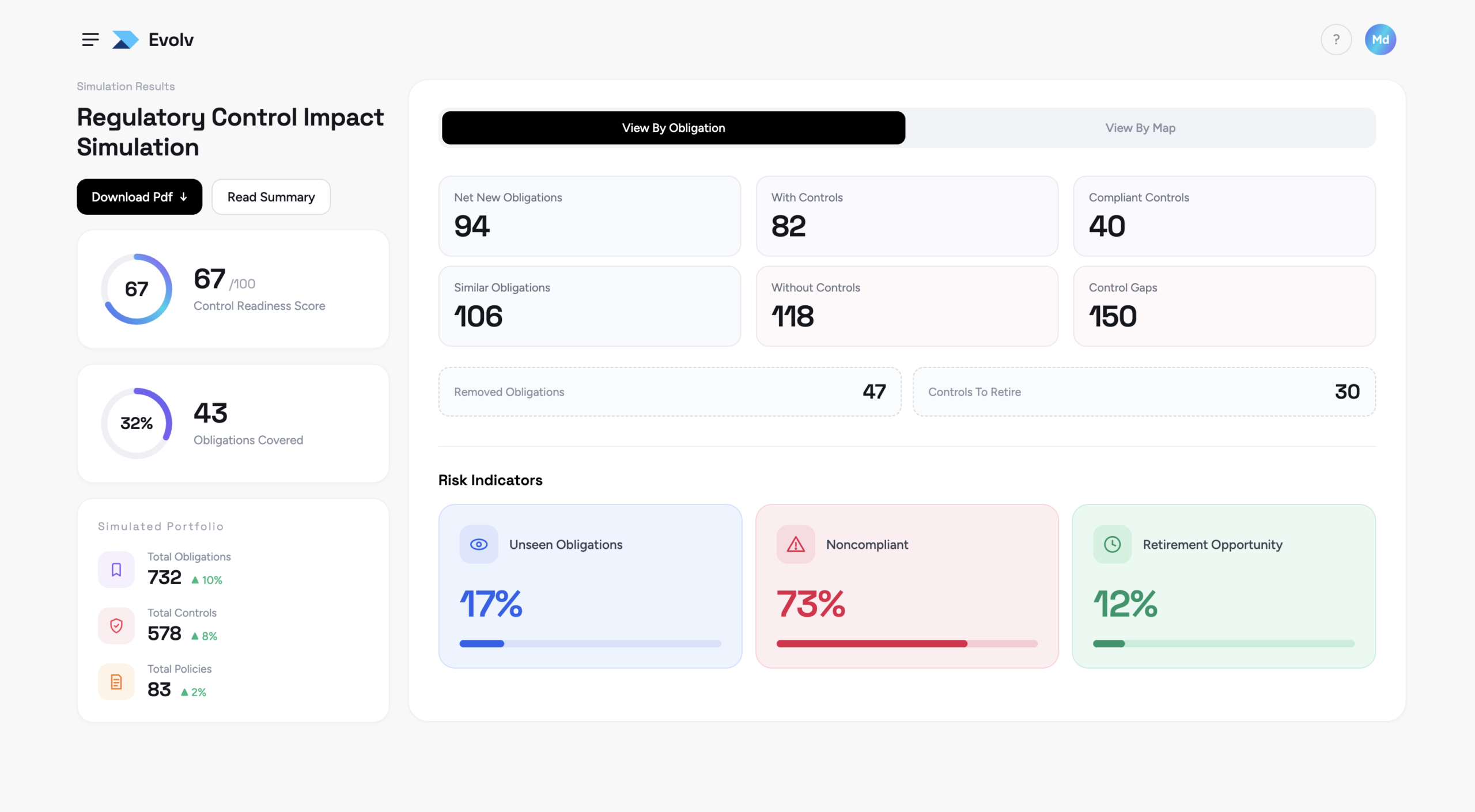
Record quality is the least glamorous problem in GRC and one of the most expensive. A control that reads “controls are in place” clears a workflow gate and then fails an audit. The hygiene operator reads free-text fields against quality rules, names the field and the rule it failed, and shows the reviewer what compliant language looks like. Run daily across a portfolio, it returns roughly 15 hours a month to each reviewer and catches the wording a person skims past.
Every operator, in every domain, follows the same five steps.
Plenty of vendors have one of these. The defensible position is having all three on the same foundation.
-
Gather
Pull relevant records and context from Archer.
-
Analyze
Interpret against standards and prior work.
-
Generate
Propose a finding, mapping, or plan.
-
Approve
A named human reviews, edits, or rejects.
-
Update
Write back to Archer with full traceability.
One adaptive loop, repeated in every domain.
Whichever domain an operator works in, it fills one stage of the same loop. There are Listen operators, Decide operators, Act operators, Assure operators, and Learn operators, everywhere.
-
1
Listen
Watch the signals already flowing through a process and catch material change early.

-
2
Decide
Classify and rank by impact and urgency against standards and risk appetite.

-
3
Act
Draft outputs, assign owners, trigger governed execution inside Archer.

-
4
Assure
Confirm the result and produce audit-ready evidence with full lineage.

-
5
Learn
Feed outcomes back to sharpen the operator for the next cycle.

Nine domains, one system underneath.
Compliance is live today and built the foundation everything else stands on. Every other domain is on the roadmap, instantiating the same loop on the same data. Below is a representative look at each, not the full roster, just enough to see the shape of what each domain does.
-
Top chip
IT Risk
From a static asset register to a living digital twin.
IT Asset Initiation
Pulls signals from CMDBs, scanners, and cloud tools into one complete asset profile.
Risk Scoring Assistant
Prioritizes IT risk by business impact and blast radius, not just severity.
Control Alignment & Evidence Sync
Keeps controls and their evidence tied to the assets they actually protect.
-
Top chip
Operational & Enterprise Risk
From static risk registers to continuous risk intelligence.
Emerging Risk Detection
Watches internal and external signals for new risk themes before they become incidents.
Scoring & Recalibration Assistant
Turns control failures into updated risk scores automatically, not on the next review cycle.
Treatment Orchestration & Rationale Packs
Builds the evidence pack and routes the treatment plan in one motion.
-
Top chip
Resiliency
From static continuity plans to continuous decisioning.
Dependency Graph Maintenance
Keeps a live map of critical services and what they depend on to recover.
Tolerance Breach Detection
Flags RTO/RPO conflicts and concentration risk before a disruption tests them.
Evidence & Regulator Pack Assembly
Assembles continuous, audit-ready resilience evidence for the board and regulators.
One data spine. One runtime. Every domain builds on top.
Compliance ships first because it builds the spine everything else reads from, the authoritative lineage of obligations, controls, business units, risks, and processes inside Archer. Every planned domain operator reuses that spine instead of rebuilding it, and all of them run on the same underlying engine.
Domain Operators · Planned 2026+
Audit, AI Risk Management, Third Party Risk, Policy Change Management, IT Risk, Operational & Enterprise Risk, Resiliency
run on
AI Operator Framework: The Shared Runtime
Signals already moving through Archer become governed outcomes on a schedule, inside your approval gates.
read & write
The GRC Data Spine: Built by Compliance, Live Today
Clean, connected lineage is what makes every downstream automation trustworthy.
Every domain climbs the same four stages.
Operators arrive in waves, not all at once, each stage depends on the trust and data the one before it builds.
-
1
Core Automation
Automate the manual task: roll forward an engagement, extract obligations, build a vendor profile.

-
2
Intelligence
Standardize outputs at volume: classification, scoring, and reusable templates remove reviewer variation.
-
3
Risk Insight
Shift from reactive to predictive: anomalies and emerging signals surface issues before they become findings.

-
4
GRC Orchestration
Operators coordinate across domains: one control failure informs risk, audit, and resilience posture at once.
Three pillars: The Combination No One Can Replicate.
Compliance, Risk, and Intelligence distinct solutions that share one data model, so obligations, controls, and signals stay connected end to end.
Built for GRC
Archer’s proprietary models are trained specifically on regulatory and GRC data, since 2017. Not adapted from general-purpose productivity tools.
526
PROPRIETARY MODELS
Contextual intelligence
Operators are grounded in the record your organization has already built in Archer: its controls, policies, findings, and workflows. A generic model has access to none of it. As more AI agents appear in more workflows, the same governance layer extends to cover them, so identity, audit trail, and approval gates are already in place instead of being rebuilt for each new agent.
25+
YEARS AS THE SYSTEM OF RECORD
Engineered for governance
Operators draft and recommend; a person decides. Every run is logged together with the evidence it relied on, which is what makes the output hold up in front of an auditor or an examiner.
100%
OF ACTIONS HUMAN-APPROVED BEFORE WRITE-BACK
Impressive in demos. Indefensible in audits.
The agents are useful. The agents are productive. Productivity without governance is exposure. Archer Evolv builds every digital worker inside the control environment, without slowing what it can do.
Generic AI agent
Here’s what you get
-
Foundation model with a prompt and discretion to call tools
-
No native identity binding or scope constraint
-
Outputs without calibrated confidence or justification
-
Locked to one LLM provider
-
26% to 94% error rates on domain-specific queries
Archer Evolv™ AI Operators
Here’s what you get
-
Identity-bound (SAML/OIDC + SCIM 2.0) and scope-constrained
-
Every action emits a structured, immutable audit record
-
Calibrated confidence and justification on every output
-
Multi-provider model fabric, no LLM vendor lock-in
-
Expert-in-the-loop supervision on every run
Grounded answers, tested against raw LLMs.
In published tests on regulatory date extraction and requirements traceability, raw LLMs with crafted prompts were wrong 56% to 88% of the time. Archer Evolv’s grounded approach held error under 5%, verified, cited, and traced.
Questions we hear
most often
No. Foundation is the base every domain runs on, then you add the specific domain Operators your team needs on top of it.
No. Every Operator is draft-and-recommend by design. Step 4 of the build pattern is a human approval gate, with no silent auto-approval, ever.
Compliance is available today. Foundation is the underlying layer it’s built on. Every other domain shown is planned, not yet delivered.
Independently recognized, not just self-described.
Archer is recognized as a Leader in the 2025 Gartner Magic Quadrant for GRC Tools and Assurance Leaders and in the 2025 Verdantix Green Quadrant for GRC Software, and earned a top score in Compliance Management in the Q2 2026 Forrester Wave for GRC.
-
About Archer
Archer’s GRC platform keeps some of the world’s most regulated enterprises ahead of constant regulatory change. More than 1,300 organizations run on Archer, including half the Fortune 500 and 37 of the top 50 global banks. More than 100 of them run Evolv Compliance today. That installed base is the foundation this operator architecture is built on.

Built for GRC. Engineered to be governed.
See how governed, audit-emitting AI Operators run inside the Archer platform you already trust as your system of record.