5 Critical Uses of AI for GRC
Regulations update every seven minutes globally. Enterprise data volumes double every eighteen months. More than 60% of risk leaders lack real-time visibility into emerging threats, and over 70% of GRC effort is consumed by manual tasks —mapping, evidence gathering, and reconciling data across siloed systems.
Whitepaper
Regulations update every seven minutes globally. Enterprise data volumes double every eighteen months. More than 60% of risk leaders lack real-time visibility into emerging threats, and over 70% of GRC effort is consumed by manual tasks —mapping, evidence gathering, and reconciling data across siloed systems. The answer is not simply throw the problem at AI. It must be the right kind of AI: domain-focused, governed, and built on the concepts, workflows, and evidence standards that define risk and compliance practice. This paper explores five critical uses of AI for GRC — and makes the case that specialization is not a feature. It is a requirement
Generic AI models are trained on broad datasets and can summarize, draft, and answer general questions.
Domain-focused GRC AI is built on risk and compliance-specific content, workflows, taxonomies, and evidence standards. The result is that generic AI produces plausible outputs, while domain- focused GRC AI produces outputs that are traceable, policy-aware, and defensible under regulatory and audit scrutiny.
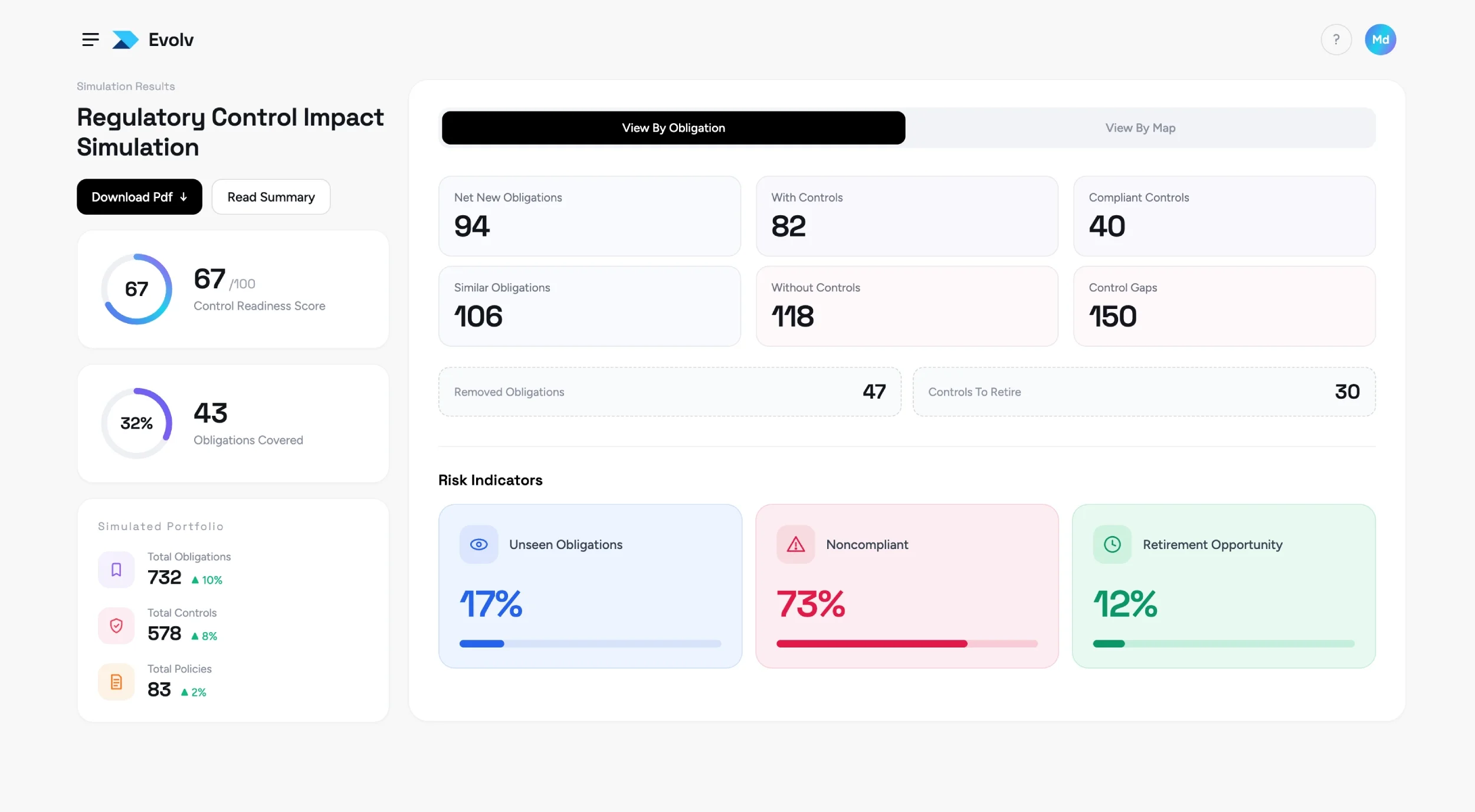
AI improves regulatory compliance by continuously monitoring regulatory sources for relevant changes, automatically assessing which obligations and controls are impacted, routing actions to the right owners with full context, and capturing evidence as a byproduct of execution. This transforms compliance from a periodic, reactive process into a continuous, proactive program.
GRC powered by AI can transition into an operating model where signals from the external regulatory environment and internal operations continuously drive governance actions. Rather than operating on annual cycles and quarterly reviews, this GRC strategy replaces calendar-driven governance with a continuous sense-and-respond loop: Listen, Decide, Act, Assure, and Learn. Archer Evolv is Archer’s AI intelligence layer designed to power this model at enterprise scale.
Yes, when it is designed correctly. Trustworthy AI in GRC must be explainable, traceable, and subject to human review at material decision points. Archer Evolv’s AI Operators maintain a full audit trail of every action taken, including the data used, the logic applied, and the human approvals obtained. This governance-by-design approach means AI outputs can be shown to regulators and defended in audits.
AI Operators are focused, auditable automations built into the Archer platform that perform specific GRC tasks with traceable inputs and outputs. They come in three types: Monitor Operators (detect and classify signals),
Workflow Operators (route work, capture evidence, and execute tasks), and Judgment Operators (apply consistent expert logic for classification and escalation). Every Operator includes a human- in-the-loop at material decision points.
About Archer
For 25 years, Archer has been a trusted leader in GRC innovation, providing global organizations with enterprise compliance and risk management solutions that combine artificial intelligence, risk intelligence, and integrated approaches to improve decision-making, strengthen regulatory compliance, and build resilience at scale. Learn more at www.archerirm.com