One common governance backbone can reduce rework, improve consistency, and help teams manage local requirements without starting over each time
Key Takeaways
- The EU AI Act can serve as a practical starting backbone for global AI governance because it translates AI oversight into classification, requirements, documentation, and lifecycle controls.
- A shared model reduces duplicate work when regional teams assess similar AI systems, vendors, or embedded AI capabilities.
- Local requirements still matter. They should be managed as overlays on top of the shared model, not as separate governance systems.
- The operating model should define inventory, intake, risk classification, review routing, control evidence, ownership, reporting, and refresh triggers.
- Archer can help connect global AI governance requirements to a live GRC workflow that supports accountability, evidence, and oversight.
What Is a Global AI Governance Model?
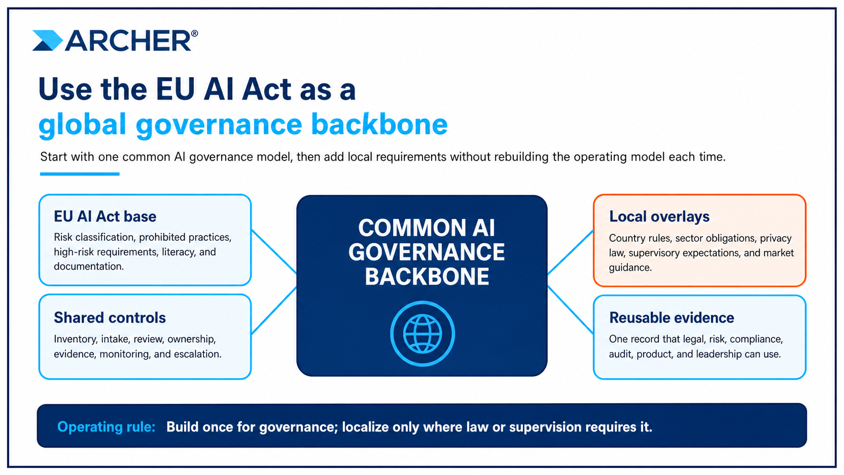
A global AI governance model is the common operating structure that an organization uses to govern AI systems across countries, business units, and risk domains — and the EU AI Act provides that structure with a practical, regulation-ready foundation. The goal is not to force every jurisdiction into a European template. The goal is to stop rebuilding the same governance capability each time a new regulation is introduced.
A global AI governance model is the common operating structure an organization uses to govern AI systems across countries, business units, products, and risk domains. It defines how AI use is identified, classified, reviewed, controlled, documented, monitored, and reported.
The need is practical. Global teams are often trying to solve the same problem through different frameworks. The Europe team works through the EU AI Act. US teams often use NIST language. Product and engineering teams want a review process that does not change completely every time a new market comes into scope. Legal and compliance teams need room for local interpretation.
When every region builds its own process, the organization gets more documents, more review paths, and more local spreadsheets, but not necessarily stronger oversight. Similar use cases may be classified differently. Evidence may be stored in different formats. Decision history may be hard to reuse. Incident response may slow down because ownership is unclear.
A better model starts with one shared governance backbone and adds local overlays where law, sector rules, regulator expectations, or market practice require more. The EU AI Act is a strong starting point because it gives organizations a structured way to think about AI scope, risk classification, prohibited practices, high-risk requirements, literacy, documentation, human oversight, transparency, and lifecycle management.
Why Does the EU AI Act Work as a Starting Backbone?
The EU AI Act is useful as a governance backbone because it translates the same questions every organization must answer — which AI uses are prohibited, which are high risk, what controls apply, and who is accountable — into a structured, enforceable framework with practical global reach. Other frameworks, such as NIST AI RMF, ISO/IEC 42001, and OECD principles, reinforce the same core logic and can be mapped into one operating model instead of being managed as disconnected projects.
The EU AI Act is useful as a governance backbone because it gives organizations a structured starting point for decisions they need to make anyway. Which AI uses are prohibited? Which uses are high risk? Which controls and records are needed? Who must understand the system? What information needs to be available when a regulator, auditor, or customer asks for evidence?
The Act also has practical reach for global organizations. Article 2 covers providers, deployers, importers, distributors, product manufacturers, authorized representatives, and affected persons in the Union, and it can apply where the output produced by an AI system is used in the Union [*1]. That means many organizations outside Europe cannot treat the Act as a purely regional matter.
The implementation timeline also turns this from a future-facing policy topic into an operating-model issue. General provisions, including AI literacy, and prohibitions entered into application on 2 February 2025. General-purpose AI rules began applying from 2 August 2025, and the broader roll-out continues in stages through 2 August 2027 [*2].
The Act is not the only framework an enterprise should care about. NIST AI RMF provides a voluntary risk management structure organized around Govern, Map, Measure, and Manage [*5]. ISO/IEC 42001 provides requirements for establishing, maintaining, and continually improving an AI management system [*4]. OECD principles reinforce trustworthy AI, human rights, democratic values, and accountability [*6]. The practical point is that these frameworks can be mapped into one governance operating model instead of being managed as disconnected projects.
A common backbone is valuable because the same core questions keep appearing across frameworks: what AI system exists, why is it used, who owns it, what risks does it create, what controls apply, what evidence exists, what changed, and who is accountable for decisions.
Why Does Fragmented Regional Governance Create Risk and Rework?
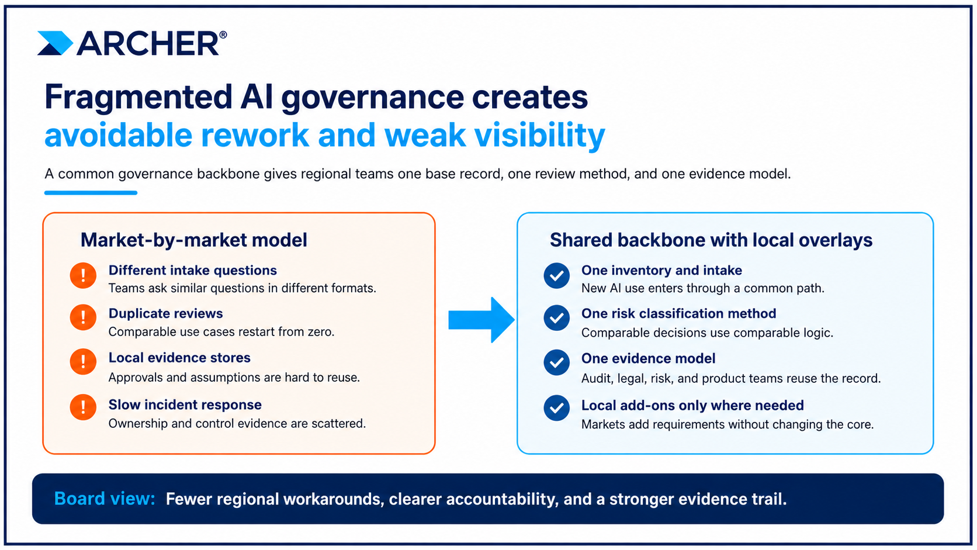
Fragmented AI governance often looks reasonable at first — each region builds what it needs, and each action is sensible in isolation. The risk becomes visible at scale when similar AI systems are reviewed differently, evidence is stored in incompatible formats, and no one can quickly show leadership what the enterprise’s exposure actually is.
Fragmented AI governance often looks reasonable at first. A region sees a new requirement and builds a local process. A business unit creates a review checklist. A product team documents its own controls. A privacy team stores its assessment in a separate location. Each action may be sensible in isolation.
The weakness appears when the business scales. One region reviews an AI contract analysis tool. Another region reviews a similar tool six months later and starts from zero. A vendor adds an AI feature to a platform already used globally, but only one local team notices. A model issue surfaces, and no one can quickly show which business units use similar capabilities or whether the same control weakness exists elsewhere.
This is not simply a documentation problem. It is an operating model problem. When intake, classification, approval, evidence, and reporting differ by region, leadership cannot easily compare risk across the enterprise. Audit cannot rely on one evidence model. Legal cannot reuse prior analysis efficiently. Product teams face slower reviews without necessarily receiving clearer guidance.
A shared governance model changes the sequence. A use case enters one intake path. It is classified using a common method. The classification drives review routing, control expectations, documentation requirements, and approval conditions. Local teams add what their market requires, but the enterprise keeps one reusable record of the decision.
What Should the Common Backbone Include?
A common governance backbone should be small enough to operate consistently and strong enough to support legal, risk, privacy, security, product, audit, and board oversight. It should not be a theoretical policy architecture. It should be a working workflow with owners, thresholds, records, review points, and reporting — built around six capabilities that convert regulatory expectations into a repeatable process.
A common governance backbone should be small enough to operate consistently and strong enough to support legal, risk, privacy, security, product, audit, and board oversight. It should not be a theoretical policy architecture. It should be a working workflow with owners, thresholds, records, review points, and reporting.
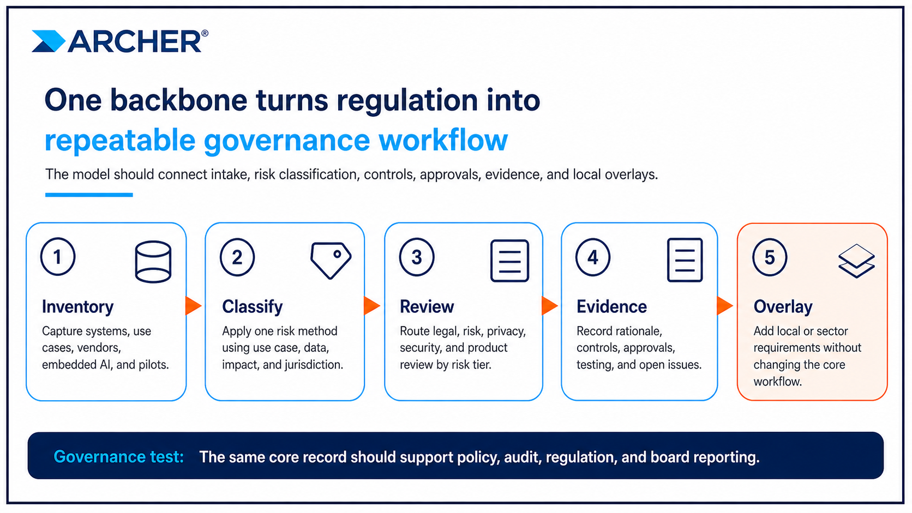
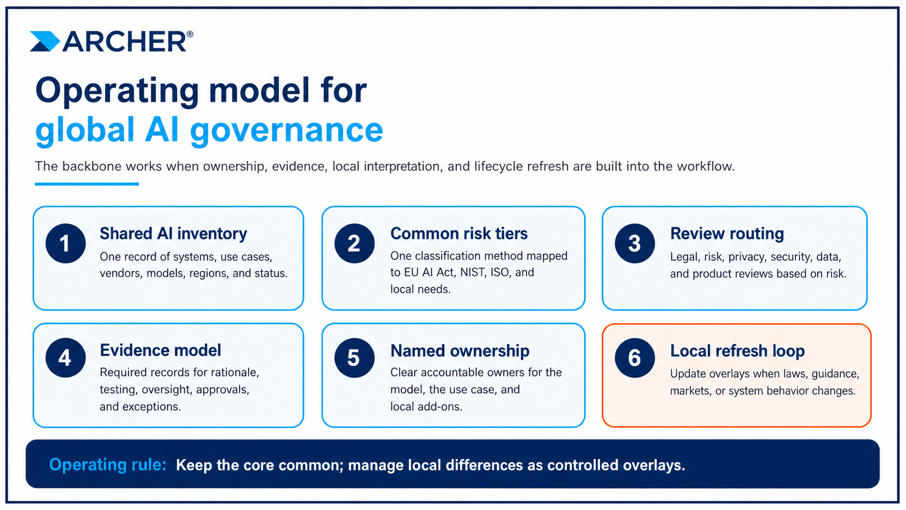
The backbone usually needs six capabilities. First, an AI inventory that captures systems, use cases, vendors, embedded AI features, copilots, agents, and pilots. Second, one risk classification method that can map to the EU AI Act and other frameworks. Third, an intake and review workflow that routes the right reviews based on risk tier and jurisdiction. Fourth, a control and evidence model that records what was reviewed, why decisions were made, what controls apply, and what exceptions remain open. Fifth, clear ownership across business, technology, legal, compliance, privacy, security, and risk. Sixth, refresh triggers so the record changes when the system, vendor, data, use case, law, or guidance changes.
The important design choice is to separate the common base from the local overlay. The base should be reused across markets. The overlay should capture what a jurisdiction, sector, regulator, or customer requires beyond the base.
| Governance element | Common backbone | Local overlay |
| AI inventory | One record of systems, use cases, owners, vendors, data, regions, and status. | Add market-specific fields, regulator references, or sector requirements. |
| Risk classification | One risk-tier method using use case, impact, data sensitivity, and affected groups. | Map local categories or thresholds without changing the core risk logic. |
| Review workflow | One intake path and review routing for legal, privacy, security, risk, and product teams. | Add regional approvals where law, regulator guidance, or sector rules require them. |
| Evidence model | One set of records for rationale, testing, controls, oversight, approvals, exceptions, and incidents. | Add local evidence artifacts such as notices, impact assessments, filings, or translations. |
| Reporting | One enterprise view for leadership, audit, issue tracking, and board oversight. | Add market views for local management, supervisory response, and remediation tracking. |
How Should Local Overlays Work?
Local overlays are not exceptions to governance — they are controlled additions to a common model. That distinction matters. An overlay adds a requirement because the market needs it, not because no one agreed on the base process. When discipline holds, the overlay layer makes the model more useful without replacing it.
Local overlays are not exceptions to governance. They are controlled additions to a common governance model. That distinction matters. A local overlay should add a requirement, field, review, approval, document, or reporting view because the market needs it. It should not create a parallel process unless there is a strong legal or operational reason.
For example, a high-impact HR AI system may need common intake, inventory, risk classification, model information, vendor information, human oversight, testing evidence, and issue tracking. A local overlay may add a specific notice requirement, works council consideration, language requirement, privacy impact assessment field, customer disclosure, or regulator-facing evidence summary.
The overlay model helps organizations move faster without losing control. Regional legal teams keep the authority to interpret local law. GRC keeps the workflow, evidence model, and enterprise view coherent. Business and product teams get one path to follow, not a different governance maze for every country.
The hardest part is discipline. Teams need to agree that local additions must be documented, owned, reviewed, and periodically refreshed. Otherwise, the overlay layer becomes another form of fragmentation.
| Planning implication: Treat the global AI governance model as a controlled operating model. Local add-ons should have owners, rationale, effective dates, review cycles, and links to the law, regulator guidance, or business requirement that created them. |
Who Should Own the Governance Backbone?
Ownership is often the barrier. No single function can govern AI effectively alone, but the enterprise still needs one accountable owner for the operating model — typically in GRC or enterprise risk, working closely with legal, privacy, security, data, product, and business leadership. The role is not to approve every AI decision. It is to keep the system coherent.
Ownership is often the barrier. Legal teams own interpretation. Product teams own product decisions. Security and privacy teams own specific control domains. Risk and compliance teams own governance expectations. Business leaders own outcomes. No single function can govern AI effectively alone.
The enterprise still needs one accountable owner for the operating model. In many organizations, that role sits naturally in GRC or enterprise risk, working closely with legal, privacy, security, data, product, procurement, internal audit, and business leadership. The reason is practical: GRC is usually closest to workflows, controls, evidence, issues, policy, and reporting.
The governance owner should not try to approve every AI decision. The role is to keep the system coherent. That means maintaining inventory, defining the common risk method, coordinating review routing, ensuring evidence quality, managing policy-to-control mapping, tracking issues and exceptions, and giving leadership a reliable view of AI exposure.
Boards and executive committees do not need every prompt, every experiment, or every technical detail. They need confidence that material AI use is visible, classified, owned, controlled, and refreshed as risk changes.
How Do You Build the Governance Backbone? Six Steps for 2026
For 2026 planning, risk and compliance leaders should treat the governance backbone as part of the AI governance control environment — with one inventory, one classification method, one intake workflow, a structured evidence model, deliberate local overlays, and continuous refresh. The objective is governance effectiveness, not training completion.
1. Start with one AI inventory. Capture internal systems, vendor AI, embedded SaaS features, copilots, agents, pilots, and known shadow AI. Include business owner, region, data categories, use case, vendor, status, and review date.
2. Define one classification method. Map use cases by risk tier, impact, data sensitivity, affected groups, human oversight needs, and relevant jurisdiction. Make the method explainable enough for business teams to use.
3. Create one intake and review workflow. Route reviews based on risk tier and context. Bring in legal, privacy, security, product, procurement, risk, and compliance only where their review is relevant.
4. Build the evidence model. Define the required records for each risk tier: decision rationale, testing evidence, control mapping, vendor assurance, human oversight, approvals, exceptions, incidents, and remediation.
5. Add local overlays deliberately. Document each local addition and keep it linked to the market, regulation, sector rule, supervisory expectation, or customer requirement that created it.
6. Refresh the model continuously. Trigger reassessment when AI systems change, vendors release new AI capabilities, laws or guidance change, issues occur, or business use expands into new markets.
Building a Global AI Governance Model with Archer
Archer helps organizations turn AI governance from a set of regional projects into a connected GRC operating model. The priority is to connect AI inventory, risk classification, control requirements, evidence, vendor assurance, issues, exceptions, and reporting in one place.
That gives teams a practical way to use the EU AI Act as a starting backbone while still managing local requirements. A use case can be captured once, classified consistently, routed to the right reviewers, linked to controls, assigned to owners, and tracked through lifecycle changes. Local overlays can be added without losing the enterprise view.
This approach gives leadership a stronger basis for oversight. Instead of asking each region for a separate update, leaders can see where material AI use exists, what risk tier it carries, what controls are in place, what evidence exists, and what needs attention.
Learn more about Archer AI Governance: https://www.archerirm.com/ai-governance
Learn more about Archer GRC Solutions: https://www.archerirm.com/
FAQs
Why use the EU AI Act as a global AI governance starting point?
The EU AI Act gives organizations a structured way to classify AI systems, identify prohibited and high-risk uses, define documentation expectations, and connect AI governance to lifecycle controls. For global organizations, that structure can become a practical base even when local requirements differ.
Does a global governance model replace local legal interpretation?
No. A global model provides the common foundation. Local legal, regulatory, sector, and supervisory requirements should be managed as overlays so the organization maintains consistency while respecting market-specific obligations.
How does NIST AI RMF fit with this approach?
NIST AI RMF can help structure risk management through Govern, Map, Measure, and Manage. Those functions can be mapped into the same operating model used for EU AI Act readiness, especially around accountability, risk mapping, measurement, and risk treatment.
How does ISO/IEC 42001 fit with this approach?
ISO/IEC 42001 supports an AI management system approach. It helps organizations establish, maintain, and continually improve policies, processes, and governance structures for responsible AI use. That makes it a useful complement to a global AI governance backbone.
What should be common across all markets?
The core inventory, risk classification method, intake process, evidence model, ownership structure, issue process, and reporting logic should be common wherever possible. Local requirements should add fields, documents, approvals, or reporting views only where needed.
How can Archer support a global AI governance model?
Archer can help connect AI inventory, assessment, control mapping, vendor assurance, workflow, issue tracking, evidence, and reporting in a structured GRC model. That supports both enterprise consistency and local governance overlays.
Sources
[*1] AI Act Service Desk, Article 2: Scope: https://ai-act-service-desk.ec.europa.eu/en/ai-act/article-2
[*2] AI Act Service Desk, Timeline for the Implementation of the EU AI Act: https://ai-act-service-desk.ec.europa.eu/en/ai-act/timeline/timeline-implementation-eu-ai-act
[*3] European Commission, AI Literacy Questions and Answers: https://digital-strategy.ec.europa.eu/en/faqs/ai-literacy-questions-answers
[*4] ISO, ISO/IEC 42001:2023 Information technology – Artificial intelligence – Management system: https://www.iso.org/standard/42001
[*5] NIST, Artificial Intelligence Risk Management Framework 1.0: https://www.nist.gov/itl/ai-risk-management-framework
[*6] OECD, AI Principles: https://oecd.ai/en/ai-principles