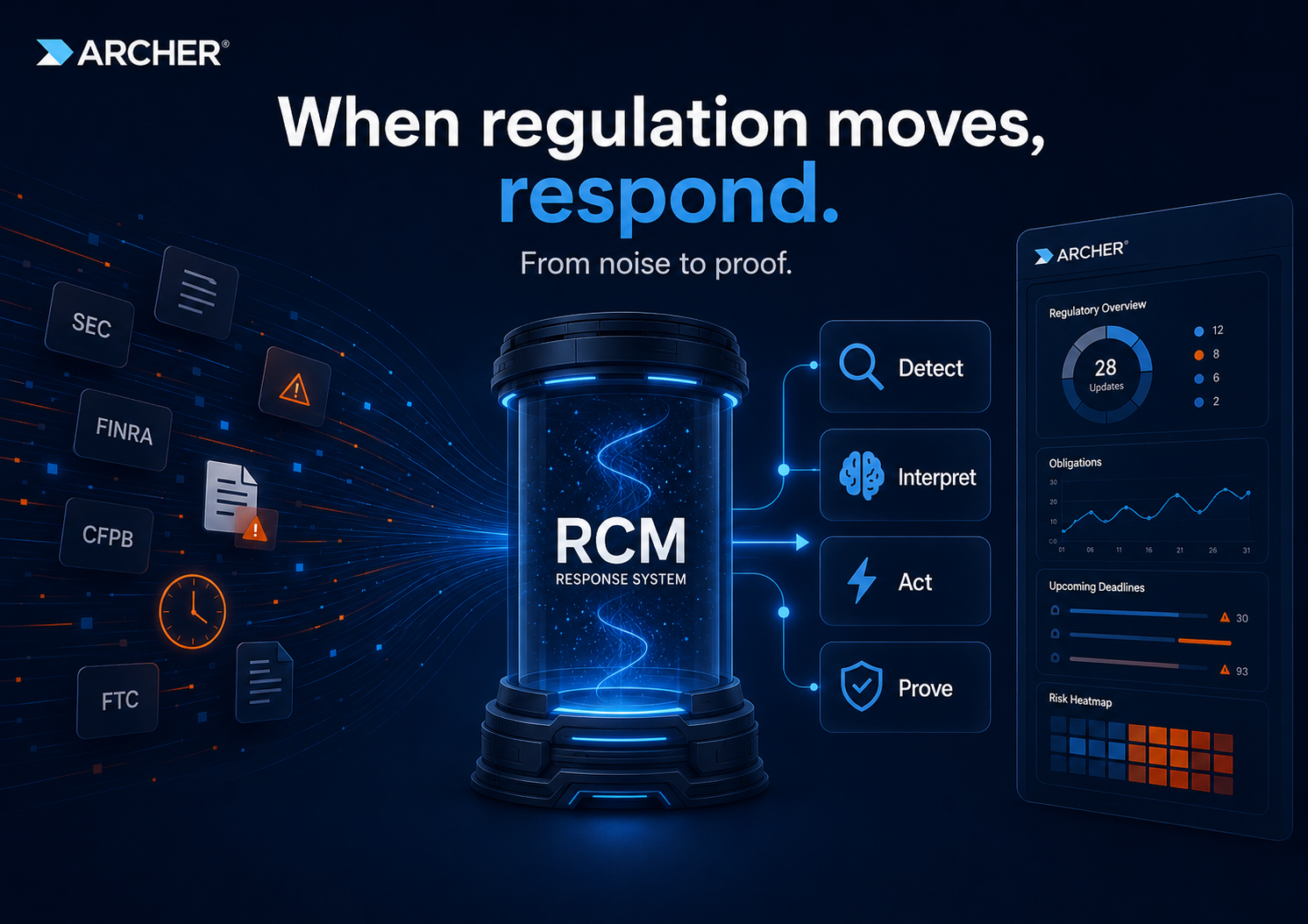

Regulatory change management (RCM) is the continuous discipline of detecting regulatory change at its source, interpreting it into specific obligations, and operationalizing those obligations through policies, controls, and evidence before deadlines hit. It allows organizations to anticipate regulatory shifts, maintain compliance, and avoid penalties while reducing firefighting and enabling growth.
What is regulatory change management?
Regulatory change management (RCM) is the systematic process of identifying relevant changes in laws, regulations, and guidance; interpreting them into concrete obligations; updating policies, controls, and processes; and maintaining audit‑grade evidence that those obligations have been met. It transforms regulatory updates from ad hoc reactions into a structured, repeatable discipline.
You can think of RCM as your organization’s early warning and response system for regulatory shifts. Instead of scrambling when a new rule takes effect, you detect changes at the source, assess their impact, and implement aligned controls before effective dates arrive.
Why does regulatory change management matter now?
The pace and complexity of regulatory change have reached a structural inflection point, with regulators publishing updates faster than most teams can track manually. In a 2025 Regology survey, 92% of compliance professionals reported their roles have become more difficult due to regulatory volume and velocity, and 77% said they still rely primarily on manual processes.
The stakes are concrete:
- Financial services organizations confront overlapping updates across Basel IV capital rules, SEC disclosure mandates, CFPB rulemaking, and state‑level consumer protection laws, often with similar or conflicting effective dates.
- Healthcare organizations juggle HIPAA amendments, FDA digital health guidance, CMS reimbursement rule changes, and accreditation standards simultaneously.
- Any organization deploying AI now faces new obligations under regimes such as the EU AI Act, NIST AI Risk Management Framework, and emerging state‑level AI governance laws.
Without an effective RCM program, organizations experience systemic latency between when a regulation changes and when a control reflects that change is the exact gap regulators and auditors look for.
What is the difference between regulatory change management and regulatory compliance?
Regulatory compliance and regulatory change management are related but distinct.
| Dimension | Regulatory compliance | Regulatory change management |
| What it addresses | Meeting current regulatory requirements | Tracking and implementing new or updated requirements |
| Time orientation | Present state | Future‑to‑present state |
| Primary output | Attestations, evidence, and reports | Updated policies, controls, and implementation plans |
| Typical trigger | Ongoing operations or audit cycles | Regulatory publication, guidance, or enforcement events |
Regulatory compliance is the destination by demonstrating that obligations are currently being met.
How does the regulatory change management process work?
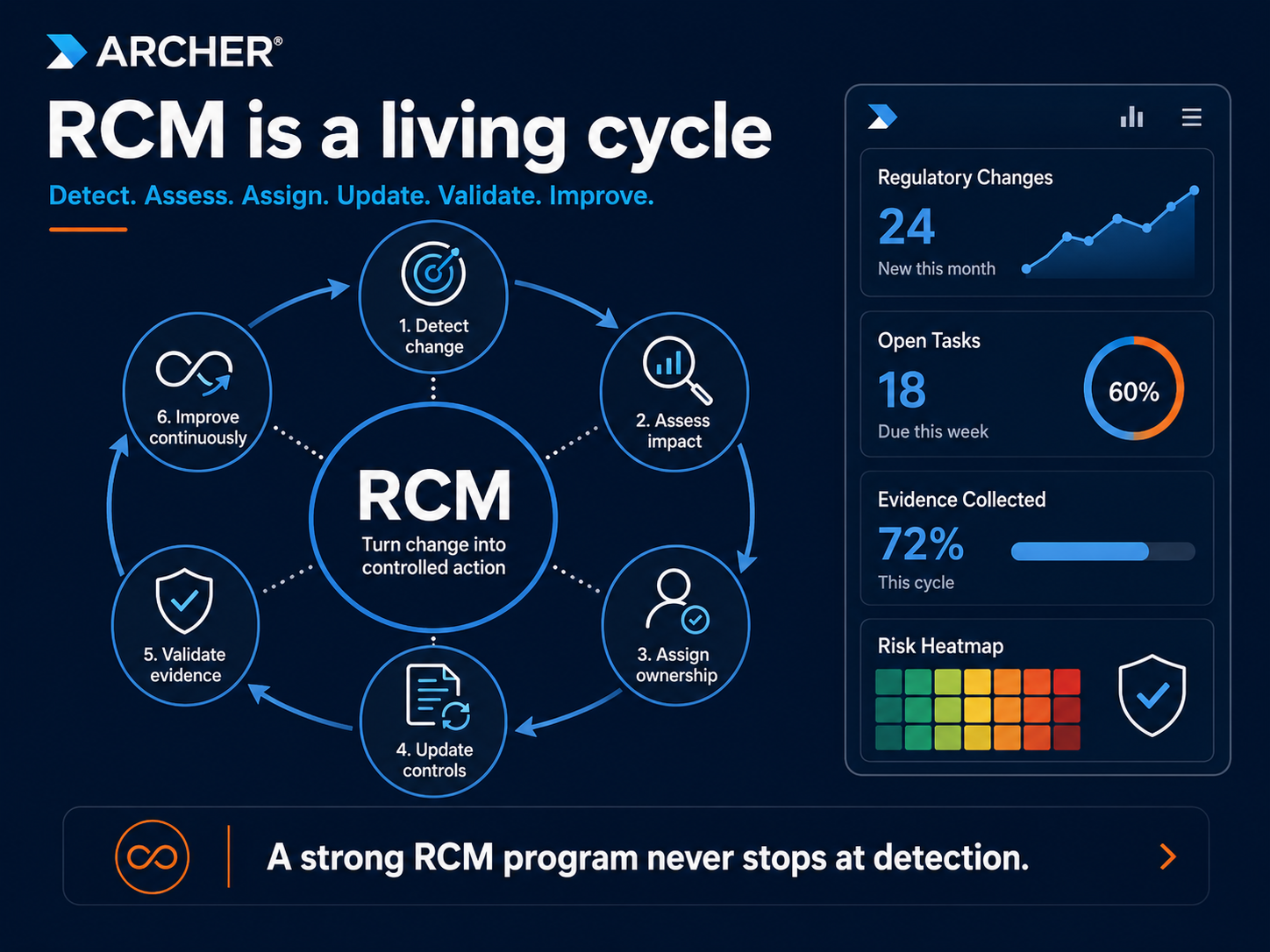
Effective regulatory change management programs follow a structured lifecycle, regardless of industry or regulatory domain.
Step 1: How do you detect regulatory change at the source?
RCM begins before a regulation is finalized by monitoring proposed rules, comment periods, enforcement actions, and legislative activity, not just final rules. Organizations track federal and state regulators, international bodies, industry associations, legal advisories, and AI‑powered regulatory intelligence feeds that aggregate and classify updates in near real time.
Relying solely on email alerts and manual website checks means that regulatory change arrives late, filtered through inconsistent human judgment, and unevenly distributed across teams.
Step 2: How do you assess the impact of a regulatory change?
Once a change is identified, the critical question is: “What does this require of us specifically?” Impact assessment maps the change to affected business units, processes, systems, and existing policies and controls. It also evaluates materiality, urgency, and required implementation timelines relative to effective dates.
A structured impact assessment framework prevents two common failure modes: treating every change as equally urgent, which overwhelms teams, or overlooking seemingly minor changes that carry significant risk.
Step 3: Who owns regulatory change inside the organization?
Regulatory change typically spans legal, compliance, risk, IT, operations, finance, and HR. Effective programs assign a named change owner responsible for driving implementation, contributing stakeholders in each impacted function, and escalation paths for high‑priority or board‑relevant changes.
Clear ownership and governance distinguish programs that merely document responsibilities from those that reliably implement them.
Step 4: How are controls, policies, and procedures updated?
Implementation translates regulatory requirements into operational changes: revised policies, updated control language, modified workflows, new training, and system configuration updates. Programs must coordinate across functions when one regulation touches multiple departments and manages effective dates, including phased implementations.
If your system of record for controls and policies is fragmented or outdated, implementation changes may not propagate accurately across the environment.
Step 5: How is compliance documented and validated?
Every action taken in response to a regulatory change should leave an evidence trail. Validation activities include control testing, management attestations confirming completion, and internal audit reviews for high‑risk or material changes.
Audit‑grade lineage, tracing from regulatory publication to obligation interpretation, control implementation, and evidence, is what regulators, auditors, and transaction counterparties examine during reviews.
Step 6: How do you monitor and continuously improve?
RCM is a continuous discipline rather than a project with an end date. After implementation, organizations monitor for subsequent guidance, FAQs, or enforcement actions that may refine earlier requirements, and they periodically reassess controls for effectiveness as the business environment changes.
Key metrics include time from regulatory publication to control implementation, the percentage of changes implemented before the effective date, and audit findings attributable to RCM gaps.
Core components of an RCM program
Regardless of size or industry, effective regulatory change management programs share several foundational elements.
- Regulatory intelligenceA structured capability to identify, capture, and triage regulatory developments across all relevant jurisdictions and bodies. This includes horizon scanning, automated feeds, and classification of changes by topic, jurisdiction, and impact.
- Impact assessment frameworkA repeatable methodology for evaluating how a regulatory change affects operations, controls, and risk posture, using consistent criteria for severity and scope.
- Workflow and ownership infrastructureDefined processes and tools for routing changes to owners, tracking implementation status, and escalating issues when deadlines or risk thresholds are at risk.
- Policy and control alignmentMechanisms to update internal policies, procedures, and controls to reflect new requirements, including version control and linkage between regulatory sources and internal control language.
- Documentation and audit trailComprehensive records demonstrating that the organization identified the change, assessed impact, implemented updates, and validated compliance, including evidence repositories and reporting dashboards.
- Obligations and requirements libraryA centralized catalog of applicable regulatory and non‑regulatory requirements that serves as a single source of truth, replacing scattered spreadsheets and email threads.
Common challenges in regulatory change management
Even organizations with dedicated compliance teams struggle with RCM.
- Volume and velocity of change: The number of regulatory publications across jurisdictions exceeds what manually resourced teams can monitor comprehensively.
- Interpretation complexity: Regulatory language is often ambiguous, and inconsistent interpretation across business units leads to gaps auditors can exploit.
- Multi‑jurisdictional and cross‑border complexity: Requirements may overlap, conflict, or diverge across regulators, complicating global compliance strategies.
- Organizational silos: Regulatory change affects multiple functions simultaneously; without structured workflow, changes stall at functional boundaries.
- Evidence fragmentation and weak traceability: Documentation spread across shared drives, emails, and local files makes it difficult to prove that a specific control satisfies a specific obligation.
- AI and emerging technology obligations: Existing RCM infrastructure may not be designed to track AI‑specific regulations, new monitoring sources, and new control types.
Manual vs automated regulatory change management
The choice between manual and automated approaches significantly affects scalability and risk.
| Dimension | Manual approach | Automated approach |
| Regulatory monitoring | Fragmented email alerts, manual website checks, periodic legal briefings | Continuous feeds across 100+ sources, AI‑assisted classification and relevance filtering |
| Impact assessment | Analyst judgment in spreadsheets; inconsistent taxonomy | Automated mapping to policies, controls, and business units; structured scoring of impact and urgency |
| Workflow execution | Email‑based task assignment; status tracked in spreadsheets | Platform‑driven task routing, centralized status tracking, automated escalations |
| Audit trail | Documents scattered across inboxes and shared drives | Centralized, timestamped evidence chain from regulatory source to control implementation |
| Scalability | Breaks under volume; new regulatory domains require proportional headcount | Scales across jurisdictions and domains without linear resource increases |
| Time to implementation | Weeks to months; higher risk of missing effective dates | Days to weeks; automated deadline tracking with early warning |
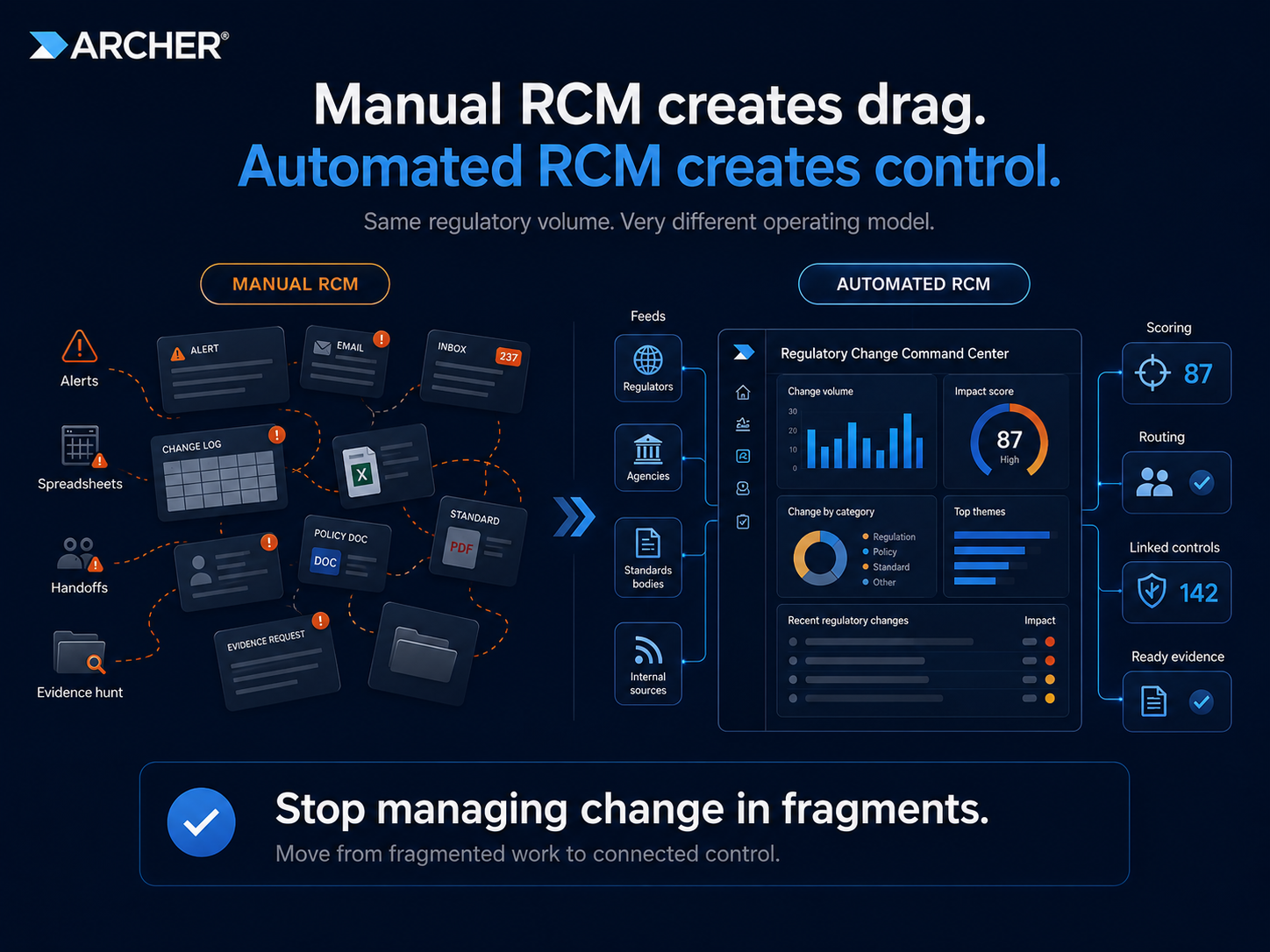
Organizations managing more than a handful of regulatory bodies typically find that manual approaches cannot keep pace, shifting the question from whether to automate to how quickly they can make the transition
The new dimension: AI governance and regulatory change management
RCM now must govern an environment in which AI agents participate directly in control execution.
This introduces two parallel challenges:
- AI regulations as a new source of change: Frameworks such as the EU AI Act, NIST AI RMF, and state‑level AI laws are generating large volumes of new obligations with short implementation timelines. Organizations deploying AI need RCM programs capable of tracking AI‑specific regulatory developments alongside traditional domains.
- AI inside the control environment: When an AI system makes credit decisions, flags exceptions, or routes alerts, the RCM program must govern the AI itself by tracking AI assets as regulated objects, maintaining lineage from AI outputs to controls, and ensuring AI behavior remains within regulatory commitments.
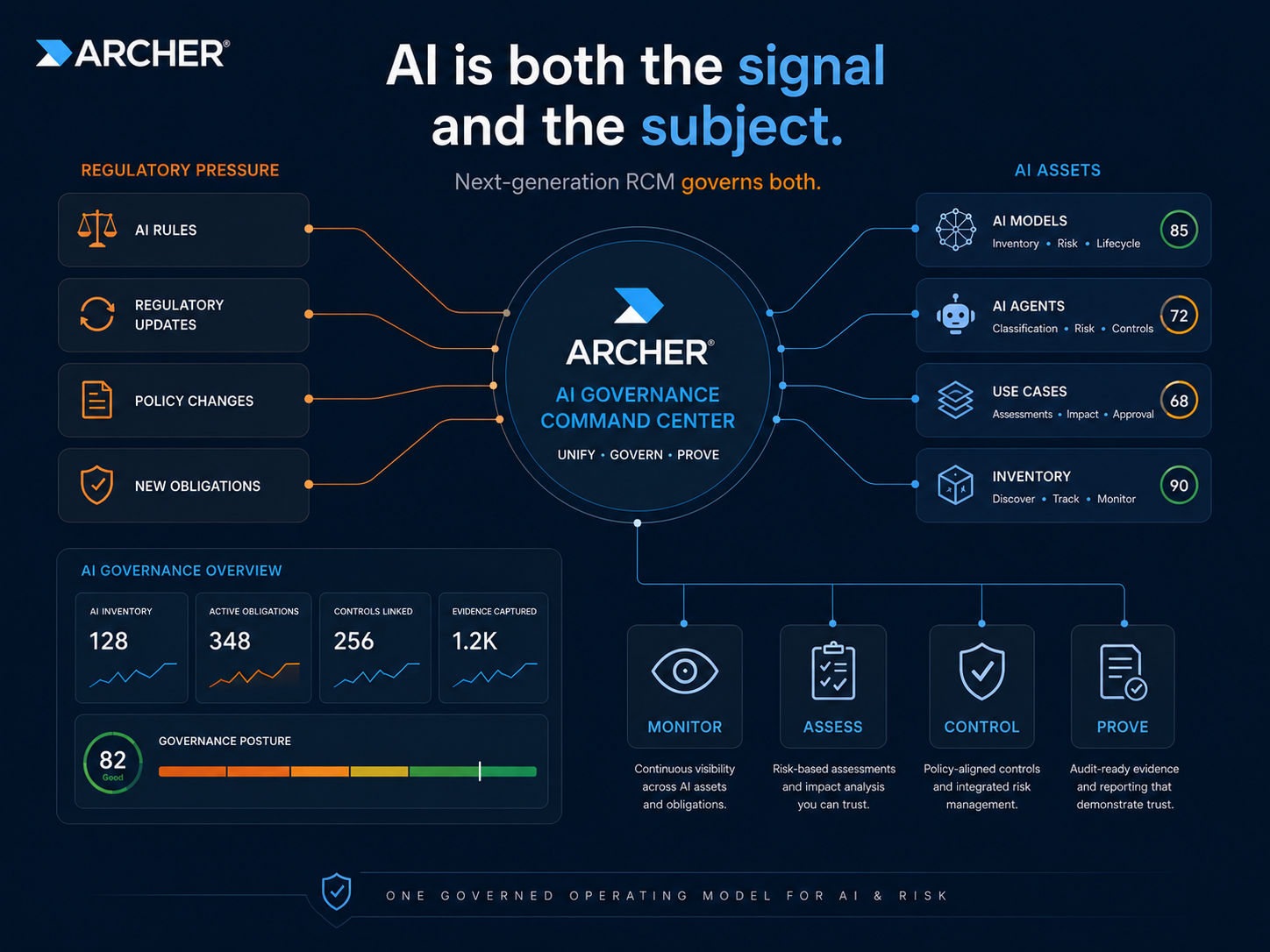
Leading organizations are integrating AI governance directly into their RCM infrastructure so that AI‑related obligations flow through the same detect–interpret–operationalize cycle as every other regulation.
Regulatory change management by industry
How should financial services firms manage RCM?
Banks and asset managers face some of the highest densities of regulatory change globally, with concurrent updates from prudential regulators, securities regulators, consumer protection agencies, and international standard setters. Effective programs typically rely on automated regulatory intelligence feeds, direct mapping of regulatory changes into RCSA frameworks, and formal escalation paths to boards or audit committees for prudential changes.
Strong RCM capabilities in financial services often become strategic differentiators, enabling faster product launches and smoother supervisory relationships.
How does RCM work in healthcare?
Healthcare organizations must comply with HIPAA, CMS reimbursement rules, FDA digital health guidance, and accreditation standards like those from the Joint Commission. Regulatory changes often have combined clinical, operational, and technical impacts, requiring cross‑functional coordination under tight timelines.
Healthcare RCM programs benefit from integrated governance between compliance, clinical leadership, IT, and revenue cycle teams, backed by clear traceability from regulatory change to updated clinical workflows and technologies.
What about technology and AI‑native companies?
Organizations that build or deploy AI face an emerging regulatory environment with limited precedent, including the EU AI Act’s risk classification and conformity requirements and increasing adoption of the NIST AI RMF in sectors like finance and government. These obligations map directly to RCM capabilities: asset inventories, risk classification, documentation, and continuous monitoring.
AI‑native firms can turn this into advantage by embedding AI governance into product development and operations, using RCM programs as the coordinating layer between engineering, risk, and compliance.
How do pharmaceuticals and life sciences handle RCM?
Pharmaceutical and life sciences organizations operate under some of the most structured change management regimes, including FDA requirements for changes to manufacturing, labeling, and clinical protocols. GxP‑compliant RCM programs require validated change control systems, formal approval workflows, and full audit trails.
RCM in these contexts often integrates closely with quality systems and specialized regulatory affairs functions.
What does an RCM program maturity look like?
Maturity models help organizations understand where they are today and what capabilities they need to develop.
| Maturity level | Characteristics |
| Reactive | Changes identified after effective dates; manual tracking; ad hoc workflow; audit findings drive remediation |
| Defined | Formal monitoring process; documented workflow; ownership assigned; manual tools and spreadsheets |
| Managed | Technology‑enabled monitoring; structured impact assessment; KPIs tracked; audit trail maintained |
| Optimized | Continuous, automated regulatory intelligence; AI‑assisted impact assessment; real‑time control linkage; AI governance integrated |
Most mid‑ to large‑scale organizations operate at the Defined or Managed level, and the gap to Optimized is closing as regulatory intelligence platforms and integrated GRC systems become more accessible.
Best practices and metrics for regulatory change management
Several practices consistently distinguish effective RCM programs.
- Build a single source of truth for obligations: Consolidate all regulatory requirements into a centralized obligations library rather than spreadsheets and email threads.
- Link every regulation to a control owner: Assign ownership so each obligation has a responsible party and escalation path.
- Standardize impact assessment criteria: Use consistent scoring for impact and urgency across changes, reducing subjective variance.
- Engage the business early: Involve operational leaders in impact assessments and implementations; compliance cannot operate in isolation.
- Measure program health with KRIs and KPIs: Track metrics such as time‑to‑compliance, number of open gaps, percentage of changes completed before effective date, and audit findings related to regulatory obligations.
- Continuously tune monitoring coverage: Periodically validate that your regulatory intelligence feed covers all relevant bodies, including new AI or sector‑specific regulators.
How does Archer and AI Support Regulatory Change Management?
Regulatory change management does not have to remain a reactive burden. With a modern GRC platform and AI capabilities, organizations can turn it into a strategic capability that protects the enterprise and enables controlled innovation.
Archer Evolv™ for Compliance is purpose‑built to support regulatory change management programs end‑to‑end, from automated regulatory intelligence and structured impact assessment to audit‑grade control linkage and AI governance. It brings AI‑powered horizon scanning, a centralized obligations catalog, workflow orchestration, and real‑time dashboards together in a single platform so you can detect changes early, assign ownership, implement controls efficiently, and produce the evidence examiners expect.
How does automated regulatory feeds and filtering work?
Archer Evolv™ for Compliance ingests regulatory updates from thousands of sources and uses AI to filter for relevance based on your industry and jurisdiction. Instead of monitoring dozens of websites by hand, you receive curated alerts for the changes that matter. It monitors more than 4,500 regulatory content sources around the clock, across 170 jurisdictions and over 40 languages.
AI-driven impact and gap analysis
AI can automatically assess which obligations, policies, and controls are affected by a change, and propose resolutions. What once took weeks of manual review can happen in hours. Archer Evolv™ for Compliance uses AI to perform gap analysis and conflict detection across your entire obligations catalog.
Centralized obligations catalog
A single repository for all regulatory and non-regulatory requirements, mapped to controls and business processes, eliminates the scattered spreadsheet problem. Everyone works from the same source of truth.
Real-time dashboards and audit trails
Software provides visibility into compliance status, pending changes, and complete documentation for auditors. When regulators or internal audit ask questions, you have answers immediately, not after days of searching through files.
Frequently asked questions about regulatory change management
What is the difference between regulatory change management and compliance management?
Compliance management focuses on meeting current regulatory requirements and maintaining ongoing adherence across operations. Regulatory change management focuses on tracking and implementing new or updated requirements as they are issued, feeding updated obligations and controls into the compliance program.
Who owns regulatory change management in an organization?
Ownership typically sits with the Chief Compliance Officer or General Counsel, with operational accountability distributed across legal, compliance, risk, and business functions. For AI‑related changes, roles such as the CISO or a Chief AI Officer often play a prominent role in governance.
How do you prioritize regulatory changes when volume is high?
Effective programs score changes on two dimensions: impact (which controls, policies, and business units are affected and how materially) and urgency (time remaining before effective date). High‑impact, near‑term changes receive top priority, while lower‑impact or distant‑deadline changes are tracked but resourced later.
What role does AI play in regulatory change management?
AI plays two distinct roles: it powers regulatory intelligence tools that automate monitoring, classification, and impact assessment, and it operates as a governed object inside the control environment when used in decisioning and monitoring. RCM programs must therefore both leverage AI to scale and ensure AI systems themselves remain compliant with evolving regulatory expectations.
What is horizon scanning in the context of RCM?
Horizon scanning is the proactive monitoring of proposed regulations, legislative activity, guidance, and enforcement trends before changes are finalized. It gives organizations early visibility to begin planning implementation, compressing timelines and reducing reactive scrambling when rules become effective.
How does regulatory change management support audit readiness?
A well‑run RCM program produces the evidence chain auditors and examiners expect: documentation that the organization identified a regulatory change, assessed impact, updated controls and policies, and validated that those changes were implemented correctly. Without this chain, teams are forced to reconstruct events during examinations, increasing effort and risk.
What are the most common causes of RCM program failure?
The most common causes include inadequate monitoring coverage, inconsistent impact assessment, fragmented documentation, organizational silos, and unmanaged AI‑related obligations. These weaknesses manifest as missed changes, inconsistent responses, and incomplete audit trails that regulators quickly identify.