Why AI governance starts with knowing what systems exist, who owns them, and how they are controlled
What Is an AI Inventory in AI Governance?
An AI inventory is the controlled record of AI systems and AI-enabled capabilities used across the organization — recording what each system does, who owns it, what data it touches, what controls apply, and whether it is governed. Without it, risk classification, control design, regulatory registration, and board reporting all sit on a weak foundation.
An AI inventory is the controlled record of AI systems and AI-enabled capabilities used across the organization. It records what each system does, where it is used, what data it touches, who owns it, how risky it is, what controls apply, and whether it is approved, under review, in pilot, remediating, or retired.
The inventory is not limited to models built internally. It should include vendor AI, embedded SaaS features, copilots, agents, experiments, and shadow AI use that governance teams discover after adoption has already begun.
The practical board question is simple: can management show where AI is operating and whether each material use is governed? Without an inventory, risk classification, control design, vendor assurance, regulatory registration, and board reporting all sit on a weak foundation.
The EU AI Act strengthens this need because registration and information requirements for certain high-risk AI systems depend on records that are accurate and kept up to date. Article 49 covers registration, and Annex VIII specifies information that must be submitted and maintained for relevant high-risk AI systems [*1]. ISO/IEC 42001 and the NIST AI RMF reinforce management-system and risk-management discipline around AI governance, lifecycle control, and evidence [*4][*5].
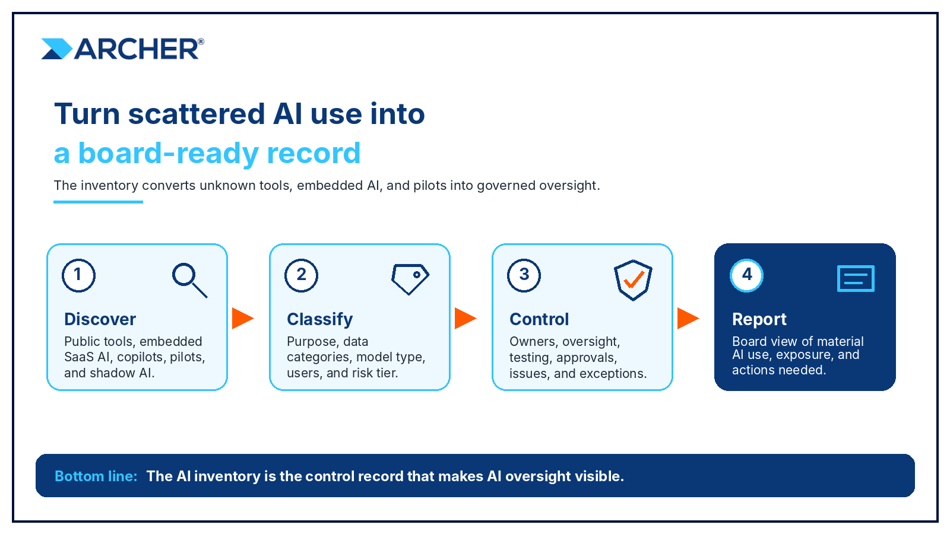
The leadership issue is whether the enterprise can see, classify, own, control, and explain AI use before it becomes a regulatory, operational, or trust problem.
Key Takeaways
- The AI inventory is becoming a core governance record, not an administrative list of tools.
- Board oversight depends on a current view of material AI use, risk tier, ownership, controls, exceptions, and open issues.
- Vendor AI and embedded SaaS features make passive inventory processes unreliable because AI capability can arrive through routine product updates.
- A defensible inventory should support regulatory registration, lifecycle risk management, control evidence, vendor assurance, and board reporting.
- Archer can help connect AI inventory, risk classification, control design, third-party risk, issue tracking, and leadership reporting in one governance model.
Why Has the AI Inventory Moved Onto the Board Agenda?
The AI inventory has moved up the governance agenda because regulatory, oversight, and commercial assurance pressures now converge on the same record. Staged regulation, board accountability for material AI exposure, and growing demands from customers, auditors, and insurers all require management to show not just that AI is used, but that it is governed.
The AI inventory has moved up the governance agenda because regulatory, oversight, and commercial assurance pressures now point to the same record.
The first pressure is regulatory. The AI Act applies on a staged basis. The official AI Act Service Desk timeline shows general provisions, AI literacy, prohibitions, and general-purpose AI obligations already in application, with other obligations phased across later dates [*2]. Staged regulation does not reduce the need for inventory discipline. It increases the need to know what exists, how it is classified, and what evidence is available.
The second pressure is board oversight. Directors do not need a catalogue of every prompt or experiment. They do need a credible view of material AI systems, sensitive uses, third-party dependencies, control gaps, incidents, exceptions, and remediation. Unknown AI deployments are hard to defend because management cannot explain risk exposure that it cannot see.
The third pressure is commercial assurance. Customers, partners, investors, auditors, and insurers increasingly ask whether AI is governed with the same discipline used for privacy, cybersecurity, operational resilience, and third-party risk. A current inventory gives the organization a factual basis for those conversations.
| Planning implication: Treat the AI inventory as a governed record with owners, minimum data fields, update triggers, review cadence, control evidence, and board reporting. Do not treat it as a one-time spreadsheet exercise. |
What Should a Board-Level AI Inventory Contain?
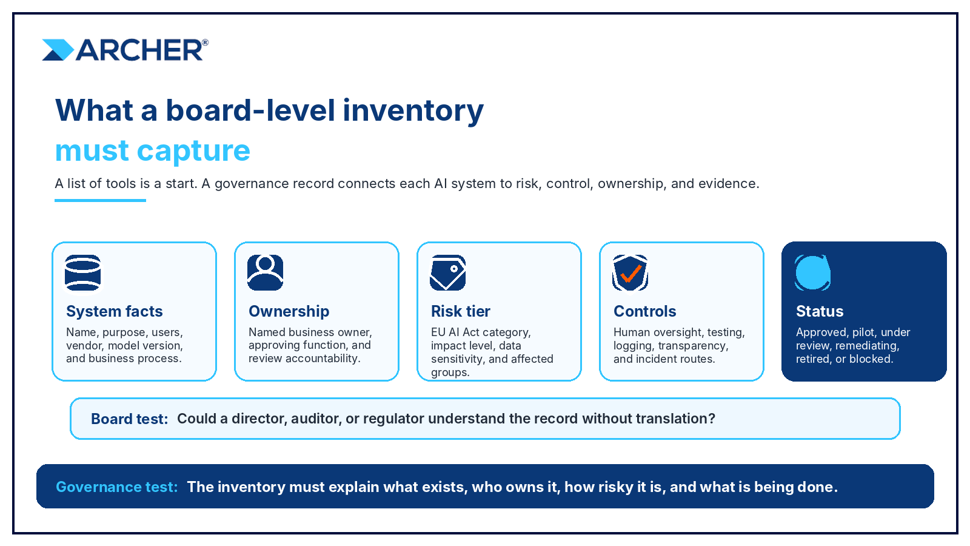
A board-level inventory needs to be more than a list of tools. It needs to tie each AI system to business context, risk, control, and accountability — with named owners, current status, and a control response that reflects the actual stakes of each use case, not just the fact that the system exists.
Most organizations begin with a spreadsheet. That is a useful start. A board-level inventory needs to be more than a list of tools. It needs to tie each AI system to the business context, risk, control, and accountability.
A governance record should capture system facts such as name, purpose, users, vendor, model version, workflow, and deployment status. It should also capture data categories, personal data use, sensitive or regulated data exposure, model dependencies, and whether the system is internally built, externally procured, embedded in a vendor product, or used through an employee account.
Ownership is equally important. Each material AI system should have a named business owner, not only a technology contact. Technology teams may run the platform, but business teams own the consequences of how the system is used.
Risk classification should drive the control set. Systems that influence employment, credit, healthcare, legal rights, safety, compliance decisions, customer treatment, or material business actions need stronger oversight than low-risk productivity assistance. The inventory should make those distinctions visible and should show the control response attached to each tier.
Status should be current. Approved, in pilot, under review, flagged for remediation, retired, or blocked should be explicit. A stale inventory gives leaders false comfort because it preserves a record without preserving oversight.
Why Does Vendor AI Make the Inventory Harder to Maintain?
AI capability now enters the organization through routes that were not designed for AI governance. A SaaS provider can release a generative AI feature into a platform the organization already uses, and a business team can activate it during renewal without a separate procurement decision — creating blind spots that periodic vendor reviews and passive inventory processes will not catch.
AI capability now enters the organization through routes that were not designed for AI governance. A SaaS provider can release a generative AI feature into a platform the organization already uses. A workflow tool can add summarization, recommendation, classification, or agentic action. A business team can activate a feature during renewal without a separate AI procurement decision.
That creates a blind spot for third-party risk management. Periodic vendor reviews, material change notifications, renewal checks, and security questionnaires need AI-specific questions. The review process should ask whether the vendor has added AI features, what data those features process, whether customer data is used for training or improvement, what model providers are involved, what logs are retained, what human oversight exists, and whether the vendor can provide evidence of testing, monitoring, and issue management.
The inventory should also capture AI concentration risk. If multiple business processes depend on the same model provider, SaaS platform, or AI agent architecture, the organization needs to understand the operational and contractual dependency. A board cannot assess concentration risk if the same dependency appears as disconnected entries across procurement, security, and business records.
Shadow AI belongs on the inventory too. The point is not to legitimize unsafe use. The point is to make the exposure visible so it can be blocked, remediated, moved to an approved tool, or governed through a formal intake path.
What Questions Must the Inventory Answer for the Board?
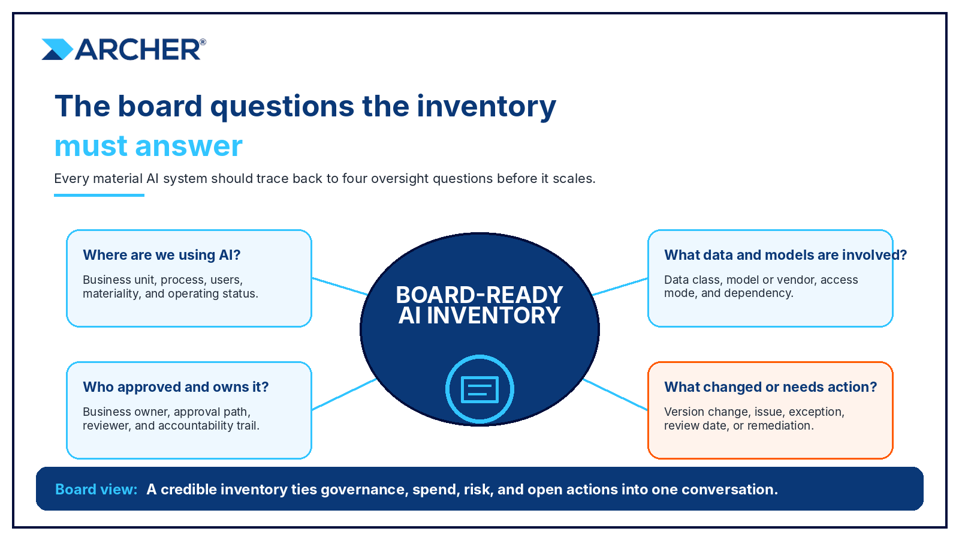
An AI inventory becomes board material when it can answer the questions leadership will ask during oversight, audit, incident review, budget planning, or regulatory preparation. The inventory is only as useful as the answers it can produce under pressure.
An AI inventory becomes board material when it can answer the questions leadership will ask during oversight, audit, incident review, budget planning, or regulatory preparation.
| Board question | Why it matters | Inventory evidence |
| Where are we using AI? | Shows material AI adoption across business units and workflows. | System name, business process, users, status, and purpose. |
| Which uses could affect people or regulated decisions? | Separates low-risk productivity use from use cases that may need stronger review. | Risk tier, impacted groups, decision context, and impact assessment status. |
| Who owns and approved the system? | Creates accountability when issues arise or when a review is overdue. | Business owner, approval record, reviewer, and review date. |
| What data and vendors are involved? | Links AI governance to privacy, security, third-party risk, and concentration risk. | Data categories, vendor, model, access mode, subprocessors, and contracts. |
| What changed or needs action? | Keeps the record live as models, data, use cases, and controls change. | Version changes, issues, exceptions, incidents, remediation, and next review date. |
How Does the Inventory Connect to EU AI Act Registration and Evidence?
If a relevant high-risk AI system must be registered in the EU database, the required information does not appear at filing time — it has to come from the internal inventory. Inventory work is foundational because it supports classification, technical documentation, control mapping, evidence gathering, and board reporting. Organizations that wait for supervisory deadlines before building the record will be building it under pressure.
If a relevant high-risk AI system must be registered in the EU database, the required information does not appear at filing time. It has to come from the internal inventory. Article 49 and Annex VIII point to information such as provider and deployer details, intended purpose, system status, conformity information, and summaries of relevant impact assessments for deployers where applicable [*1].
The AI Act timeline is staged. Organizations should avoid waiting for every supervisory date before building the record. Inventory work is foundational because it supports classification, risk management, technical documentation, control mapping, evidence gathering, and board reporting [*2].
ISO/IEC 42001 specifies requirements for establishing, maintaining, and continually improving an AI management system. That kind of management system depends on a reliable view of AI systems in scope [*4]. The NIST AI RMF organizes AI risk management around govern, map, measure, and manage functions. The inventory is especially important to the govern and map functions because it identifies the systems, context, actors, and risks that must be governed [*5].
When the inventory is incomplete, the evidence chain is incomplete. A board report, regulator filing, vendor review, control test, or audit response can only be as strong as the record behind it.
How Do You Build a Board-Ready AI Inventory? Five Steps for 2026
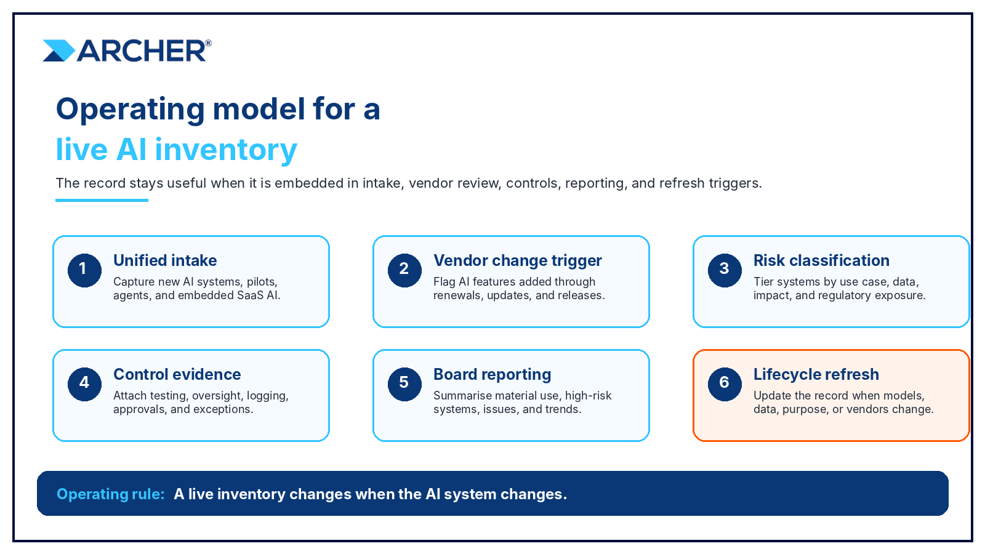
For 2026 planning, risk and compliance leaders should treat the AI inventory as part of the AI governance control environment. The goal is one credible record that supports responsible adoption, oversight, regulatory readiness, and defensible evidence — not a completed spreadsheet, but a living governance record that stays current as systems, vendors, and risks change.
1. Audit the AI footprint. Identify AI systems across business units, including internally built models, SaaS features, copilots, agents, pilots, and shadow AI discovered through security, procurement, or employee reporting.
2. Define the minimum data model. Agree on the required fields for every AI entry: purpose, owner, users, data, vendor, model, risk tier, controls, status, review date, issues, and evidence links.
3. Classify risk and assign controls. Use risk tiering to determine required reviews, human oversight, testing, logging, data controls, transparency measures, and escalation paths.
4. Update vendor and change processes. Make AI capability changes part of third-party reviews, renewals, material change notifications, and product update checks.
5. Tie the inventory to board reporting. Report material AI use, high-risk systems, control gaps, exceptions, incidents, concentration risk, and remediation progress through the governance cadence already used by the board or audit committee.
These steps move the inventory from a compliance exercise to an operating record. A completed spreadsheet may answer a point-in-time question. A live governance record helps leaders manage AI as the technology, vendor base, and risk profile change.
Building the AI Inventory with Archer
Archer helps organizations turn AI inventory management from a document exercise into a structured governance capability. The priority is to connect AI systems, business owners, third parties, obligations, risks, controls, approvals, issues, exceptions, and evidence in one operating model.
That means maintaining an AI inventory, assessing AI use cases, mapping risks to controls and obligations, assigning owners, capturing approvals, tracking issues, and producing reporting that shows where AI adoption is happening and where action is needed.
A strong AI inventory does not slow responsible AI adoption. It gives employees and business teams a clearer route to approved use while giving governance leaders a stronger basis for oversight. The organizations that manage AI risk well in 2026 will not rely only on policies and scattered spreadsheets. They will build a living record that connects AI use to accountability, controls, and evidence.
Learn more about Archer AI Governance: https://www.archerirm.com/ai-governance
Learn more about Archer GRC Solutions: https://www.archerirm.com/
FAQs
What is an AI inventory?
An AI inventory is a governed record of AI systems and AI-enabled capabilities used across the organization. It records what each system does, where it is used, what data it touches, who owns it, how risky it is, what controls apply, and what its current status is.
Why does the board need an AI inventory?
The board needs a credible view of material AI use, risk exposure, ownership, control gaps, vendor dependencies, incidents, and remediation. Without an inventory, management cannot give directors a reliable answer to where AI is operating or how it is governed.
Should embedded AI in SaaS tools be included?
Yes. Embedded AI in vendor platforms should be included because it may process organizational data, influence workflows, create new dependencies, or change the risk profile of an existing system without a separate procurement event.
How does the EU AI Act connect to AI inventory?
The EU AI Act includes registration and information requirements for certain high-risk AI systems. Internal inventory records help organizations identify systems in scope, classify risk, capture required information, and maintain evidence for oversight and review.
What should every AI inventory entry contain?
Every entry should include system purpose, owner, users, data categories, vendor or model details, risk classification, controls, approval status, review date, issues, exceptions, and evidence links.
How often should an AI inventory be updated?
The inventory should be updated whenever a system is introduced, modified, scaled, retired, or materially changed. It should also be reviewed through a defined governance cadence, so stale records are flagged before they create oversight gaps.
How can Archer support AI inventory governance?
Sources
[*1] AI Act Service Desk, Article 49: Registration and Annex VIII information requirements: https://ai-act-service-desk.ec.europa.eu/en/ai-act/article-49 and https://ai-act-service-desk.ec.europa.eu/en/ai-act/annex-8
[*2] AI Act Service Desk, Timeline for the Implementation of the EU AI Act: https://ai-act-service-desk.ec.europa.eu/en/ai-act/timeline/timeline-implementation-eu-ai-act
[*3] European Commission, AI Act regulatory framework overview: https://digital-strategy.ec.europa.eu/en/policies/regulatory-framework-ai
[*4] ISO, ISO/IEC 42001 Artificial Intelligence Management System: https://www.iso.org/standard/42001
[*5] NIST, Artificial Intelligence Risk Management Framework AI RMF 1.0: https://www.nist.gov/itl/ai-risk-management-framework and https://nvlpubs.nist.gov/nistpubs/ai/nist.ai.100-1.pdf
[*6] Archer AI Governance and Archer GRC Solutions: https://www.archerirm.com/ai-governance and https://www.archerirm.com/