What does the future of internal audit look like?
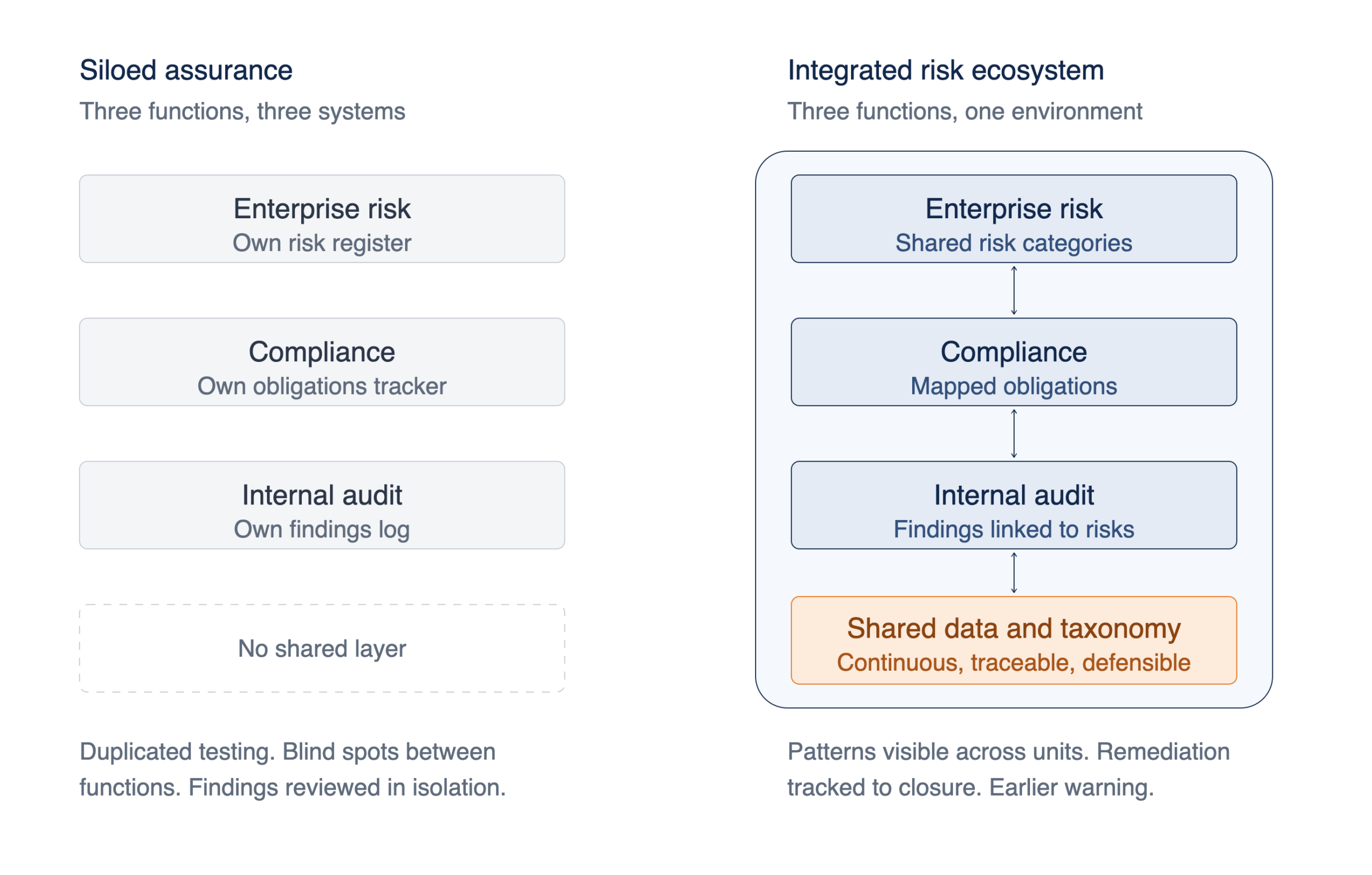
The future of internal audit is continuous, connected, and predictive. Instead of running annual audit plans and reporting on what already went wrong, internal audit teams are shifting toward real-time risk monitoring inside an integrated risk ecosystem: one shared environment where audit, risk, and compliance data all speak the same language.
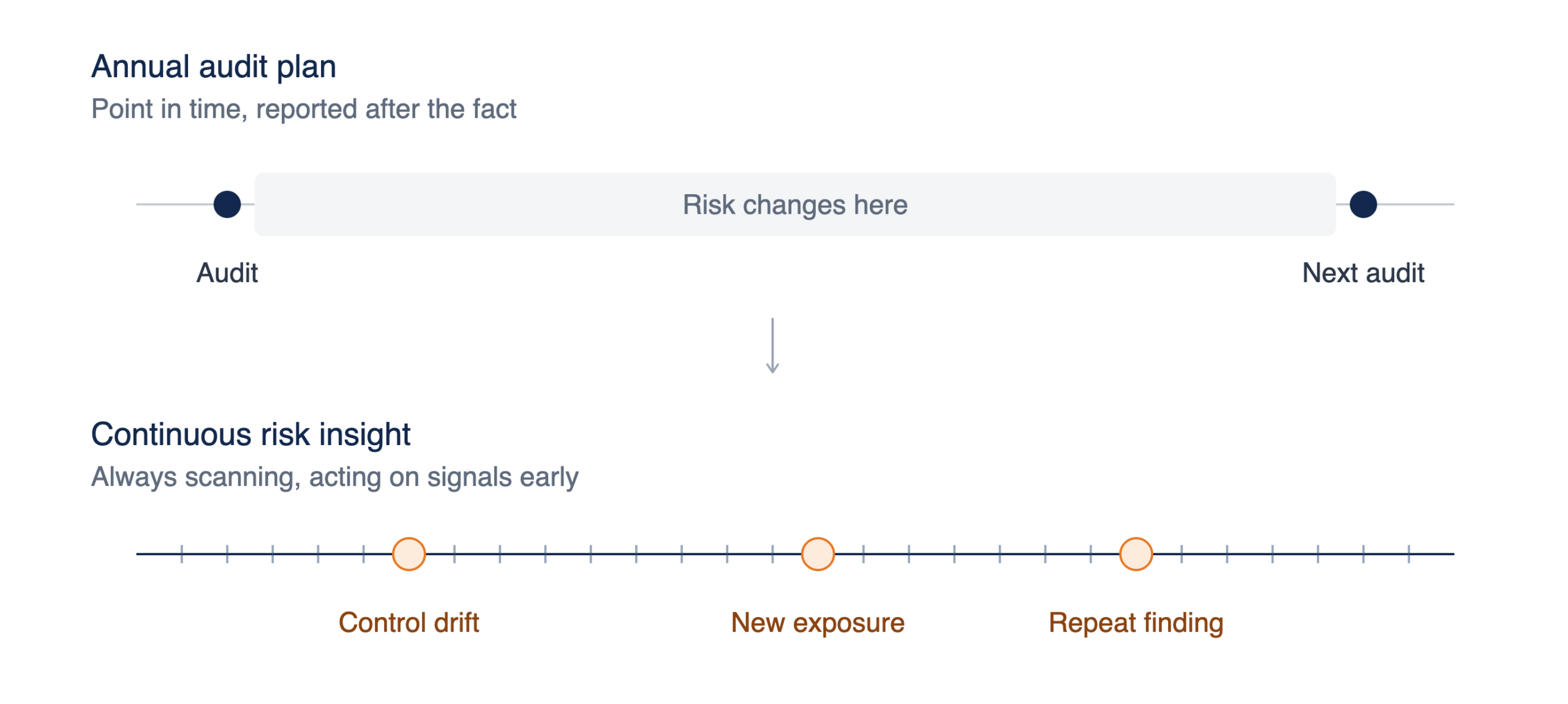
That shift matters because risk doesn’t wait for your audit calendar anymore. A control gap identified in March can be irrelevant by the time a report lands in September. Organizations that connect audit findings to enterprise risk data, instead of filing them away in a separate system, get a head start on problems before they become headlines.
Below, we break down what’s driving this change, what an integrated risk ecosystem actually looks like in practice, and what it means for the internal auditors doing the work.
The annual audit plan is losing its grip
For most of internal audit’s history, the job was straightforward. Pick a set of areas each year, test the controls, write up what’s broken, move on to the next engagement. It worked fine when risk moved slowly and businesses had time to react between review cycles.
That’s not the environment anyone operates in now. A new regulatory change lands somewhere in the world every 6 minutes. Add digital transformation, heavier reliance on third parties, and the arrival of AI into everyday business processes, and the rate at which new risks appear has outrun the review cycle designed to catch them. An audit finding from six months ago might already be describing a problem that has mutated into something else entirely.
This is forcing a rethink of what internal audit is actually for. It’s no longer enough to be the function that shows up after the fact and explains what happened. The value now sits in catching risk signals early enough to do something about them, which means audit has to plug into the same data streams that risk and compliance teams are already watching.
From point-in-time reviews to continuous risk insight
Continuous risk insight doesn’t mean throwing out audit methodology. It means feeding it live data instead of relying purely on scheduled check-ins.
In practice, this looks like:
- Monitoring control performance trends between formal audits, not just during them
- Reprioritizing audit focus areas as new risk signals emerge, rather than sticking rigidly to a plan set 11 months ago
- Using integrated data, not just audit-owned data, to spot patterns across the business
Think of it as audit acting like a radar system. Always scanning, always picking up signals across operations, technology, and controls, rather than switching on once a year for a scheduled sweep.
What is an integrated risk ecosystem?
An integrated risk ecosystem is a shared framework where enterprise risk, second-line controls and compliance, audit findings, and issue remediation all live in connected systems using common taxonomies, rather than in separate silos with their own spreadsheets, definitions, and reporting cadences.
Most organizations still run these functions independently. Risk management has its own risk register. Compliance tracks obligations its own way. Audit maintains its own findings log. The result is duplicated effort, inconsistent terminology, and blind spots nobody notices until something goes wrong across two departments at once.
Connecting these pieces changes what audit can actually see. Instead of reviewing one finding in isolation, auditors can trace how that finding relates to a broader enterprise risk category, whether similar control failures are showing up in other business units, and whether remediation is actually sticking or just getting marked “closed” on paper.
Turning audit findings into risk intelligence
A single audit finding, on its own, doesn’t tell you much. It’s a snapshot of one control, in one process, at one point in time.
But when that finding is mapped to enterprise risk categories, tied to a specific business process, linked to its root cause, and tracked through remediation, it becomes something more useful: a data point in a much bigger pattern.
That pattern recognition is where the real value shows up. Recurring control failures across regions. Systemic weaknesses in a particular process. Issues that keep getting “remediated” without ever actually closing. None of that is visible when findings sit in isolated reports.
This is the practical difference between reporting what happened and explaining why it keeps happening, and, more usefully, what to do about it next.
Audit reporting needs to change too
Boards and executives aren’t short on data. What they’re short on is synthesis. A 40-page report full of individual findings and ratings doesn’t tell a CFO where the organization’s risk exposure is actually trending.
Modern audit reporting needs to lead with insight, not observation. That means prioritizing:
- The handful of risk themes that matter most right now
- Root causes that span multiple functions, not just one department
- Whether control effectiveness is improving or slipping over time
- Recommendations tied directly to business decisions, not generic “strengthen controls” language
Done well, this turns the audit report from a compliance artifact into something executives actually read and act on. It also repositions internal audit as an advisor, not just a scorekeeper.
Integrated assurance doesn’t mean losing independence
There’s a common concern that closer collaboration with risk and compliance teams compromises audit’s independence. In practice, done right, it does the opposite.
Integrated assurance means using shared data to:
- Cut down on duplicated testing across the three lines
- Spot where assurance coverage has gaps
- Direct limited audit resources toward the areas with the highest actual risk
Audit still retains its independent role: challenging assumptions, validating that risk management processes actually work, and reporting without bias. Shared data doesn’t replace independent judgment. It just means that judgment is based on a fuller picture.
The role of technology and AI in modern audit
None of this works without the right infrastructure. Integrated risk platforms give audit, risk, and compliance a single environment where findings, risks, and controls connect instead of living in parallel spreadsheets. More than 1,300 organizations run on Archer®, including half the Fortune 500 and 37 of the top 50 global banks.
Platforms at this level typically support:
- Centralized audit management across the full lifecycle, from planning to issue tracking
- Direct linkage between findings, risks, and controls
- Real-time dashboards instead of static, quarter-old reports
- Automated workflows that cut down on manual documentation
AI adds another layer on top of that foundation. It flags anomalies in large datasets, supports continuous monitoring, and speeds up the documentation and testing that used to eat hours out of an auditor’s week.
That said, AI is a support tool, not a replacement for judgment. It works best when it’s governed properly, with clear oversight and auditors who still apply professional skepticism to what the technology surfaces. A model flagging an anomaly still needs a human to decide whether it actually matters. That is the difference between an audit conclusion you can defend to an examiner and one you can only explain.
What this means for internal auditors
The skill set is shifting. Technical control knowledge and accounting fundamentals are still table stakes, but they’re no longer enough on their own.
The auditors who thrive in this environment tend to combine:
- Solid risk management fundamentals
- Comfort working with data and analytics tools
- Real understanding of how the business actually operates, not just how it’s supposed to on paper
- The ability to explain complex findings clearly to non-audit executives
- Enough technical fluency to work alongside AI and integrated platforms, not around them
This is a multidisciplinary role now. Part auditor, part analyst, part translator between technical findings and business decisions.
The bottom line
Internal audit isn’t optional overhead, and it isn’t a once-a-year compliance exercise either. Organizations that connect audit into a shared risk ecosystem, instead of running it as an isolated function, get earlier warning on emerging risks and better-informed decisions at the top.
The function’s value going forward won’t be measured by how many audits got completed. It’ll be measured by how much of what audit found actually changed a decision.
If you’re mapping out what that connected model looks like for your own audit function, see how Archer brings audit, risk, and compliance onto shared data and taxonomies.
Learn more at https://www.archerirm.com/audit-management
Frequently asked questions
What is an integrated risk ecosystem in internal audit?
An integrated risk ecosystem is a connected framework where audit, risk management, and compliance functions share data, taxonomies, and reporting structures instead of operating in separate silos. It gives internal audit visibility into how individual findings relate to broader enterprise risks, rather than reviewing each finding in isolation.
How is internal audit different from continuous risk monitoring?
Traditional internal audit relies on scheduled engagements and periodic reviews, typically following an annual plan. Continuous risk monitoring uses real-time or near-real-time data to track control performance and emerging risks between formal audits, allowing teams to adjust priorities as conditions change rather than waiting for the next scheduled review.
Does using shared risk data compromise internal audit’s independence?
No. When implemented correctly, shared data supports independence rather than undermining it. Internal audit still performs independent testing, challenges assumptions, and reports without bias. Access to shared risk and compliance data simply gives auditors better context, helping them target resources at higher-risk areas instead of spreading coverage evenly regardless of actual exposure.
What skills do internal auditors need for the future of internal audit?
Technical control knowledge and accounting fundamentals remain the baseline, but they are no longer sufficient on their own. Internal auditors increasingly need risk management fundamentals, working comfort with data and analytics tools, a practical understanding of how the business operates, the ability to explain findings to non-audit executives, and enough technical fluency to work alongside AI and integrated risk platforms.