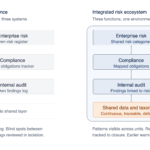
Most organizations don’t have a data problem. They have a fragmentation problem and a gap between knowing and doing that no dashboard can close.
The standard critique of risk technology tends to focus on visibility: teams can’t see what’s happening across the enterprise, data lives in silos, reporting is inconsistent. That’s a real challenge, and it’s one that the GRC market has spent years addressing. But the harder problem sits one step further down the chain.
What happens after the dashboard?
In most organizations, the answer is: manual work. Spreadsheets. Email threads. Follow-up conversations that may or may not produce documented outcomes. Risk findings get surfaced and then quietly stall. Compliance gaps get identified and then routed to whoever has bandwidth. The platform stops at insight, and execution is left to individuals working around it.
That gap, between knowing a risk exists and actually resolving it, is where most risk programs quietly break down. And it’s worth understanding why.
The Environment Has Changed; Most Risk Programs Haven’t
For years, the prevailing model for risk technology was built around capture and reporting. Data came in, was stored centrally, and was surfaced periodically when leadership asked. That model was well-suited to an environment where regulatory change moved in annual cycles and risk review was a scheduled event.
That environment is gone.
According to the PwC Global Compliance Survey 2025, 85% of organizations say compliance requirements have become more complex over the past three years. Seventy-seven percent report that complexity is actively impacting areas critical to business growth. Enforcement timelines have compressed. Regulatory expectations have become continuous rather than cyclical. Boards are asking harder questions more often, and they expect answers that don’t require two weeks of manual aggregation to produce.
The organizations managing this well aren’t necessarily those with the most data or the most sophisticated reporting. They’re the ones who have closed the distance between a risk finding and a documented, tracked, time-bound response.
Why Connected Data Is the Starting Point, Not the Destination
Compliance teams rarely suffer from a shortage of information. The findings exist. The assessments have been done. The third-party reviews are somewhere in the system. The problem is that the information is distributed across platforms, teams, and formats in ways that make it nearly impossible to connect the dots.
That fragmentation carries real cost. The PwC survey found that 63% of compliance leaders say disaggregated data makes compliance harder. But organizations that consolidate risk, compliance, policy, and third-party data into a unified environment report measurable returns: 64% better risk visibility, 53% faster issue response, and 43% direct cost savings.
Those returns don’t come from better data collection. They come from what becomes possible when the data is connected: the ability to see exposure clearly, escalate what needs attention, and document decisions in a way that holds up under audit.
The Gap That Actually Costs Organizations
Only 7% of organizations in the PwC survey consider themselves compliance leaders today, while 38% aim to reach that level within three years. That distance isn’t primarily a strategy problem. The strategic ambition is clear. The operational infrastructure to close the gap isn’t there yet.
The pattern is predictable. A risk assessment surfaces a finding. A control test identifies a gap. A third-party review flags a vendor concern. The platform reports it. And then the work of resolving it, assigning an owner, setting a due date, tracking progress, documenting closure, and producing the audit evidence gets done manually, inconsistently, or not at all.
The question worth asking is: what would it take to make that resolution process as structured and traceable as the identification process? Not just for high-priority risks, but across the program, continuously.
The answer isn’t more dashboards. It’s an operational model where findings move automatically into tracked, owned, time-bound actions, where the platform supports the full cycle, not just the front half of it.
Why Technology Investment Alone Isn’t Enough
Organizations that have invested heavily in risk platforms and still underperform tend to share a common pattern: technology without governance.
Automation without structure creates noise. Data integration without clear ownership doesn’t scale. Reporting without a defined decision process just adds to the volume of information that no one acts on.
The PwC data is direct on this point. Fifty-five percent of compliance leaders name senior management sponsorship as the single most important factor in a strong compliance culture. Fifty-nine percent of organizations with aligned, centralized compliance models report higher confidence in decision-making compared to those operating in silos.
Technology enables the capability. The governance structure determines whether that capability compounds into a strategic advantage or sits underutilized.
That distinction matters when thinking about how risk programs are built and sustained. It’s not a go-live problem. It’s a how-the-program-operates-over-time problem.
What Execution-Ready Risk Management Looks Like
The capabilities that distinguish execution-ready risk programs from reporting-focused ones tend to cluster around a few core areas.
Issue management with real accountability. Findings don’t disappear into inboxes. They become tracked records with owners, due dates, escalation paths, and documentation requirements built in. Closure is documented. The audit trail exists without being manually assembled.
Policy management connected to risk. When a regulation changes, the downstream impact is visible immediately: which policies are affected, which controls need updating, what the compliance implications are. Organizations that discover those gaps after the fact, through an audit rather than through their own systems, pay a higher price.
Third-party risk as part of the same picture. Sixty-four percent of organizations rely on third parties to deliver products and services. A vendor compliance failure doesn’t stay isolated; it becomes a regulatory risk, an operational risk, and potentially a reputational one. Third-party oversight that lives in a separate program, disconnected from enterprise risk, means those connections aren’t visible until it’s too late to respond proactively.
Continuous controls monitoring. The difference between discovering control failures at audit time and identifying them as they occur is significant. One is reactive by design. The other allows organizations to address gaps within the operating cycle rather than after it.
Executive reporting that doesn’t require manual aggregation. CCOs and CROs shouldn’t spend the days before a board presentation pulling data from multiple systems and reformatting it. The view leaders need should be continuously available, with supporting detail accessible on demand.
Where the Discipline Is Headed
Eighty-two percent of organizations plan to increase investment in compliance technology over the next three years, according to PwC. Seventy-one percent expect digital transformation to require significant compliance support over the same period.
The investment trend reflects real demand. But the returns on that investment will continue to vary widely, not because some organizations buy better technology, but because some organizations pair that technology with the governance model needed to make it perform.
The direction that matters most isn’t toward more data or more dashboards. It’s toward AI and analytics embedded at the point of decision, automation that is structured and traceable rather than layered on top of fragmented processes, and deeper connectivity that eliminates the silos still slowing response times.
The organizations that will lead through the next wave of regulatory complexity aren’t waiting for the landscape to stabilize. They’re building programs where finding a risk and resolving it are part of the same operational cycle, and where the gap between the two is measured in days, not quarters.
How Archer Supports Execution-Ready Risk Management
Archer gives risk and compliance teams the tools to manage the full cycle, from risk identification through documented resolution, within a single connected environment. Issue management, controls monitoring, policy management, third-party risk, and executive reporting are built to work together, not aggregated after the fact.
Learn more about how Archer helps organizations move from visibility to execution at archerirm.com.
What does “execution-ready” risk management mean, and how is it different from traditional GRC?
Traditional GRC platforms were designed primarily around data collection and reporting: capturing risk information, storing it, and surfacing it in dashboards or periodic reports. Execution-ready risk management goes further. It means the platform actively supports what happens after a risk is identified, including assigning ownership, triggering workflows, tracking remediation, documenting closure, and producing the audit evidence regulators and boards require. Rather than treating reporting as the end state, an execution-ready model treats it as one output of an operational system that runs continuously, connecting risk assessment, policy management, controls monitoring, and third-party oversight in a single environment.
How can compliance teams close the gap between risk findings and resolution?
The key is replacing manual handoffs with structured workflows. When a risk is identified through an assessment, a controls test, a third-party review, or an audit, the resolution process needs built-in ownership, due dates, escalation paths, and documentation requirements. Without that structure, issues move into email or spreadsheets and resolution becomes inconsistent. The PwC Global Compliance Survey 2025 found that organizations using connected compliance technology report 53% faster issue response, and that improvement comes directly from making the resolution process as traceable as the identification process.
Why should third-party risk management be part of an integrated platform rather than a separate tool?
Because third-party risk doesn’t exist in isolation. A supplier compliance failure creates a regulatory risk. A vendor cybersecurity incident becomes an operational and reputational issue. A contract gap surfaces in an audit. When third-party risk lives in a separate system, organizations lose the ability to see how vendor risk connects to their broader compliance posture, and they end up managing the consequences reactively. Bringing third-party findings into the same platform as enterprise risk, policy management, and controls monitoring means those connections are visible in real time, assessed against the same risk framework, escalated through the same workflows, and included in the same executive view.
Why isn’t technology investment alone enough to improve risk program performance?
Technology without governance falls short in predictable ways. Automation without structure creates noise. Data integration without clear ownership doesn’t scale. Reporting without a defined decision process just adds to the volume of information no one acts on. The PwC survey found that 55% of compliance leaders name senior management sponsorship as the single most important factor in a strong compliance culture, and 59% of organizations with aligned, centralized compliance models report higher confidence in decision-making. The platform provides the capability. The governance model determines whether that capability compounds into a strategic advantage over time.
Source: PwC Global Compliance Survey 2025, pwc.com/gx/en/issues/risk-regulation/global-compliance-survey.html