What Is the Human Firewall in AI Governance?
The human firewall is the workforce judgment layer that helps prevent risky AI use before it becomes a data, compliance, or trust issue. In AI governance, it means employees understand what AI tools do, what information they should not share, when outputs need review, which use cases create higher risk, and how to raise concerns before a shortcut becomes an incident.
Shadow AI usually starts with a reasonable business need. A sales representative wants to personalize outreach faster. A manager wants to summarize a long document before a meeting. A compliance analyst wants help interpreting regulatory text. Public AI tools are easy to reach, easy to test, and often more convenient than approved enterprise workflows.
That convenience creates risk when employees do not have clear guidance. Microsoft and LinkedIn reported that 75% of global knowledge workers were using generative AI at work and that 78% of AI users were bringing their own AI tools to work [*1]. IBM later reported that one in five studied organizations experienced a breach due to shadow AI, while only 37% had policies to manage AI or detect shadow AI [*2].
The practical issue is not that employees are careless. The issue is that work moved faster than governance. AI literacy closes that gap by giving people usable decision rules at the moment they decide what to share, what to trust, and what to do next.
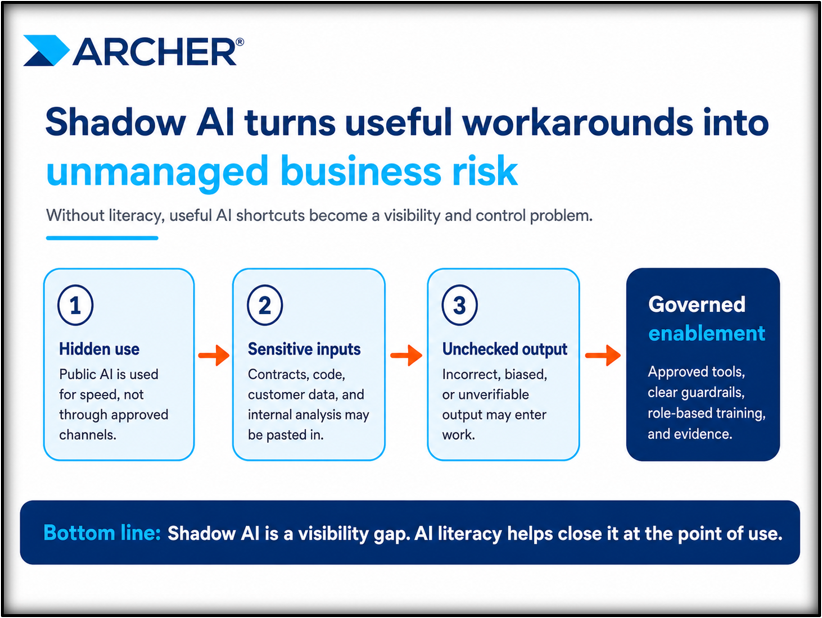
Visual 1. Shadow AI becomes manageable when hidden workarounds are converted into governed enablement.
Key Takeaways
- Shadow AI is a visibility and governance gap. It often begins when employees try to solve real work problems without a clear, approved path.
- AI literacy is now an operating requirement and a regulatory expectation under the EU AI Act Article 4 for providers and deployers of AI systems.
- Generic awareness training is not enough. Employees need role-based guidance for data sharing, output verification, high-risk use cases, and escalation.
- A strong human firewall gives employees safe ways to use AI, while giving leaders evidence that guidance, controls, approvals, and monitoring are working.
Why Shadow AI Is a Governance Problem
Many organizations first respond to Shadow AI as a technology control problem. They block websites, publish a policy, and warn employees not to paste sensitive information into public tools. Those steps may be necessary, but they rarely solve the underlying behavior.
When people face workload pressure and the approved path is unclear, slow, or unavailable, they improvise. The risk then becomes harder to see. Prompts, files, transcripts, source code, customer details, contract terms, and internal analyses may move into tools that security, legal, compliance, and IT teams have not assessed.
The Samsung example remains useful because it shows how quickly this can happen. Reuters reported that Samsung temporarily restricted generative AI use on company devices after discovering that an employee had uploaded sensitive code to ChatGPT [*3]. The lesson is simple: well-intentioned productivity behavior can become an enterprise risk event when the rules are not understood at the point of use.
Governance teams should treat Shadow AI as a signal. It often reveals friction between what employees need and what the enterprise has made safe, available, and understandable. A mature response reduces unsafe use while creating approved routes for experimentation, productivity, and responsible adoption.
AI Literacy Is Now an Operating and Legal Obligation
The EU AI Act has made AI literacy a live governance obligation. Article 4 requires providers and deployers of AI systems to take measures to ensure a sufficient level of AI literacy among staff and other people dealing with AI systems on their behalf. The European Commission explains that literacy should consider technical knowledge, experience, education, training, the context in which AI is used, and the people affected by the system [*4].
This obligation entered into application on 2 February 2025. The European Commission also states that AI Act supervision and enforcement rules apply from 3 August 2026 [*4]. The broader AI Act timeline remains staged, with prohibited practices and AI literacy already in application, GPAI model obligations from 2 August 2025, and other requirements phasing in across 2026 and 2027 [*5].
Organizations should be careful with the phrase training. Article 4 is not satisfied by a one-time slide deck in every case. The Commission says there is no single required format and no required certificate, but organizations can keep internal records of training and other guidance initiatives [*4]. That means the governance burden is practical: define what people need to know, adapt it by role and risk, deliver it in ways employees can use, and keep evidence that the program exists.
| Planning implication: AI literacy should be managed as a control with owners, scope, training records, refresh cycles, escalation paths, and evidence. It should not sit only as an annual awareness activity. |
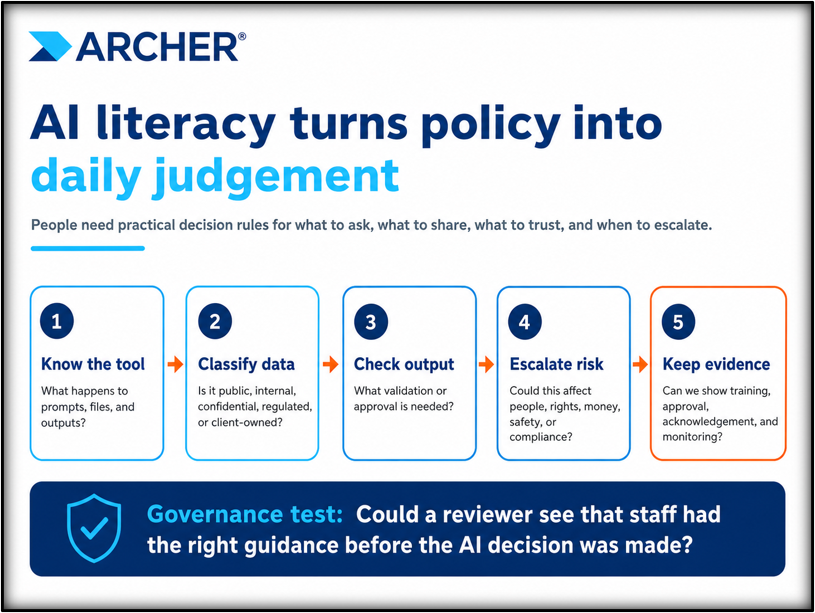
Visual 2. AI literacy converts policy into practical decisions before employees share data or rely on outputs.
Why Awareness Training Falls Short
Traditional awareness training is usually designed to warn people. AI literacy has to prepare people to judge. That difference matters because employees are not only avoiding a threat. They are using a powerful tool inside real work.
Fear-based messages can push AI use underground. A better approach explains where AI can help, where it creates risk, and how to use approved options responsibly. Employees need to understand why customer data, confidential code, regulated records, contract terms, non-public strategy, and personal data require special handling. They also need to know when AI output is a draft, when it is a clue, and when it needs expert validation before use.
The training model should be role-based. Sales teams need examples about customer information and outreach claims. HR teams need examples about hiring, performance, and employee data. Legal and compliance teams need examples about privileged information, regulatory interpretation, and evidence. Technology teams need examples about source code, secrets, architecture, and access permissions.
Policy without comprehension does not scale. A person who understands the reason behind the rule is more likely to make a safe decision when the exact scenario was not covered in the policy.
The Human Firewall: What Employees Actually Need to Know
The most important control point is the decision moment: an employee chooses the tool, writes the prompt, attaches the file, accepts or rejects the answer, and decides whether to act on it. Four questions should be simple enough to remember and specific enough to change behavior.
| Decision question | What the employee needs to know |
| What data am I sharing? | Employees should know whether the input is public, internal, confidential, regulated, client-owned, personal, privileged, or proprietary. |
| Can I trust this output? | Employees should know that AI outputs can be incomplete, biased, fabricated, outdated, or badly reasoned. Verification rules should be explicit. |
| Is this a high-risk use case? | Employees should recognize uses that may affect employment, credit, access to essential services, safety, legal rights, compliance decisions, or material business actions. |
| Where do I escalate? | Employees need a low-friction way to ask for approval, report questionable tool behavior, or request an approved AI capability. |
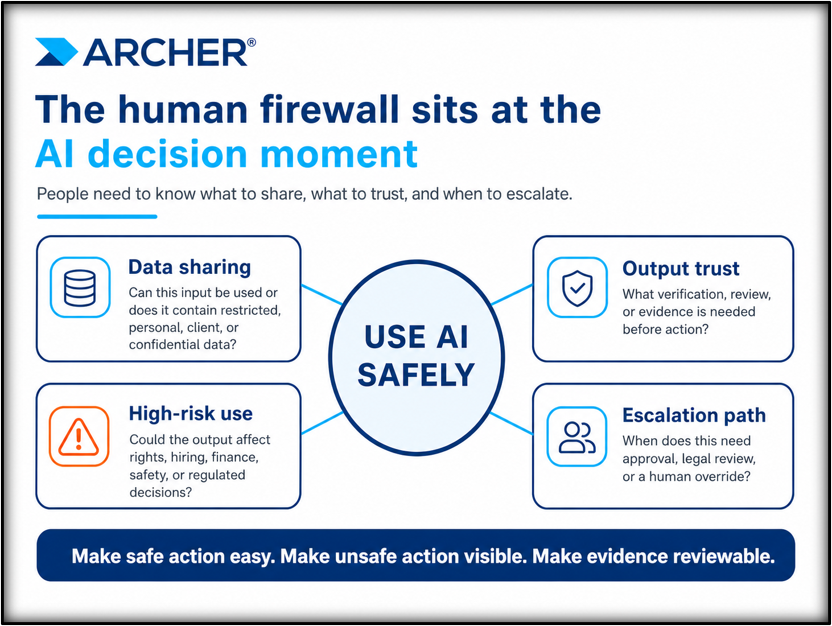
Visual 3. The human firewall is the decision point where data, output, use-case risk, and escalation come together.
What Leading Organizations Do Differently
The strongest programs treat AI literacy as an operating control. They avoid relying on policy distribution alone and build a management system around approved use, role-based education, safe experimentation, and evidence.
They make boundaries easy to understand. Employees know which tools are approved, which data must never be entered, which use cases need review, and which actions require human approval. The guidance is written in plain language, not only legal or technical terms.
They also make safe experimentation visible. When the only answer is no, employees create their own workaround. When the organization provides approved tools, intake channels, sandboxes, and governance review, demand becomes easier to see and manage.
Leadership behavior matters. Employees learn what is acceptable from what leaders model in meetings, sales motions, product decisions, and operating reviews. Governance that exists only in documents will not hold under workload pressure.
Finally, ownership is cross-functional. AI literacy is connected to security, legal, compliance, privacy, HR, technology, and business operations. Each function sees a different part of the risk, and employees need one coherent message.
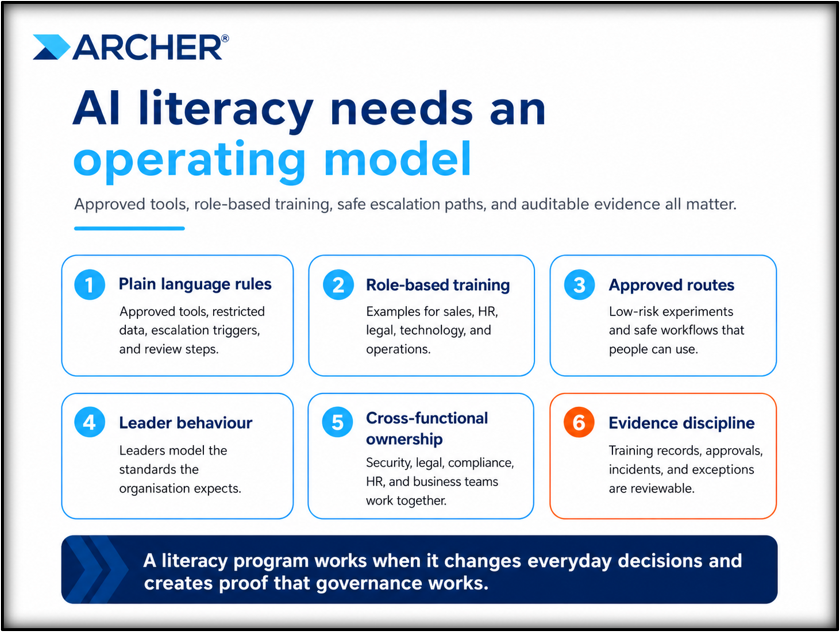
Visual 4. An AI literacy program needs a practical operating model, not a one-time training asset.
How to Build a Human Firewall in 5 Steps
For 2026 planning, risk and compliance leaders should treat AI literacy as part of the AI governance control environment. The objective is to reduce unsafe AI use while enabling responsible adoption. That requires clear rules, approved pathways, monitoring, and records that can stand up to review.
Follow these five steps to convert AI literacy from a training activity into a working governance control:
- Audit your AI tool landscape. Document every AI tool employees are using — public tools, embedded SaaS features, copilots, and agentic workflows — so governance controls can be scoped and targeted correctly.
- Define data sharing boundaries. Establish clear rules about what employees can and cannot share with AI tools, using data classifications they can act on — not only technical or legal categories.
- Train by role, risk, and use case. Replace generic annual modules with targeted guidance for each function. Sales, HR, legal, technology, and operations teams face different AI risks and need different examples.
- Create low-friction escalation paths. Give employees a simple way to request approval, report questionable AI behaviour, or access approved experimentation routes. When the governed path is harder than the workaround, shadow AI grows.
- Build and maintain governance evidence. Document AI literacy measures, policy acknowledgements, approvals, exceptions, incidents, monitoring, and remediation. This is what turns a training programme into a control that can stand up to regulatory review.
- These steps move the conversation from training completion to governance effectiveness. A completed course is useful. A workforce that consistently makes safer AI decisions is more valuable.
Building the Human Firewall With Archer
Archer helps organizations turn AI governance from a policy statement into a structured operating capability. For Shadow AI and AI literacy, the priority is to connect people, systems, tools, risks, controls, evidence, and accountability in one governance model.
That means maintaining an AI inventory, assessing AI use cases, mapping risks to controls and obligations, assigning owners, capturing approvals, tracking issues, and creating evidence that shows how AI is governed across the enterprise. It also means giving leaders visibility into where AI adoption is happening, where exposure may be building, and what action is needed.
A strong human firewall does not slow responsible AI adoption. It gives employees clearer choices and gives governance teams a stronger basis for oversight. The organizations that will manage AI risk well in 2026 will not rely only on blocking tools. They will combine literacy, approved pathways, control evidence, and continuous governance.
Learn more about Archer AI Governance: https://www.archerirm.com/ai-governance
Learn more about Archer GRC Solutions: https://www.archerirm.com/
FAQs
What is Shadow AI?
Shadow AI is the use of AI tools, models, features, or agents without organisational approval, oversight, or monitoring. It includes public AI tools, unreviewed SaaS AI features, personal accounts used for work, and AI workflows built outside approved governance processes.
Why is AI literacy important for reducing Shadow AI?
AI literacy gives employees the judgment to use AI safely, reducing the risk that well-intentioned productivity behaviour becomes a governance incident. It helps them understand which data should not be shared, when outputs need verification, which use cases require approval, and where to escalate concerns.
What does EU AI Act Article 4 require?
Article 4 requires providers and deployers of AI systems to ensure a sufficient level of AI literacy among staff and others who deal with AI on their behalf. Measures should reflect the person’s knowledge, experience, training, the AI use context, and the people affected by the system.
Is annual AI awareness training enough?
Annual awareness training is usually not sufficient on its own. Organisations also need role-based guidance, approved tool routes, practical examples, escalation paths, refresh cycles, and internal evidence that literacy measures were delivered and maintained.
What should employees know before using AI at work?
Employees should know whether the tool is approved, what data they can share, whether the output needs review, and who to contact when they are unsure. They should also understand that AI output can be wrong, biased, incomplete, or inappropriate for direct use.
How can Archer support AI literacy and Shadow AI governance?
Archer helps organisations build a governance backbone for AI literacy by connecting inventory, risk assessment, controls, accountability, and evidence in one operating model. This includes managing approval workflows, tracking issues, and giving leaders visibility into where AI adoption is happening and where exposure may be building.
Sources
[*1] Microsoft and LinkedIn, 2024 Work Trend Index Annual Report: https://news.microsoft.com/source/2024/05/08/microsoft-and-linkedin-release-the-2024-work-trend-index-on-the-state-of-ai-at-work/
[*2] IBM newsroom release on AI-related breaches and Shadow AI: https://newsroom.ibm.com/2025-07-30-ibm-report-13-of-organizations-reported-breaches-of-ai-models-or-applications,-97-of-which-reported-lacking-proper-ai-access-controls
[*3] Reuters, ChatGPT fever spreads to US workplace, sounding alarm for some: https://www.reuters.com/technology/chatgpt-fever-spreads-us-workplace-sounding-alarm-some-2023-08-11/
[*4] European Commission, AI Literacy Questions and Answers: https://digital-strategy.ec.europa.eu/en/faqs/ai-literacy-questions-answers
[*5] European Commission, AI Act application timeline: https://digital-strategy.ec.europa.eu/en/policies/regulatory-framework-ai
[*6] European Commission AI Act Service Desk, Timeline for the implementation of the EU AI Act: https://ai-act-service-desk.ec.europa.eu/en/ai-act/timeline/timeline-implementation-eu-ai-act