The risk matrix shows up in nearly every board deck. It’s familiar. It’s tidy. That grid of red, yellow, and green gives the impression that risk is understood and neatly categorized. For many boards, it feels reassuring.
The problem is that reassurance disappears the moment real money enters the conversation.
Imagine you’re deciding how to spend a $500,000 risk budget. Do you upgrade fire suppression systems or invest in new cybersecurity software? On the heat map, both risks sit squarely in the red zone. They look equally urgent. But that visual doesn’t tell you which one puts more pressure on earnings, or where that half-million dollars actually reduces exposure in a meaningful way.
At that point, color stops being helpful.
If risk is meant to guide financial decisions, it has to be expressed in financial terms. Boards don’t debate shades of red. They debate dollars. And doing that doesn’t require advanced math or exotic technology. It requires moving beyond color and toward numbers.
Where the Heat Map Breaks Down
Qualitative risk assessments rely on labels like High, Medium, and Low. These labels are subjective by design. They capture how uncomfortable an organization feels about a risk, not how that risk behaves financially.
There’s another issue that’s harder to ignore: you can’t calculate with colors.
You can’t meaningfully combine a “Medium” reputational risk with a “High” operational risk and arrive at anything useful. The result is a list of concerns that can’t be aggregated, compared, or prioritized in a way that supports executive decisions.
Leadership doesn’t need disconnected judgments. They need a view of total exposure across the business. That requires a language that supports math, comparison, and trade-offs. Colors can’t do that. Numbers can.
Three Numbers That Change the Conversation
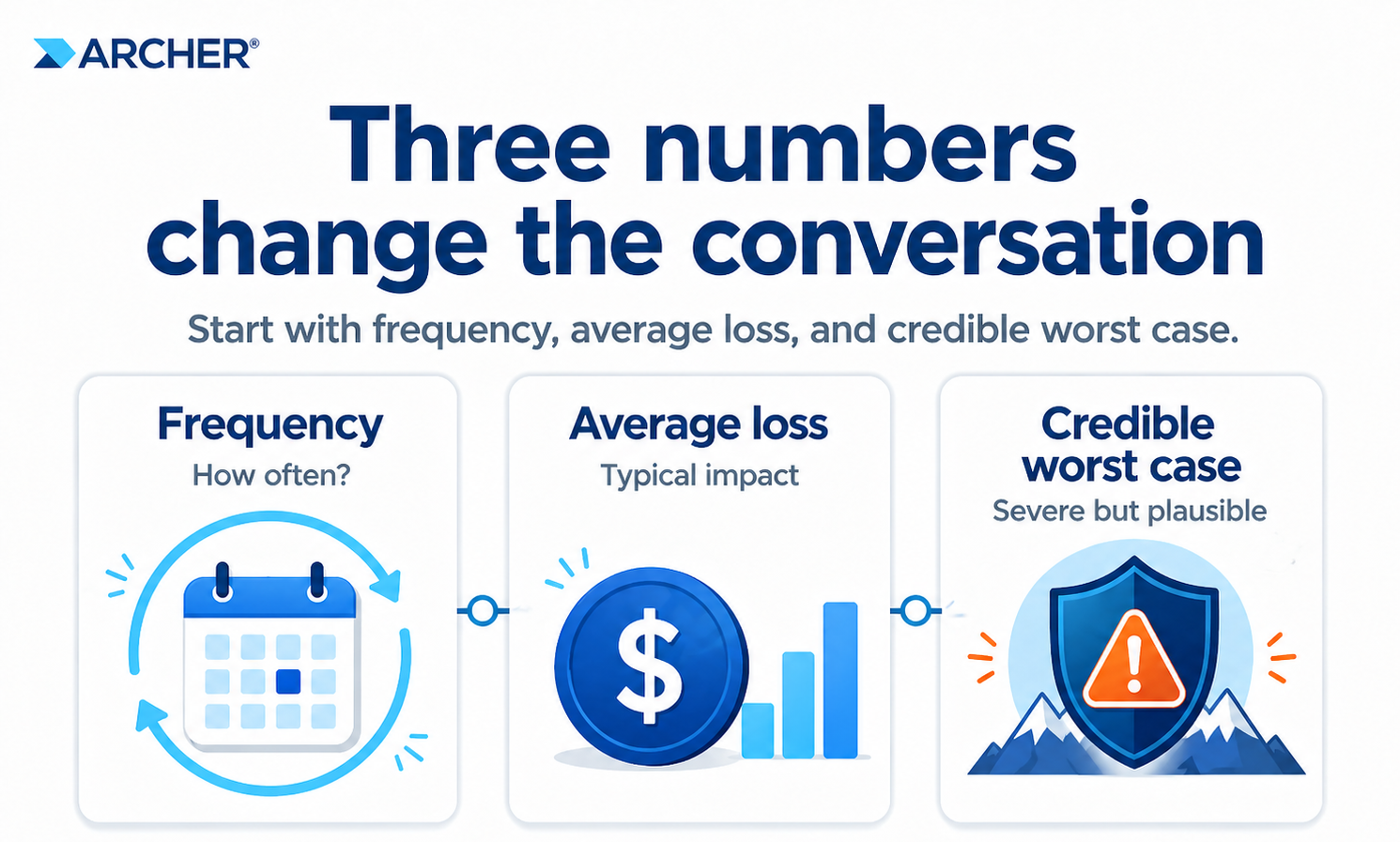
Quantifying risk doesn’t mean overengineering the process. At its core, it comes down to answering three practical questions for each risk scenario:
- Frequency How often does this event occur on an annual basis?
- Average loss If the risk occurs, what is the average loss over a given period? This reflects the routine friction the risk introduces into operations.
- Credible worst case If the risk occurs, what is the maximum loss expected at a given confidence level? This is the scenario that threatens earnings, liquidity, or long-term viability.
Once those three inputs exist, risk stops being abstract. It becomes something you can model, compare, and simulate.
Don’t Let Perfect Data Stop Progress
One of the biggest obstacles to risk quantification is the belief that the data must be perfect before modeling can begin. That belief stalls more initiatives than any technical limitation.
Well-calibrated estimates from subject matter experts are enough to get started. An estimate like “once every three years” is mathematically useful. It can be tested, adjusted, and simulated. A checkbox labeled “Unlikely” can’t.
Estimates invite discussion and refinement. Labels shut it down.
Waiting for flawless data only guarantees that decisions continue to be made without visibility into uncertainty. Modeling imperfect information today is far more valuable than waiting indefinitely for certainty that never arrives.
Seeing Risk Clearly with a Quantitative View
Once risks are quantified, visualization becomes more meaningful. Instead of forcing everything into a grid, risks can be plotted on a chart that compares frequency and severity.
This immediately reveals distinctions the traditional heat map hides.
High-frequency, low-severity risks behave like a steady drain on the budget. These erosion risks are best addressed through process improvements, automation, and tighter controls. The goal is to reduce the ongoing cost of doing business.
Low-frequency, high-severity risks tell a very different story. These are solvency risks. They don’t happen often, but when they do, they can overwhelm the organization. These exposures call for insurance, capital buffers, and financial planning rather than operational tuning.
A standard heat map paints both scenarios red and treats them as interchangeable. They aren’t. Chronic loss and existential threat require different responses. Quantitative views make that distinction unavoidable.
Building a True Enterprise Risk Portfolio
The real strength of quantification shows up when risks are aggregated across the enterprise.
Take a hypothetical company with two divisions:
· The manufacturing group deals with supply chain disruptions and workplace safety incidents. These events happen regularly and tend to carry moderate losses.
· The tech division faces cyber incidents and intellectual property theft, which occur less often but can be catastrophic.
On a qualitative heat map, both divisions might look equally risky. That creates a false equivalence.
When risks are quantified, leadership can compare the credible worst-case exposure of each division and understand how those risks stack up against the balance sheet. They can evaluate trade-offs, assess concentration, and decide where investment actually changes outcomes.
This supports questions executives care about:
- ROI Optimization: Where does the next dollar of preventive controls deliver the greatest risk reduction?
- Risk-Adjusted Return: Which business units generate excessive exposure relative to profit?
- Financial Adequacy: How much capital must be held in reserve to withstand a combined shock?
Those questions can’t be answered with color.
Why This Matters Even More in an AI-Driven World
As organizations look to apply AI across GRC, the quality of underlying risk data becomes critical.
AI models work with structured data and probabilities. They don’t interpret sentiment well. A risk register built on qualitative labels is difficult for machines to learn from. A register built on frequency and loss estimates is immediately usable.
With quantified data, AI tools can analyze historical losses, detect emerging patterns, and run simulations at a scale humans can’t. Without it, years of red and yellow boxes offer little insight.
Quantification provides the fuel. AI provides the engine. Heat maps provide neither.
Getting Started
The biggest barrier to this shift isn’t technical. It’s cultural.
Organizations already have the knowledge they need. They have data. They have experienced practitioners. Even rough estimates improve visibility and decision quality compared to static visuals.
This isn’t about achieving perfection overnight. It’s about giving leadership a clearer picture than they had before.
When risk teams make this shift, their role changes. They stop reporting status and start informing capital decisions. Boards don’t need more colors. They need tools that support judgment, trade-offs, and accountability.
Risk quantification is one of the clearest ways to get there.
For more information, visit Archer at www.archerirm.com and learn how organizations are turning risk data into a competitive advantage.
FAQs
What is risk quantification and why is it important for enterprise risk management?
Risk quantification is the process of assigning numerical values—typically financial impact and likelihood—to risk scenarios so organizations can measure and compare exposure.Unlike qualitative methods such as heat maps, risk quantification allows leadership to evaluate trade-offs, prioritize investments, and understand total enterprise risk in dollar terms. This is critical for decision-making because boards and executives allocate capital based on financial outcomes, not subjective labels like “high” or “medium.”
Why are risk heat maps insufficient for financial decision-making?
Risk heat maps rely on subjective categories like red, yellow, and green, which do not translate into measurable financial impact.
While they provide a simple visual overview, they fail to support calculations, aggregation, or direct comparisons between risks. This makes it difficult for organizations to determine where to invest resources or how risks affect earnings. For financial decision-making, risks must be expressed in quantitative terms such as frequency and potential loss.
How can organizations start quantifying risk without perfect data?
Organizations can begin risk quantification by using informed estimates from subject matter experts rather than waiting for perfect data.
By defining three key inputs—frequency (how often a risk occurs), average loss, and credible worst-case loss—teams can start building useful risk models immediately. These estimates can be refined over time, enabling better analysis, simulations, and decision-making. Starting with imperfect data is far more effective than relying on qualitative labels that cannot be measured or improved.