
Is your AI compliant? Prove it.
Archer turns the regulations and policies that already apply to you into live AWS Bedrock guardrails, enforced before the model is invoked and evidenced on the record your auditors trust.
1,500 organizations run on Archer · Half of the Fortune 500 · SOC 2 Type II · ISO 27001
-
1,500+
Enterprise customers
-
Half
Of clients in the Fortune 500
-
25+
Years as a system of record
-
8,000+
Regulatory & standard-setting sources tracked
AI agents are already acting on your behalf.
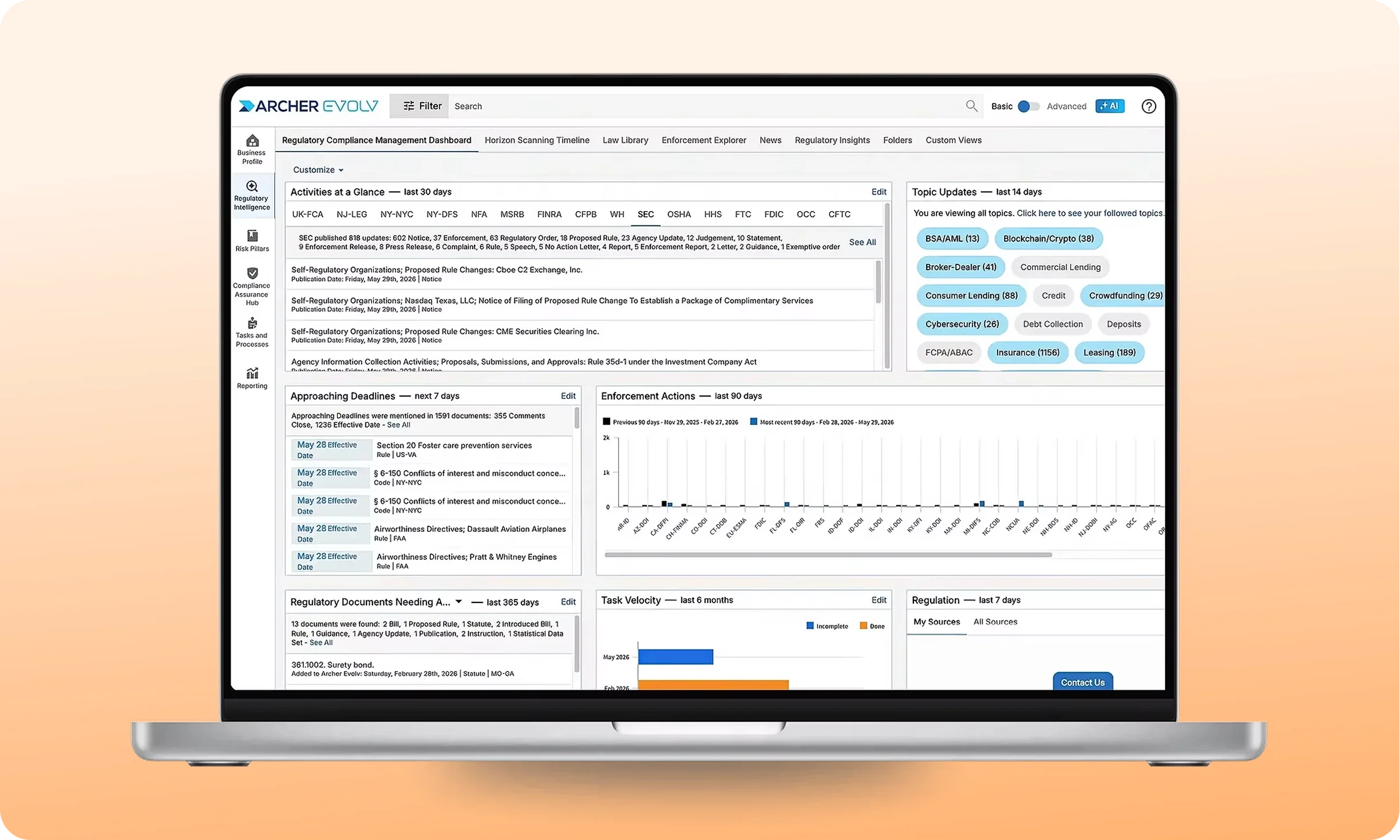
AI agents are now performing tasks previously managed by employees and third parties on the enterprise’s behalf. These agents have the potential to unknowingly expose sensitive data and operations in direct conflict of regulations and company policies.
Traditional GRC programs were designed around employees and third parties, not autonomous AI agents. Archer closes that gap: AI actions are checked against policy and regulation before they create regulatory, operational, or reputational risk.
What this actually catches.
Guardrails aren’t abstract when they’re doing their job.
Here’s the kind of thing Archer is checking for, and blocking, before it ever reaches the model.
-
PII
Names, Social Security numbers, account numbers, and other personal identifiers a model shouldn’t see or repeat.
-
PHI under HIPAA
Patient records, diagnoses, and clinical notes that trigger breach notification if they leave the boundary.
-
Payment & cardholder data
Card numbers, account details, and other data regulated under PCI DSS.
-
Source code & credentials
API keys, secrets, and proprietary code pasted into a prompt by mistake.
-
Confidential business data
Contracts, deal terms, and other information your policy already restricts.
-
Policy violations
Actions that conflict with your own AI usage rules, even when no regulation is technically at issue.

Regulation in. Guardrails out. Evidence back.
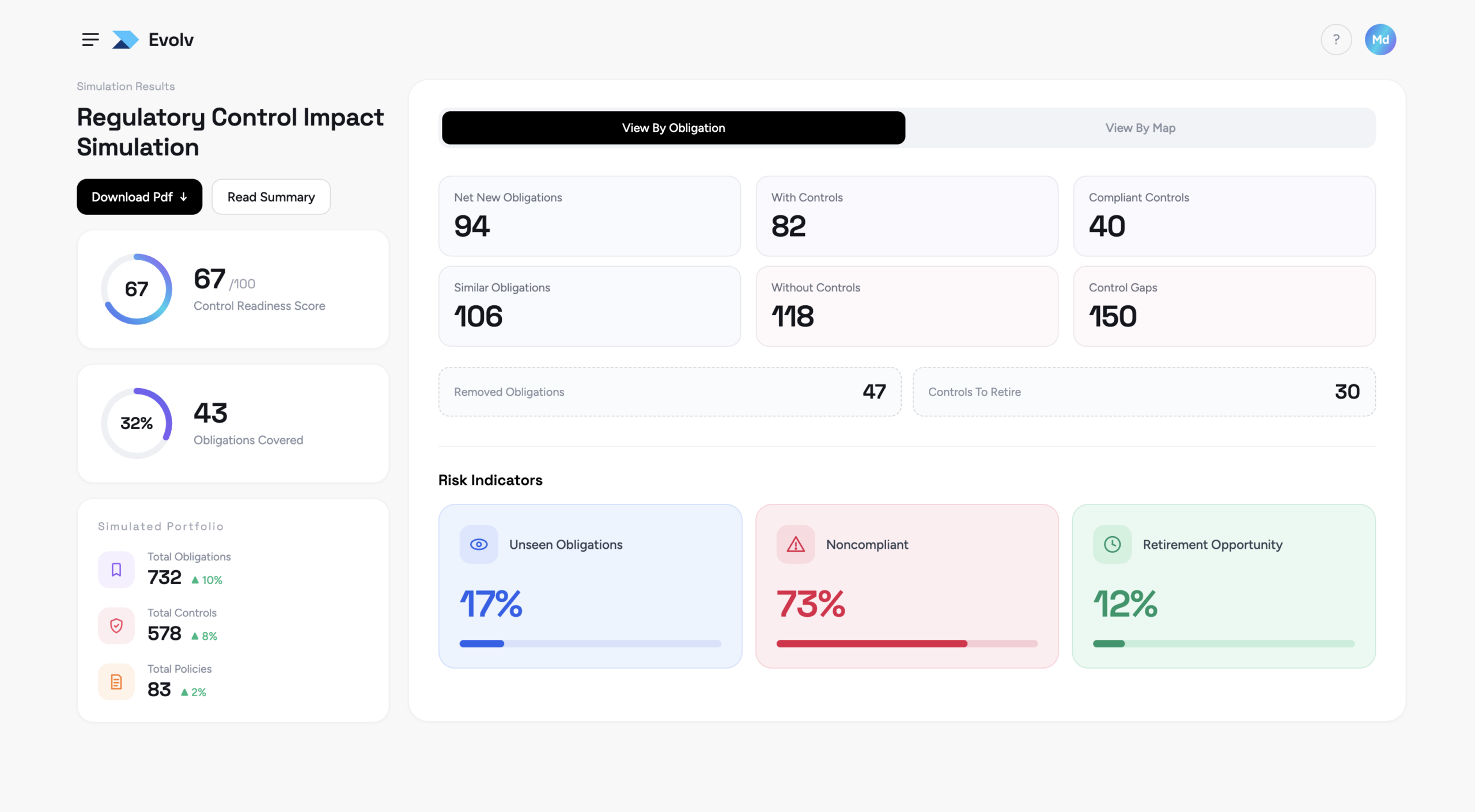
One continuous loop: listen to regulations and policies, decide what applies to you, act at inference with native AWS Bedrock guardrails, assure conformance against live traffic, and learn from every finding. Enforcement happens natively in your account.
1
Ascolta
Regulations, privacy sources, and your own policies become tracked controls, tuned to your jurisdictions and risk appetite.
2
Decidi
Enforceable controls become draft AWS Bedrock guardrails to run in observe mode, deployed on your approval.
3
Legge
Traffic is evaluated against the guardrail pre-inference in your AWS account; violations are blocked and logged.
4
Garantire
Deployed guardrails tested on cycle against the control you approved; drift and tampering are flagged first.
5
Scopri
Findings route into Archer issue management, owned and driven to closure on a trusted system of record.
Prevent it, and prove it.
Preventing a violation and proving why it was prevented are two different problems. AI governance platforms watch and find violations later. Guardrail firewalls block but can’t explain why. Archer does both, natively in your AWS account, with no proxy in the inference path.
Two problems, one chain.
Every other category in this market solves one half of the problem. Archer closes both, on the same record.
-
Prevention and lineage
Violations blocked pre-inference, never generated, with every block traced to the obligation that required it.
-
Approval and control
Nothing enforces without your approval, and every action is recorded against a named owner on one chain of evidence.
-
One record, exportable
Source to control to guardrail to event, one chain examiners accept and you can audit daily, not quarterly.
Read before you decide.
-
DatasheetArchitecture, capabilities, and the five-stage loop for teams evaluating AI Compliance.
-
Solution BriefHow prevention and lineage work together, and how Archer compares to the market.
-
Solution OverviewA one-page summary of the challenge, the loop, and how it’s delivered.
Talk to someone who knows your stack.
Whether you own the platform decision as CISO, evaluate it as a security architect or AI governance lead, or set the standard as compliance, there’s a specific answer for your role. Tell us where you sit and we’ll start there.
What to expect from the conversation:
-
A concrete answer on whether your AWS Bedrock environment is in scope.
-
Clarity on what the connector touches and how the security review works.
-
An honest look at the audit log schema and the IAM integration.
-
Proof points specific to your role, from architecture for security to lineage for audit.
Recognized across the analyst community.
Archer’s standing in independent analyst research reflects 25 years of purpose-built GRC depth, not general platform breadth.
-
2
Gartner® Magic Quadrant™ per gli strumenti di governance, rischio e conformità: leader nel settore dell’assurance
-
3
Forrester Wave™: Piattaforme per la gestione dei rischi legati a soggetti terzi, primo trimestre 2026
-
4
Verdantix Green Quadrant: Software GRC 2025
Questions your team will ask.
Straight answers from the system of record perspective, for security, compliance, and audit.
Read-and-suggest only, by design
The role is read-and-suggest only: it proposes controls and drafts guardrails but deploys nothing. Every promotion, edit, and rollback is a human decision recorded against a named owner. Approve nothing, and nothing changes — you still get the assessment.
A scoped, least-privilege role reads your guardrail configuration and nothing else. Your executive report follows on day ten, showing what’s deployed, what it enforces, where it drifted, and what to fix first.
No, it runs standalone. If you have Archer GRC, evidence lands on the record your examiners already know, and remediation workflows pick it up unchanged — an advantage, not a prerequisite.
Never prompt content, responses, documents, embeddings, PII, or model weights. Only that a violation occurred, which control fired, who and when, confidence and policy type, plus guardrail version history.
For Bedrock models, no: guardrails run natively in your account with no proxy. For models outside Bedrock, ApplyGuardrail adds one API call. Same policy and evidence either way.
Enforcement continues. Guardrails are native AWS Bedrock guardrails living in your account, never proxied through us; you lose evidence collection, not protection.
Prevent before the model. Prove it after.
Regulation and policy become working controls, enforced pre-inference and evidenced on the record your auditors already trust.
