The modern enterprise is surrounded by more information than any risk function in history. Signals come from governments, regulators, hackers, competitors, activists, journalists, markets, algorithms, customers, and the organization’s own employees and systems.
Access to signals is no longer the bottleneck. Making sense of them is. Structuring, prioritizing, and integrating signals into operational processes is difficult, since not all signals carry equal weight. Not all sources are created equal in clarity, reliability, or relevance to your specific business.
To build a GRC program that is genuinely responsive, and not just signal-aware, organizations must deliberately assemble an ecosystem of external and internal data sources. Together, these create a 360-degree view of emerging risk.
The Six Major Categories of External Risk Signals
External signals fall into six essential categories. Each offers a distinct lens through which risk intelligence enters the organization.
1. Compliance and Regulatory Intelligence
Regulatory change is the most prevalent and consequential category of external risk signal for most organizations. It determines legal obligations, creates high-risk exposures, introduces sanctions liability, and reshapes compliance requirements. Organizations that respond slowly to regulatory change can face significant financial exposure.
Key monitoring sources include government regulatory portals and enforcement announcements, international sanctions lists (OFAC, UN, and EU), commercial compliance databases, adverse media monitoring services, and updates from privacy and sector-specific authorities.
2. Cybersecurity Threat Intelligence
Cybersecurity signals are among the most dynamic and time-sensitive risk intelligence categories. Threats evolve quickly. A newly published exploit can become an active attack vector within hours.
Key sources include open threat intelligence platforms (MISP and OpenCTI), government alerts (CISA and FBI), commercial threat intelligence platforms, dark web monitoring services, and industry-specific ISACs. Together, these sources reveal attacker behaviors, malware trends, brand impersonation campaigns, and emerging exploit discussions. That visibility lets risk and compliance teams anticipate threats instead of only responding to breaches.
3. Geopolitical and Country Risk Intelligence
Geopolitical signals affect supply chains, market access, sanctions exposure, and operational continuity. A political transition in a supplier’s home country, an escalating trade dispute, or a regional conflict can ripple through an organization’s third-party ecosystem within days.
Key sources include geopolitical risk intelligence platforms, international news aggregators, government travel and trade advisories, economic indicators, and country risk scoring services. These signals are especially important for organizations with global operations or complex third-party relationships.
4. Financial and Market Risk Intelligence
Financial signals capture shifts in the economic environment that affect both the organization’s own risk profile and the health of its counterparties. A vendor’s declining credit rating may signal future delivery risk before a contract breach occurs. An equity market correction may trigger covenant reviews. Macroeconomic data can inform capital planning and strategic risk appetite.
Key sources include credit rating services, equity research platforms, macroeconomic data feeds, analyst reports, and financial news aggregators.
5. Operational and Supply Chain Intelligence
Operational signals reveal disruptions and vulnerabilities in the infrastructure organizations depend on: logistics networks, critical suppliers, cloud service providers, manufacturing operations, and physical facilities.
Key sources include NOAA weather and natural disaster alerts, USGS feeds, supply chain monitoring platforms, OSHA safety databases, cloud service status dashboards, and social listening tools that detect local disruptions before they reach official channels. These signals support business continuity planning, vendor risk management, and real-time operational decisions.
6. Reputational and Brand Intelligence
An organization’s reputation is shaped largely by external forces, not internal perceptions. Reputational signals capture the narratives forming about the organization, often before leadership is aware of them.
Key sources include social listening platforms, ESG and reputational analytics services, activist and watchdog sites, consumer review aggregators, and trending topic monitoring. These signals are valuable for detecting early complaints, accusations, or controversies, which lets organizations respond proactively rather than reactively.
Building a Structured Signal Ecosystem: A Practical Blueprint
An effective GRC signal ecosystem does not emerge on its own. It requires deliberate architecture across five design decisions.
- Domain Coverage: Structure intake around all six signal categories. Gaps in any domain create blind spots. Many organizations start with regulatory and cyber signals and underinvest in operational, financial, and reputational intelligence.
- Source Mix: Integrate both open-source and commercial sources, since neither alone provides sufficient coverage. Establish clear intake channels through APIs, automated feeds, and connector-based integrations.
- Data Normalization: Tag and enrich incoming signals with business context. A regulatory update means something different to a manufacturing business unit than to a financial services compliance team. Context tagging at intake makes correlation meaningful.
- Cross-Domain Correlation: The most valuable insights emerge where signal categories intersect, such as cyber threat intelligence combined with third-party dependency data, or adverse media coverage combined with credit signals. Build the architecture to support cross-domain correlation, not just domain-specific monitoring.
- GRC Workflow Integration: Signals without workflow integration are intelligence without action. Validated and prioritized signals should trigger vendor reviews, compliance checks, incident response, risk assessments, board alerts, and strategic decision processes.
Why a Signal Ecosystem Matters for Resilience
Organizations that integrate comprehensive signal ecosystems into their GRC programs can detect trouble earlier. Spotting a supplier’s financial distress early can reduce the chance of a contract breach. Identifying a regulatory trend early allows proactive control design instead of reactive remediation. Early visibility into reputational narratives gives communications teams time to prepare before a situation escalates.
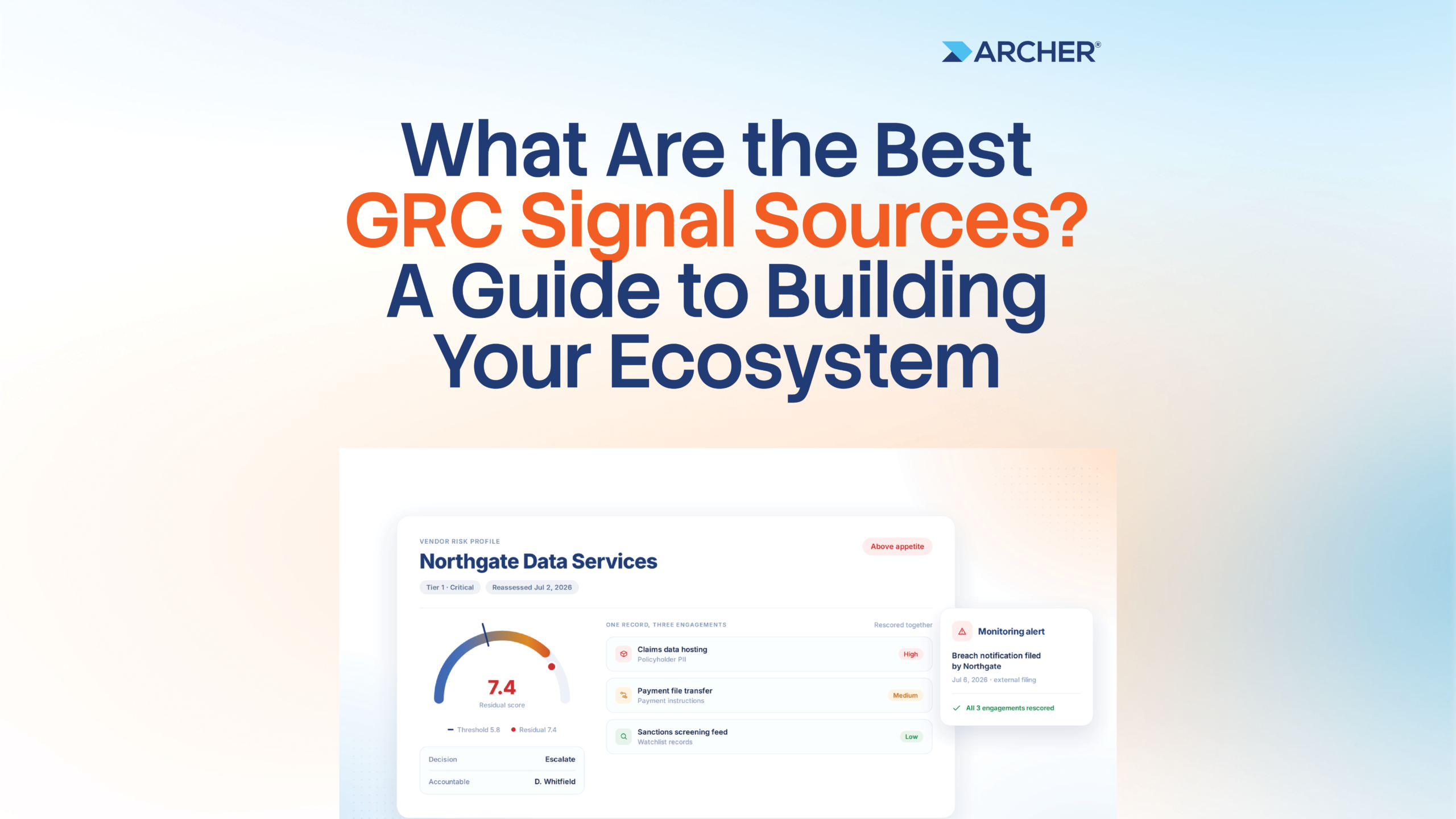
The volume involved is too large for manual tracking. Effective signal processing depends on AI to separate material changes from background noise. This challenge sits at the core of Archer Evolv’s capabilities. Archer Evolv™ continuously monitors more than 9,000 individual sources, and that coverage continues to expand.
Organizations without a structured signal ecosystem face blind spots that are hard to see until something goes wrong. Often, they learn about a risk from a news headline or a regulator’s penalty notice instead of their own monitoring.
Signal intelligence is now a foundation of modern risk management. It is the essential input for a GRC program that is current, connected, and in motion.
Häufig gestellte Fragen
External risk signals fall into six categories: compliance and regulatory intelligence, cybersecurity threat intelligence, geopolitical and country risk, financial and market risk, operational and supply chain intelligence, and reputational and brand intelligence. Each gives the organization a different lens on emerging risk.
A signal ecosystem is a structured set of external and internal data sources, designed together so that they provide a 360-degree view of emerging risk. It is built deliberately, not assembled by accident.
Key sources include government regulatory portals and enforcement announcements, international sanctions lists such as OFAC, UN, and EU lists, commercial compliance databases, adverse media monitoring services, and updates from privacy and sector-specific authorities.
Archer Evolv is designed to monitor signals from authoritative regulatory and risk sources continuously, then route them into GRC workflows with the context teams need to act. Its AI Operators support intake, classification, and prioritization, so GRC teams spend less time sorting raw data and more time deciding what to do.
Next in this series: Explore how to operationalize signal-driven GRC at scale, covering the cultural, governance, architectural, and automation dimensions of turning signal awareness into organizational behavior.