
Prove Your Controls Work, With Sources to Back It Up
Inconsistent control wording and manual regulatory mapping leave teams struggling to defend what they have in place. Compliance agents score control language, cite the regulations behind each control and draft design and operating tests for testers to approve.
48
Generally Available
8
GRC Domains
-
26
In Build Now
-
151+
On the Roadmap
Compliance
Obligations, controls and testing
-
Control Language Hygiene
Reviews control language for jargon, verbosity and ambiguity, scores each hygiene criterion, and rewrites the failing elements to a clear, auditor-ready standard. Rewrites are validated against mapped obligations before you ever see them.
View agent : Control Language Hygiene -
Test Design of Control
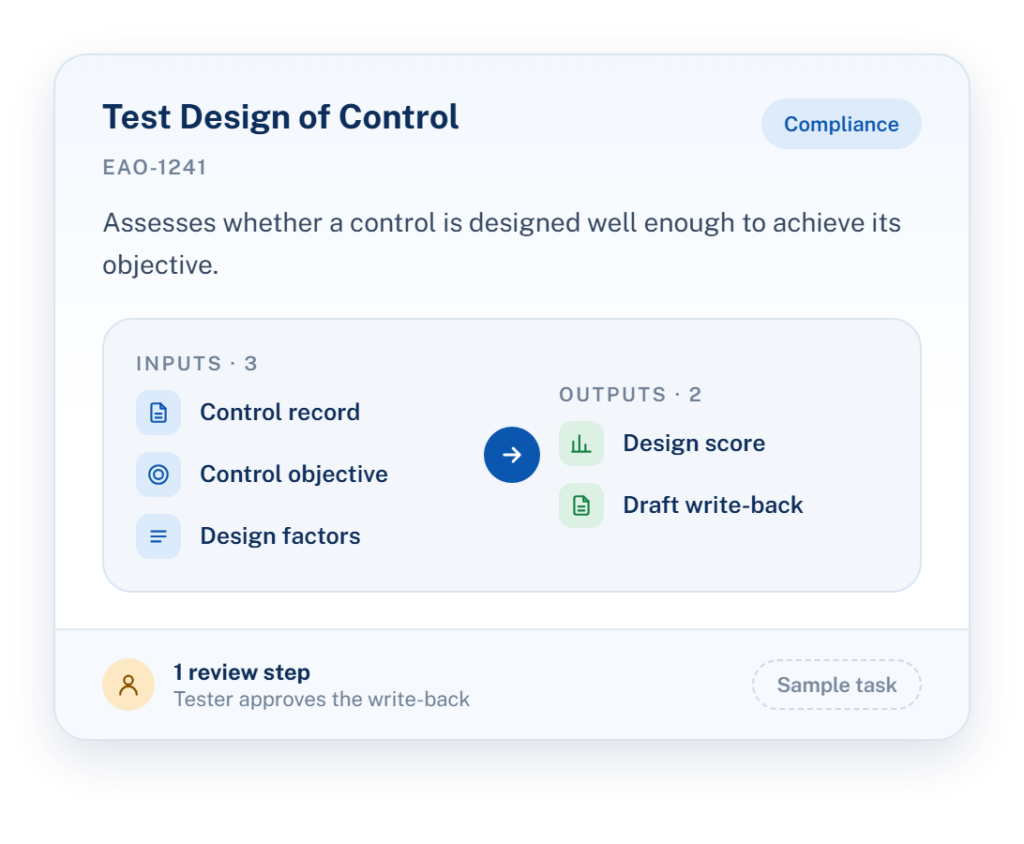
Evaluates whether a control is written in a way that would actually mitigate the risks and satisfy the obligations attached to it. The agent reads the control and its cross-references, scores the design, and recommends what to fix when it falls short.
View agent : Test Design of Control -
Test Operating Effectiveness of Control
Runs the control's own testing procedures against the evidence the owner provided, counts the exceptions against the sample size, and reports a compliance percentage and rating. Where the control fails, it drafts the finding and corrective action.
View agent : Test Operating Effectiveness of Control -
Unified Risk (Version 2)
Version 2 of the Unified Risk agent, with continued enhancements informed by client feedback on how the framework-aligned risk and control library is built and maintained.
View agent : Unified Risk (Version 2) -
Control Justification
Answers why a control requirement exists, on demand. Each implementation requirement gets a layered justification: the internal policy chain above it and the external authoritative sources that drive it, with citations and a confidence score.
View agent : Control Justification -
Unified Risk Library
Builds and maintains a framework-aligned risk and control library: generating risk statements, control descriptions and mappings from your existing content and the frameworks you follow, flagging near-duplicates, and keeping the taxonomy consistent.
View agent : Unified Risk Library
Compliance
6Obligations, controls and testing
Obligations, controls and testing
-
Control Language Hygiene
Reviews control language for jargon, verbosity and ambiguity, scores each hygiene criterion, and rewrites the failing elements to a clear, auditor-ready standard. Rewrites are validated against mapped obligations before you ever see them.
View agent : Control Language Hygiene -
Test Design of Control
Evaluates whether a control is written in a way that would actually mitigate the risks and satisfy the obligations attached to it. The agent reads the control and its cross-references, scores the design, and recommends what to fix when it falls short.
View agent : Test Design of Control -
Test Operating Effectiveness of Control
Runs the control's own testing procedures against the evidence the owner provided, counts the exceptions against the sample size, and reports a compliance percentage and rating. Where the control fails, it drafts the finding and corrective action.
View agent : Test Operating Effectiveness of Control -
Unified Risk (Version 2)
Version 2 of the Unified Risk agent, with continued enhancements informed by client feedback on how the framework-aligned risk and control library is built and maintained.
View agent : Unified Risk (Version 2) -
Control Justification
Answers why a control requirement exists, on demand. Each implementation requirement gets a layered justification: the internal policy chain above it and the external authoritative sources that drive it, with citations and a confidence score.
View agent : Control Justification -
Unified Risk Library
Builds and maintains a framework-aligned risk and control library: generating risk statements, control descriptions and mappings from your existing content and the frameworks you follow, flagging near-duplicates, and keeping the taxonomy consistent.
View agent : Unified Risk Library
Keep Controls Clear, Justified and Tested
Control wording, regulatory mapping and testing are done by hand, and quality varies with whoever did the work. Archer Evolv Compliance agents take on that work: they build the library, tighten the language, justify each control and test it, with a person approving every write-back.
Build
Agents generate framework-aligned risks, controls and mappings from your content and catch near-duplicates, all with human review.
Handled by
Unified Risk Library · Unified Risk (Version 2)
Write
Agents review control procedure language for jargon and ambiguity, score it against a quality standard and offer rewrites at the moment of authorship.
Handled by
Control Language Hygiene
Justify
On demand, agents explain which regulations justify a control requirement, citing internal policy and external sources with confidence scores.
Handled by
Control Justification
Test design
Agents assess whether a control is designed well enough to achieve its objective and draft the write-back for the tester to approve.
Handled by
Test Design of Control
Test operation
Agents work through the testing procedures, exceptions and sample maths to show whether a control operated as designed, for the tester to confirm.
Handled by
Test Operating Effectiveness of Control
Before and after
Compliance teams are asked to prove that controls work, not just that they exist.
Wording, mapping and testing by hand
Today, control quality depends on who wrote the wording, who tested it and how much time they had.
What it takes today
-
Control wording varies from author to author
-
Tracing a control back to the regulations behind it takes hours
-
Design and operating tests are assembled in spreadsheets
-
Risk and control libraries drift and collect near-duplicates
Consistent, cited, reviewable
Agents score, justify and test controls with citations and confidence scores, and testers approve what is written back.
What changes
-
Control language scored and rewritten at the moment of authorship
-
Regulation-backed justification with confidence scores
-
Design and operating tests drafted for the tester to confirm
-
Near-duplicates caught in the risk and control library
See Compliance Agents in Action
Watch Control Justification explain which regulations support a control requirement, with sources an analyst can defend.
-
1
Ask about a control
Select a control requirement and ask AI which regulations justify it.
-
2
Review the sources
AI returns the regulations and internal policies behind it, each cited and given a confidence score.
-
3
Defend with evidence
Use the justification when auditors or regulators ask, with every source cited.