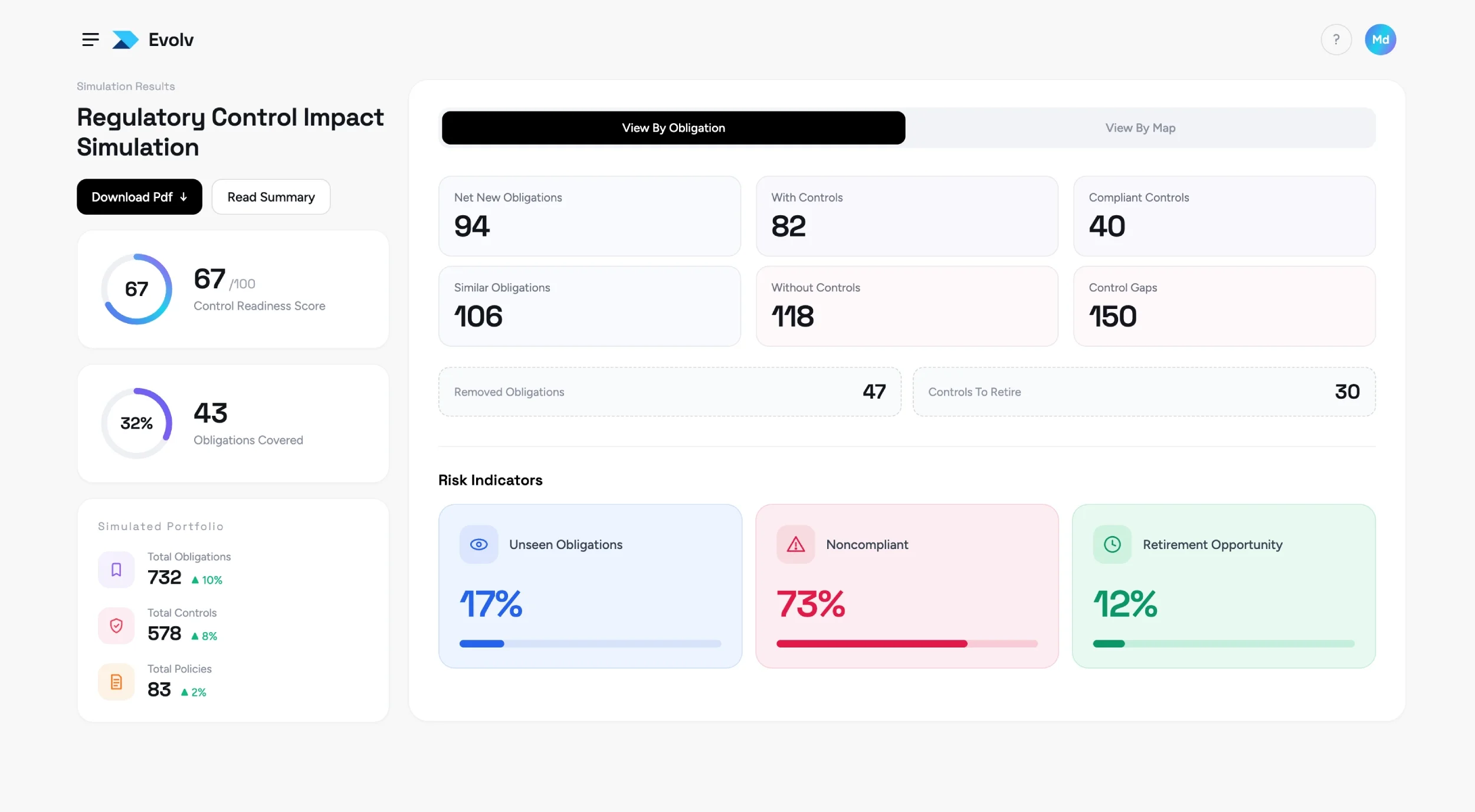
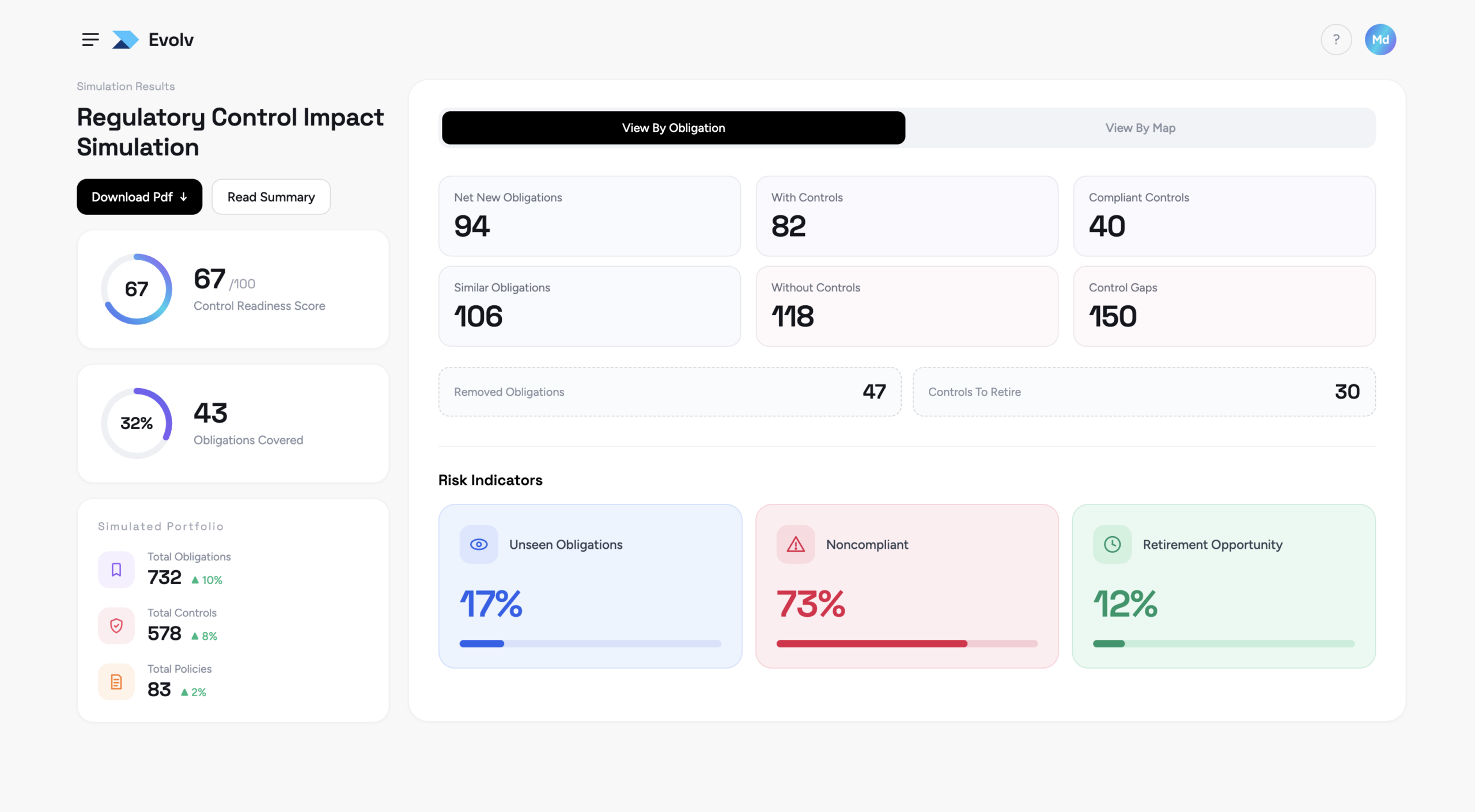
Regulatory change management, built for the pace of change.
Regulatory change no longer arrives on a quarterly cycle. It arrives continuously, from thousands of sources, across every jurisdiction you operate in, and most compliance teams still track it by hand in spreadsheets and inboxes. Archer Evolv Compliance detects change at the source, interprets it into specific obligations, and routes each one to the control owner responsible for acting on it, with evidence attached from day one. CCOs, BSA officers, and heads of regulatory change get one system of record instead of a folder of alerts nobody has time to read.
1,500 organizations run on Archer · Half of the Fortune 500 · SOC 2 Type II · ISO 27001
-
1,500+
Enterprise customers
-
Half
Of clients in the Fortune 500
-
8,000+
Regulatory & standard-setting sources tracked
-
230+
Jurisdictions covered
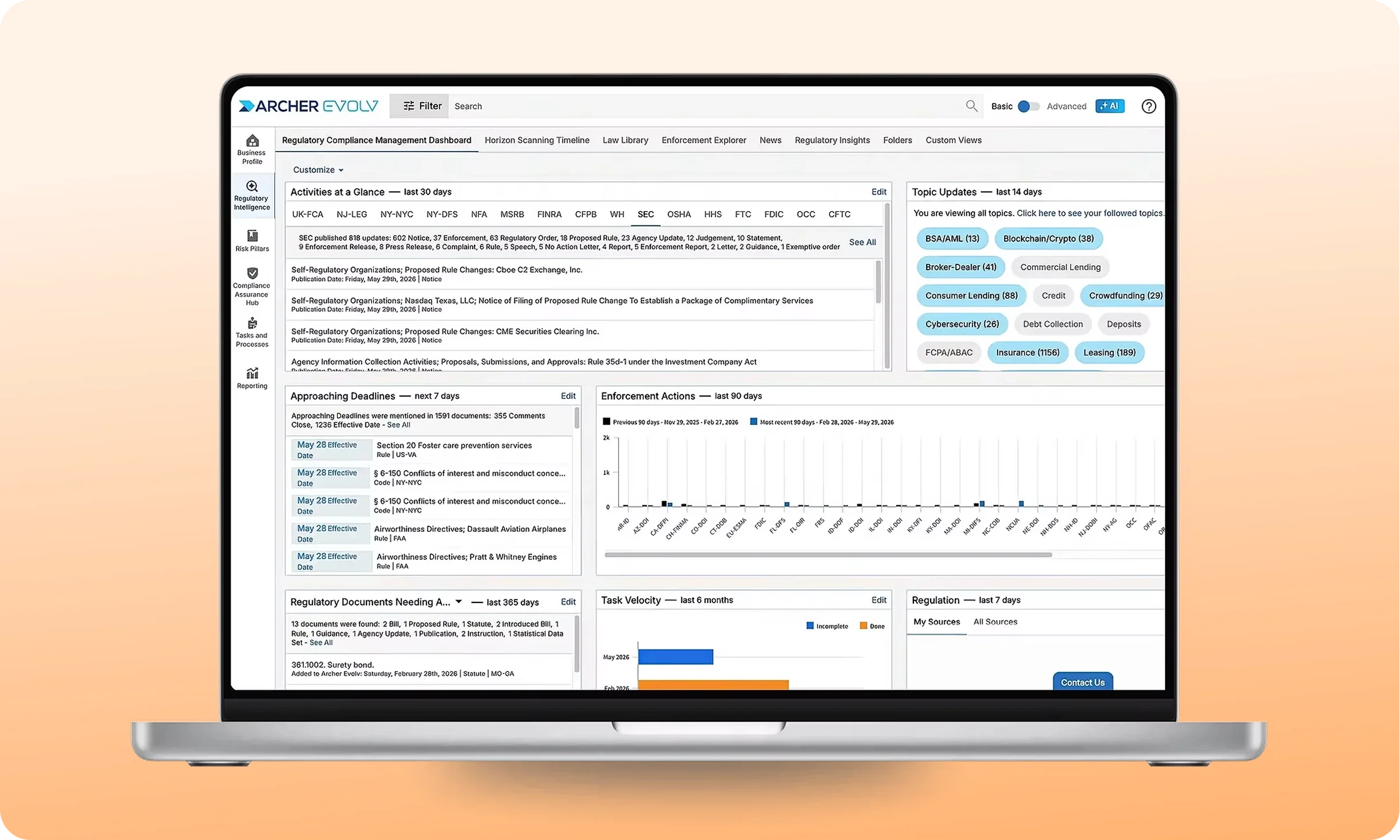
Regulatory change has outgrown the systems built to manage it.
Most enterprises still run compliance on a GRC foundation built for a slower era, while regulators ship more change, faster, across more domains than at any point in history. Global regulatory volume has grown 500% over the past decade, and institutions now track 200+ changes a day (Thomson Reuters Regulatory Intelligence, 2024). 96% of organizations say keeping up is a real challenge (Swimlane, GRC Chaos Report, 2025), and global regulatory fines reached $19.3B in 2024 (Ponemon Institute).
Rules reverse mid-cycle. The EU AI Act adds fines up to €15M starting August 2, 2026. A control built on last quarter’s read of a rule is a finding waiting to happen, and most teams are still tracking it by hand.
Every type of regulatory change,
in one obligations catalog.
Change does not arrive as one kind of document. It arrives as proposals, finals, enforcement actions, and guidance, often about the same rule at the same time. Here is what Archer’s obligations catalog tracks, tags, and routes before it ever reaches a spreadsheet.
-
Proposed rules
Tagged to the obligations they’d create, so your team can prepare before a rule is final.
-
Final rules & effective dates
Mapped to the controls they touch, with the compliance date tracked against your calendar.
-
Enforcement actions
Actions against peers and your own institution, tagged by root cause as an early warning.
-
Guidance & bulletins
Sub-regulatory guidance that changes how a rule is examined, even when its text doesn’t move.
-
Amendments & repeals
Every version of a rule that changes twice in one cycle, so the right one stays live.
-
Cross-jurisdictional obligations
The same requirement read differently by state or country, reconciled into one obligation.

Regulation in. Obligations out.
Evidence back.
One continuous loop replaces the spreadsheet and the inbox: listen to regulatory sources, decide what applies to you, act by routing the obligation to its owner, assure the control against live evidence, and learn from every update.
1
Listen
Regulatory and policy sources across your jurisdictions are monitored continuously, tuned to your risk appetite.
2
Decide
Each change goes through regulatory impact analysis and is interpreted into a specific, prioritized obligation.
3
Act
Obligations route automatically to the control owner responsible, with the context needed to act.
4
Assure
Every control carries evidence tied to the regulation and the person who addressed it.
5
Learn
Findings and recurring patterns feed back in, so the next version of a rule is caught earlier.
Track it, and close the loop.
Tracking regulatory change and operationalizing it are two different problems. Intelligence feeds watch and alert. Spreadsheets track tasks, if someone keeps them current. Archer does both: an 8,000+-source obligations catalog paired with context-grounded AI and expert-in-the-loop review, natively on the platform your controls already live on.
One record, from regulation to evidence.
A regulatory intelligence feed tells you something changed. A spreadsheet tells you who’s supposed to handle it, if it’s kept current. Archer does both, on the same record your examiners already trust.
-
Detection and interpretation together
Most feeds stop at notification. Archer interprets the change into the obligation it creates.
-
Lineage to the control
Every obligation traces to the control it touches and the evidence it was addressed.
-
One system of record
Source to obligation to control to evidence, exportable and audit-ready every day.
Talk to someone who tracks change the way you do.
Whether you own the program as CCO or BSA officer, report on it as CRO, test it as head of internal audit, or live in it as the analyst tracking updates every day, there’s a specific answer for your role. Tell us where you sit and we’ll start there.
What to expect from the conversation:
-
A concrete answer on how obligations map to your existing controls.
-
Clarity on what’s automated and what still needs a human decision.
-
An honest look at the evidence chain and how it holds up to audit.
-
Proof points specific to your role, from board reporting for CRO to lineage for audit.
Recognized across the analyst community
25 years of purpose-built GRC depth, not general
platform breadth.
-
2
Gartner® Magic Quadrant™ for Governance, Risk and Compliance Tools, Assurance Leaders
-
3
Forrester Wave™: Third-Party Risk Management Platforms, Q1 2026
-
4
Verdantix Green Quadrant: GRC Software 2025

Questions your team will ask.
Straight answers, for compliance, risk, and audit.
It listens continuously to the same authoritative sources your team already tries to monitor, at a scale no analyst can read by hand, and flags what’s actually new.
A feed tells you something changed. Archer interprets what changed into the specific obligation it creates and routes it to the person who owns the control.
No, it runs standalone. If you already run Archer GRC, obligations land on the record your examiners already know.
Obligations are drafted as sources update and routed for review the same cycle, not the next quarterly refresh.
8,000+ regulatory and standard-setting sources across 230+ jurisdictions, tracked in 100+ languages.
Track it before it’s a finding.
Prove it after.
Regulation and policy become tracked obligations, routed to the right owner, and evidenced on the record your examiners already trust.